Luggage Storage Between Flights: What Works?
 12 min read
Between flights, one question decides whether luggage storage works: can you collect the case early enough to reach the terminal, clear security and get to the gate? This guide covers bags you hand to a locker, counter or hotel yourself. Through-checked and delayed bags follow different rules.
Distance solves only half the problem when you search for “luggage storage near me”. The place also has to be open and reachable when you come back. Airline baggage transfers, through-checked bags and delayed luggage are separate subjects. If the airline has misplaced your bag rather than you placing it in voluntary custody, our guide to lost luggage at the airport covers that situation.
Which luggage storage option fits your next flight?
No option wins at every airport. A counter can sit inside the terminal and still close too early. A locker may stay accessible longer but be too small, full on arrival or locked inside a building with shorter hours. A hotel may be convenient for its own guests without promising anything to walk-in visitors.
Begin with the time you need to be back in departures. The trip from storage, a possible collection queue, another security screening and the walk to the gate all come out of that window. What remains is your personal collection deadline. One universal number of minutes would be misleading because terminals, checks and boarding rules differ.
| Option | Works only when | Check before handover | Main way it fails |
|---|---|---|---|
| Staffed airport storage | The exact counter is on your return route and staffed when you collect | terminal, level, public or secure side, hours, receipt, ID requirement, excluded contents | counter closes or the queue delays collection |
| Airport or station locker | Your bag fits and both the building and locker remain accessible | internal size, availability or reservation, rental end, code, code recovery, late terms | no suitable locker, building closes or the code is unavailable |
| City storage service | The trip into town still leaves a dependable route back | exact host, operator, route, host hours, booking proof, cancellation and claims terms | transport disruption or host closure |
| Hotel custody | The exact property confirms acceptance for you on that date | guest status, dates before or after the stay, hours, capacity, receipt, non-guest policy | refusal or restricted desk hours |
My firm recommendation is to treat collection as its own appointment. “At the airport” isn't a useful location. BER Airport places its baggage storage at the railway station on Level U1, checked on 18 October 2026. That detail can separate a calm return from an unwanted search through the terminal.
Airport luggage locker or staffed counter?
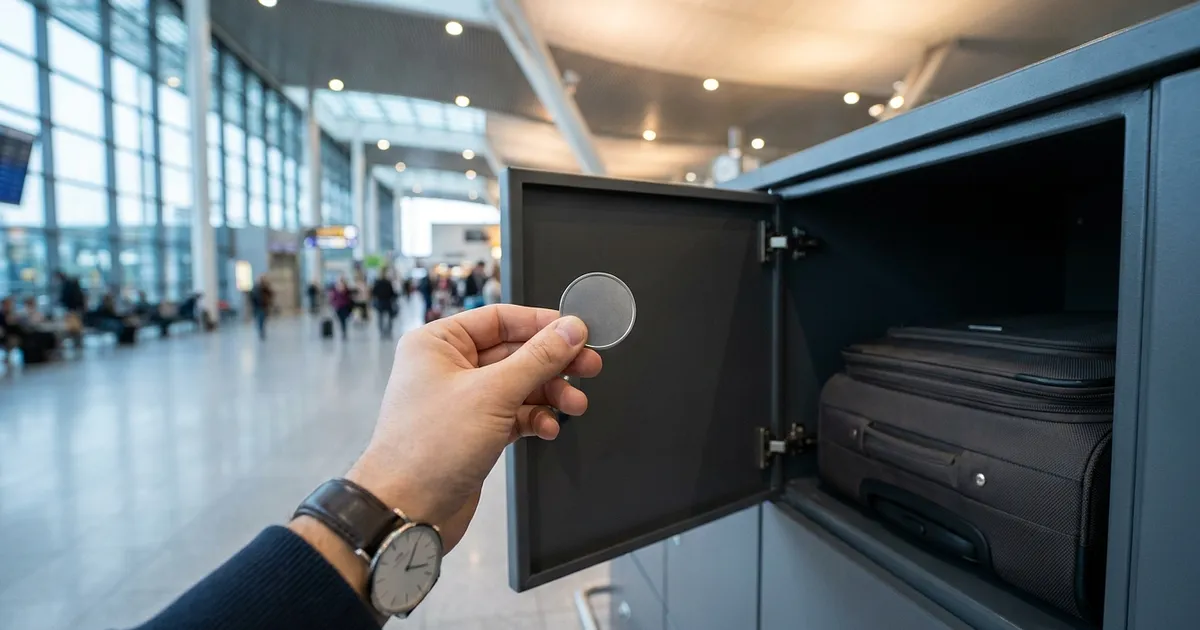
A locker may remove the handover queue, but compartment size, operation and access details become your responsibility. A photo of the locker, its number and the closed door may prove useful later. Store the code or booking confirmation somewhere that remains available if your phone dies. A paper copy kept away from the case is still useful.
A staffed counter gives you a visible handover and usually a receipt or baggage tag. Its terms explain whether collection requires ID, someone else may collect or a lost receipt creates a problem. The person at the desk helps, but doesn't replace reading those conditions.
Lockerpoint's March 2026 terms show how specific these clauses can be. At the named locations, lockers can be rented for 1 to 30 days. A door left open for more than 15 minutes may be treated as vacated, and luggage removed after expiry is stored for 30 days under those terms. None of that is a universal locker policy. It shows why rental end, late collection, access and excluded contents matter before payment.
City storage can work well when it sits on the route you'll genuinely take. A detour to a hotel, station or attraction often looks harmless on a map. On the return, a closed platform, a packed bus or slower collection changes the calculation. You don't need a made-up safety margin. You need a route that makes sense for your flight and your tolerance for disruption.
The official Berlin Hauptbahnhof page lists lockers among the station facilities, checked on 18 October 2026. It doesn't promise an empty locker, a particular size or a particular price when you arrive. Current operator details or an on-site check still have to close those gaps.
Airport storage doesn't automatically save time either. It may sit in another terminal, on a lower level or outside security. The airport name alone tells you none of that.
Location and collection deadline beat price
Frankfurt makes the problem unusually clear. Frankfurt Airport publishes different hours for two storage points in Terminal 1, checked on 18 October 2026. Area B, Level 1 is listed daily from 00:00 to 23:59, while Area B, Level 2 is listed daily from 09:00 to 17:00. A search result saying only that Frankfurt has baggage storage leaves out the detail that decides whether collection works.
Your note needs the counter, level and current hours, not merely the service name. The official page is worth checking again on the travel day because an old screenshot can't reveal temporary changes, construction or operating restrictions.
Munich Airport explicitly labels both named left-luggage points as public-area facilities, checked on 18 October 2026. Its official page lists different daily schedules of 05:00 to 23:30 and 06:00 to 22:00. Depending on your itinerary, collecting there before the next flight may mean going through security again. This isn't guidance on through-checked baggage. It's a consequence of where your chosen storage sits.
Once another screening is part of the route, the case contents may matter too. Our article about liquids disappearing at a connecting-flight checkpoint explains why one earlier screening doesn't automatically settle the next one. For sealed purchases, the related guide to duty-free alcohol while connecting is the better follow-up.
Build the deadline from the flight backwards
The calculation starts at boarding rather than at the end of a city visit:
- Return journey: Which route will you really take from your final stop to storage? A straight line on a map isn't enough.
- Collection: A staffed counter may have a queue; a locker can produce a code problem.
- Terminal change: Include the correct level, terminal and actual walking route.
- Checks: Your itinerary may add security or another formal step.
- Gate: Use the airline's current boarding and gate-closing instructions.
A fallback matters as well. Keep the operator's contact details and find out whether anyone will answer at your return time. A support line is useless if the locker won't open after that line has closed. In that case, the cheaper locker may be the riskier choice.
Check price after timing
Prices are hard to compare fairly without a current location and storage period. Some services charge per item, others by time band or booking. Heathrow's official storage page uses time-banded prices per item, checked on 18 October 2026. That's an international example of one pricing model, not a benchmark for German airports.
The research found linked price files for Munich and BER, but their text wasn't reliably readable. This guide therefore doesn't repeat figures from them. A missing price is better than a number attached to the wrong locker, period or tariff.
When does hotel luggage storage work?
Hotel luggage storage works only after the specific property confirms it for your date. A hotel may accept bags before check-in or after check-out, but that doesn't create a general entitlement. Guest status, available space, fire rules, reception hours and the individual property's practice can change the answer. None of the official sources checked for this guide established a blanket promise for non-guests.
Ask the property about your exact date. Give the number and type of bags, the handover time and the latest collection time, then request written confirmation. Ask how the receipt process works in the same message. “Reception will probably sort it out” isn't much of a plan.
MEININGER explicitly confirms complimentary pre-check-in or post-check-out storage for its own groups, checked on 18 October 2026, and asks for advance notice. That's a narrow statement. It proves neither a general rule for individual guests nor a walk-in guarantee for non-guests. The property you intend to use has to provide the confirmation.
If you're staying there and the hotel sits on your return route, this choice can avoid a separate journey. A property well away from the airport route is different; free storage can lose its appeal rather quickly. Time is the real currency here.
What to get in writing
A short message is enough if it closes the gaps. It should confirm acceptance on the named date, the latest collection time and whether reception will be accessible throughout. Ask how staff match the bags to you and whether you receive a ticket, tag or digital confirmation. Collection by another person may need separate approval.
For valuables, read the liability terms. Words such as “secure” or “protected” don't automatically mean insurance. Our travel baggage insurance guide explains that separate contract and keeps it distinct from the custody agreement.
What stays with you, and what may go into storage?
Keep your passport, boarding documents, medication, keys, payment methods and anything essential before the next flight out of the stored case. The practical question is simple: what happens if collection fails or takes longer than expected?
Batteries add another reason. EASA's dangerous-goods guidance, checked on 18 October 2026, says spare batteries and power banks must travel in carry-on baggage rather than checked baggage. EASA also tells passengers to consult their airline's dangerous-goods information. Don't leave those batteries in a case that will later travel as checked baggage.
Jewellery, camera equipment and work devices deserve a deliberate choice. Check whether the storage operator excludes them or limits liability. Our article on jewellery and valuables in luggage covers the insurance side; it can't replace the custodian's own terms.
A quick separation before handover helps:
Keep documents, medication, payment methods, keys and same-day essentials with you.
Power banks and spare batteries must match the rules for the next flight. Your airline may add instructions.
Put only accepted contents in the case, preferably things whose temporary unavailability you could manage.
Clarify prohibited or particularly valuable contents before handover. Vague conditions aren't a sound basis for leaving them.
No custody proof? Think twice
A custody record connects you with the bag. It might be a paper ticket, tag, email, QR code or app booking. Save it offline, with the operator, location and contact details stored separately. For a locker, include the locker number and access information, but never display the code on the case itself.
A photo of the exterior may help with a later claim, but it doesn't guarantee an outcome. Avoid photographing strangers or exposing access codes. The terms should also say how quickly damage must be reported and which evidence the operator expects.
An unanswered collection question is a reason to walk away
If the location, collection time or access process remains unclear, the storage plan isn't ready. Ask again, choose another provider or keep the case with you.
Free hands in the city are pleasant. Missing the next flight because a locker stayed shut would be a rotten trade.
Frequently Asked Questions
Can I store luggage at the airport between flights?
Yes, if the bag is already in your possession and the airport or an operator offers suitable storage. Check the exact location, which side of security it sits on, acceptance and collection arrangements, and the return route. A listed facility isn't automatically accessible throughout your connection.
Is left luggage the same as a luggage locker?
No. Staffed left luggage involves a personal handover and usually a receipt. A locker is self-service and depends on compartment size, access code, building hours and availability. Terms and liability differ by operator, so the labels alone don't settle which option works.
Will a hotel keep luggage after check-out?
Some hotels confirm this for their own guests, but there is no blanket promise. Ask the exact property about your date, handover and latest collection time. Get acceptance, timing and the receipt process in writing. The sources checked for this guide didn't establish a general acceptance policy for non-guests.
What if luggage storage is closed when I return?
Your bag may become unreachable for the next flight. Before handover, clarify the opening window, practical collection deadline, late terms and emergency contact. Build your own return buffer. A support line is useful only if someone answers at the time you need it.
What should I keep out of a stored suitcase?
Keep your passport, boarding documents, medication, payment methods, keys and immediate essentials with you. Check the custodian's excluded items and valuables policy. For the flight, EASA says spare batteries and power banks belong in carry-on baggage; your airline may publish further instructions.
Sources
- BER Airport places its baggage storage at the railway station on Level U1 ber.berlin-airport.de
- Lockerpoint's March 2026 terms lockerpoint.com
- Berlin Hauptbahnhof page lists lockers among the station facilities bahnhof.de
- Frankfurt Airport publishes different hours for two storage points in Terminal 1 frankfurt-airport.com
- Munich Airport explicitly labels both named left-luggage points as public-area facilities munich-airport.com
- Heathrow's official storage page uses time-banded prices per item heathrow.com
- MEININGER explicitly confirms complimentary pre-check-in or post-check-out storage for its own groups help-center.meininger-hotels.com
- EASA's dangerous-goods guidance easa.europa.eu