Duty Free Alcohol in Hand Luggage: The STEB Trap When You Connect
 5 min read
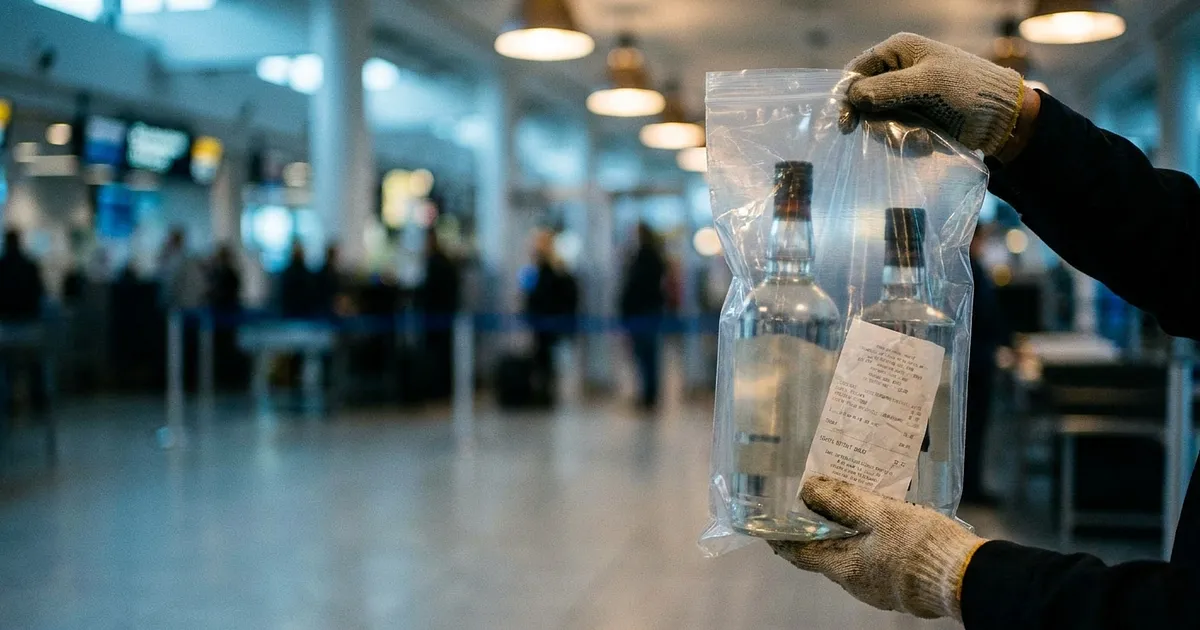
A sealed duty free bag looks like a guarantee. It isn't, at least not everywhere. Carry duty free alcohol in hand luggage across a connecting flight and you can lose the bottle at the second security checkpoint, even though the shop sealed everything correctly at the till.
Expensive. And mostly avoidable.
Duty free alcohol in hand luggage: what a STEB bag actually does
STEB (Security Tamper Evident Bag) sounds like more protection than it actually offers: the pouch is only ever the exemption from the 100ml rule, nothing more. STEB bag rules look simple on paper and still trip up plenty of travellers: two things have to hold for the bag to count at all. The seal can't be broken, and the receipt inside has to be visible and dated within the required window, commonly 48 hours according to Shosky Security.
Torn open? Gone. Even if you only wanted a quick taste mid-flight. We cover how the 100ml rule works generally in our liquids in hand luggage guide.
The connection trap for duty free alcohol in hand luggage
Honestly, the bag matters far less than your itinerary. If you stay inside the same secure zone, a Schengen connection for example, nothing usually happens. But if you get screened again, things get shaky. Airliners.de reports that duty free bought outside the EU can be refused at the second security check when you transfer through an EU airport. Airports with modern CT scanners have partly dropped the 100ml rule already, which makes the STEB bag even less relevant there. You still can't count on it though.
For US connections it's close to standard practice. Travellers there have to reclaim and recheck their bags and go through screening again, as AFAR Magazine explains.
Classic case: duty free whisky bought in Dubai, a stopover in Istanbul, then on to the US. The bottle can get flagged at any one of those checks, and there's no way to know in advance which one. That's exactly what makes a whisky hand luggage connecting flight combination the riskiest scenario of all.
Checked baggage and the 70% rule
Checked baggage has clear limits, no grey area like the STEB bag: up to 70% ABV and 5 litres per passenger, in original retail packaging, set out in the IATA dangerous goods regulations. Below 24% there's no quantity limit at all. Above 70% ABV, transport is banned outright. Taking alcohol in checked luggage instead of your cabin bag sidesteps the whole screening risk from the start.
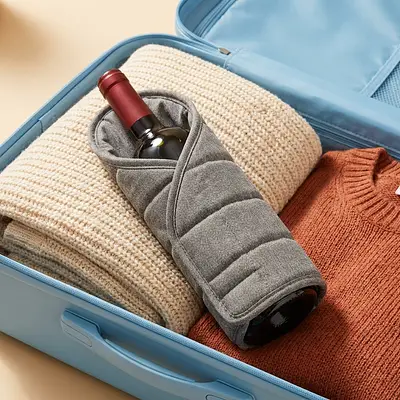
Five litres also weighs a good five kilos, which people forget. Before you plan for that, it's worth checking the weight limits for checked baggage on your airline, excess baggage isn't cheap. A luggage scale like the MYCARBON Digitale Kofferwaage costs less than a single excess baggage fee. And since glass bottles love knocking into each other inside a case, protective sleeves like the Schutzhüllen für Weinflasche 30 Stück – Klapperschutz für Transport & Reise are probably the cheapest insurance you'll ever buy for a bottle of whisky.
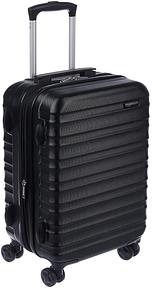
Not available in your region — closest match
Amazon Basics Hard Shell Suitcase, black
View at Amazon (as of Aug 14)Affiliate link. Buying through it earns us a commission; the price stays the same for you.
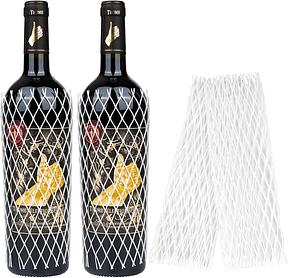
Schutzhüllen für Weinflasche 30 Stück – Klapperschutz für Transport & Reise
View at Amazon (as of Aug 28)Affiliate link. Buying through it earns us a commission; the price stays the same for you.
Customs on the way back into the EU
Security screening and customs are two separate things, and I think that's where most travellers get caught out. Zoll.de puts the allowance for arrivals from a non-EU country at 1 litre of spirits over 22% ABV, or 2 litres under 22%, plus 4 litres of still wine and 16 litres of beer, from age 17.
So yes, you can clear security without a hitch and still owe duty on arrival.
My take, and I'll be blunt about it: buy the whisky on the last leg, not at the start of the trip. If you grab it earlier anyway, it belongs in your checked bag. Nobody can promise you in advance that one particular checkpoint will honour your sealed bag. That uncertainty is exactly why duty free alcohol in hand luggage is always a bet on the next checkpoint.
All products from this post
The ones we named above are marked; the rest are alternatives in the same category.
![Wiederverwendbare Wein Beutel für Reisen [4 Stk] – Auslaufsichere Verpackung für Flugzeuge](https://kofferly.com/rails/active_storage/representations/proxy/eyJfcmFpbHMiOnsiZGF0YSI6Mjc0NDYsInB1ciI6ImJsb2JfaWQifX0=--ec494ac4f074c8393c42450fde554d7423a24406/eyJfcmFpbHMiOnsiZGF0YSI6eyJmb3JtYXQiOiJqcGciLCJyZXNpemVfdG9fbGltaXQiOlsyODgsMjg4XX0sInB1ciI6InZhcmlhdGlvbiJ9fQ==--b7a7af1d9490199d0a8048d8ed5b80d3fb201a3c/products-B0BGWXPR7H.jpg)
Not available in your region — closest match
Amazon Basics Hard Shell Suitcase, black
View at Amazon (as of Aug 14)Affiliate notice: As an Amazon Associate, we earn from qualifying purchases. Product prices and availability are subject to change.
Frequently Asked Questions
Duty free confiscated when connecting: how common is it?
It happens, mainly on itineraries with a second security screening. If your route stays inside one secure zone, a sealed bag is usually fine. Connections through the US, or non-EU purchases transferring via an EU hub, carry a noticeably higher risk.
What makes a STEB bag invalid?
A damaged or opened seal, or a receipt that's missing, hidden inside the bag, or dated outside the required purchase window. That window is commonly 48 hours. Any one of those is enough for security to keep the contents.
How much alcohol in checked baggage is allowed?
Under 24% ABV, unlimited. Between 24% and 70%, a maximum of 5 litres per passenger in original packaging. Above 70% ABV it's forbidden. Watch your case weight limit too, since glass bottles are heavier than most people expect.
Does a duty free purchase count against the customs allowance?
Yes. Duty free only means no tax was charged where you bought it. Arriving in the EU, the travel allowance of 1 litre of spirits over 22% ABV, or 2 litres below that, still applies. Bring more and you declare it and pay.