Luggage Insurance 2026: When Travel Baggage Insurance Is Actually Worth Buying
 13 min read

Most people shopping for travel baggage insurance probably don't need it. Odd way to open an article about exactly that product, I know. But it's the honest answer to the question that brought you here, and it's the one thing the comparison portals won't lead with. Before you sign anything, you almost certainly already have two or three layers of protection you've never looked at. And they cost you nothing extra.
Bags going missing has actually become rarer. Worldwide, roughly 4.9 out of every 1,000 bags were mishandled, damaged or lost in 2025, a 23% drop on the year before, at an average cost of $260 per bag (SITA Baggage IT Insights 2026). That's a global aviation-industry figure, not a German one, and it says nothing about your odds at any specific airport. Which European hubs see the worst mishandling rates is something we've broken down separately. What it does show is the order of magnitude: a real risk that usually stays in the low hundreds.
One note before we go further. This piece is written for travellers insured in Germany, because that's where the overlap between statutory airline liability, household contents cover and the private policy gets genuinely confusing. The airline-liability part applies internationally.
Four layers of cover, and you probably have three already
This is the part almost nobody lays out cleanly. It isn't "insurance yes or no." There are four overlapping layers. Three come free or are already paid for. Only the fourth is something you buy.
| Layer | Who pays | When it applies | Ceiling | What it costs you |
|---|---|---|---|---|
| Airline liability (Montreal Convention) | the airline | flights only, checked bags in the carrier's custody | 1,519 SDR, roughly €1,868 per passenger | nothing, it's automatic |
| Household contents insurance (Außenversicherung clause) | your contents insurer | burglary, robbery, fire, storm at your accommodation, trips abroad up to three months | 10% to 20% of the sum insured, capped around €10,000 | nothing extra, it's already in the policy |
| Credit card travel cover | the card's underwriter | depends on card tier, usually only if you paid for the trip with that exact card | varies enormously, often with an excess | included in the annual fee |
| Private travel baggage insurance | the insurer you choose | broadest custody-based cover, any transport mode, own-fault loss depending on tariff | whatever sum you bought | €30 to €120, see below |
The airline is liable, but only up to a ceiling
Under the Montreal Convention, airlines are liable for the loss, damage or delay of checked baggage up to 1,519 Special Drawing Rights, roughly €1,868 per passenger. That ceiling has applied since 28 December 2024 (Luftfahrt-Bundesamt; background on the increase: Kanzlei Hotes, anwalt-reiserecht.de).
The detail that trips people up: that figure covers the whole bag and everything in it, not each item separately. One lost suitcase with a laptop inside blows straight through it.
(Side note that genuinely irritates me every time. The Special Drawing Right is an artificial IMF accounting currency, so the euro value drifts with the exchange rate, and nobody tells you at check-in what your ceiling happens to be worth today. For a consumer-protection limit, that's a strange piece of design.)
How you actually file that claim, what the deadlines are, and why the property irregularity report at the airport matters so much is covered in a separate post on this blog about what to do when your bag doesn't arrive. This article is about the decision beforehand, not the claim afterwards.
Your household contents policy travels with you
This is the most underrated layer of the four. A standard German Hausratversicherung covers travel luggage through what's called the Außenversicherung clause, typically at 10% to 20% of the sum insured, capped at around €10,000, for stays abroad of up to three months (Verbraucherzentrale.de).
The catch sits in the circumstances, not the sum. Break-in theft, robbery, fire and storm damage at your accommodation are in. Pickpocketing on the street, the backpack that vanishes from under a restaurant table, the bag you leave on a train: all out.
The credit card, a large maybe
Card issuers love advertising baggage cover, but the scope depends entirely on the card tier, and nearly always on having paid for the trip with that specific card. For premium and business cards, advertised baggage sums reportedly range from around €2,700 per person to €3,000 per trip depending on the product, sometimes with an annual cap and an excess on top (reisetopia, illustrative market figures rather than independently tested values).
"I have a credit card, so I'm covered" is still the wrong conclusion. Pull up your card's benefits summary and read the two paragraphs about baggage. Five minutes, and the question is settled.
Check these before you buy anything
I'd work through four things before comparing a single tariff. If all four come back reassuring, you can skip the policy entirely.
- Do you have household contents insurance, and what's the sum insured? 20% of €60,000 is €12,000, subject to the policy's own ceiling. That covers essentially any suitcase.
- How are you paying for the trip? If the card's cover is tied to payment method and you're paying by bank transfer, the card is out of the picture.
- Are you flying, or not? Airline liability only exists in air travel. On a coach or a cruise ship you're relying on the other layers.
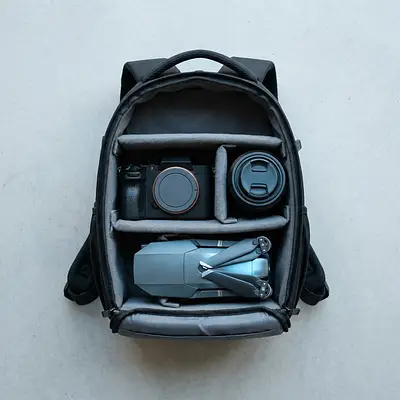
- What's your luggage realistically worth? Not the vibe, the actual total. Most suitcases land somewhere between €400 and €900. A camera backpack lands somewhere else entirely.
Then the question nobody enjoys asking: could you absorb a total loss yourself? If the answer is yes, insurance rarely makes economic sense. You insure what hurts, not what annoys.
Picture standing at check-in running the numbers fast: contents cover handles twelve thousand euros, the credit card maybe three thousand. What's left for travel baggage insurance to actually cover is often a genuinely small gap, and that gap is the only thing worth shopping for.
Is travel baggage insurance worth it? Two groups, one exception
German consumer bodies are unusually blunt here. The Hamburg consumer advice centre states plainly that you don't need travel baggage insurance, because a loss of a few hundred euros, or a bit more, isn't something you have to insure separately (Verbraucherzentrale Hamburg, as of 14 December 2022).
Stiftung Warentest, Germany's independent product-testing institute, narrows the useful case to two groups: travellers with no household contents insurance, plus ship and long-distance coach passengers (test.de). The underlying test dates from 2016, which I'd flag honestly, though the reasoning hasn't aged: if you have neither contents cover nor a liable airline behind you, you carry the loss alone.
I'd still add one exception of my own, one the German consumer centre's general verdict doesn't make: expensive kit in your bag. A road bike, a golf set, dive gear, a case of lenses: one incident there punches a hole that €1,868 of airline liability won't fill. Anyone carrying gear like that is also better off with a GPS tracker in the bag itself, which at least raises the odds the bag turns up before it becomes a claim. That's my own conclusion from the numbers above, not an official recommendation from the consumer centre.
The German term for the real risk here is Doppelversicherung, double insurance. Which captures it well, I think. The likely mistake isn't going uninsured. It's paying twice for the same thing.
What's covered, and what definitely isn't
The standard claim situations
Travel baggage insurance thinks in terms of custody rather than events. The classic trigger is your bag sitting with a carrier, so an airline, a rail operator or a ferry, or in left luggage. Depending on the tariff you also get theft, damage, and baggage delay, where many policies pay a flat amount toward emergency purchases.
The exclusions that hurt at claim time
These live in the terms, usually around page 14 of a PDF nobody opens. Short version:
Cash, tickets and documents are effectively never covered.
Glasses, contact lenses and prosthetics sit on almost every exclusion list.
Unattended luggage drops out. The classic is a bag in a parked car, which depending on the tariff is covered only in daylight hours, only in the boot, and only up to a partial sum.
Gross negligence reduces the payout proportionally. Backpack put down at a station while you turned away? Expect an argument.
Valuables, jewellery and electronics carry their own sub-limits, often a fraction of the headline sum.
That last one is where most contracts quietly take back what they promised. A €3,000 sum insured does not mean your laptop is insured for €3,000.
Replacement value or depreciated value? This is where claims collapse
Replacement value (Neuwert) means you get what an equivalent new item costs today. Depreciated value (Zeitwert) means you get what your old item was actually worth at the moment it disappeared, after age and wear.
Industry convention is to pay replacement value only for items under roughly two years old, and only against the original receipt. After that, depreciated value. And even under a nominally replacement-value tariff, a common rule kicks in once the depreciated value drops below about 40% of today's replacement price: at that point only the depreciated value gets paid. Those are industry conventions rather than a legal standard, so the exact schedule really does live in your own terms.
Worked example (hypothetical, for illustration): your laptop cost €1,400 three years ago and vanishes with your checked bag. An equivalent new machine costs €1,300 today. Because the device is older than two years, the insurer calculates depreciated value, let's say €480. Subtract the excess, frequently €50 or €100. You're left with just under €400. In exchange for several years of premiums.
This is usually where the maths tips over. The airline is liable up to roughly €1,868 for the entire contents of a lost bag anyway, and the private policy pays the same depreciated value on the same laptop. In that scenario the marginal benefit of the policy shrinks to whatever airline liability leaves uncovered, plus the incidents that happen outside air travel.
Newer gear changes the picture completely. A twelve-month-old camera on a replacement-value tariff, with the receipt in hand, is a different animal from a three-year-old laptop.
What does travel baggage insurance cost?
In a test of 14 travel baggage policies, annual contracts cost between €43 and €120, and single-trip policies between €30 and €100 (Stiftung Warentest). In fairness, that test is from 2016, so treat those figures as a sense of scale rather than a live quote.
Comparison portals currently advertise baggage modules inside broader travel-protection bundles from around €15 to €20 a year. Those are marketing figures, not tested ones, and they tell you nothing about sub-limits or the excess.
My rough rule from all of that: an annual tariff starts making sense at maybe two or three trips a year, and even then only if a genuine gap exists. A single-trip policy at €30 to €100 for a week in Mallorca with ordinary luggage simply costs more than the risk does.
What I make of it
The honest answer is awkward for a product usually sold as a no-brainer. For most air travellers insured in Germany, travel baggage insurance is a second purchase of something they own. Airline liability plus household contents cover handles the realistic loss, at no extra premium.
What's left are the cases where it genuinely carries weight. No contents insurance. Ship or coach instead of a plane. And expensive gear under two years old whose loss would actually sting.
So before buying anything, I'd do the unglamorous work first: dig out the contents policy, search it for the Außenversicherung clause, note the sum insured. Then the benefits summary for your credit card. If a gap is still open after that, you know exactly how big it is, and you can shop for a tariff that closes that gap instead of buying one at random.
And if your bag has already gone missing, that's a different job entirely. Deadlines and the airport damage report are what matter there, and this blog has a separate piece on lost luggage and your claim against the airline.
Frequently Asked Questions
Is travel baggage insurance worth it?
For most travellers, no. The Hamburg consumer advice centre says so outright: a loss of a few hundred euros doesn't need its own policy. Stiftung Warentest names two exceptions, no household contents insurance, or travel by ship or coach. My own addition: expensive kit like a camera or laptop changes that math.
What does travel baggage insurance cost?
An older Stiftung Warentest comparison from 2016 found annual tariffs between €43 and €120, single-trip policies between €30 and €100. Current travel-protection bundles advertise baggage modules from around €15 to €20 a year. Those are marketing prices that say nothing about the excess or sub-limits.
When does travel baggage insurance pay out, and when not?
While your bag sits with a carrier, an airline, a rail operator, a ferry, or in left luggage, the cover applies, along with theft, damage and sometimes delay. You get nothing for cash, tickets, documents, glasses or prosthetics. Unattended luggage and gross negligence either shrink the payout or wipe it out.
Does travel baggage insurance pay replacement value or depreciated value?
Replacement value only exists for items under roughly two years old, and only against the original receipt. After that the insurer switches to depreciated value, often even under a tariff sold as replacement-value cover. A three-year-old laptop usually nets you a fraction of what you paid for it.
Is my luggage already insured through my credit card?
Depends which card you hold and whether you paid with it. Coverage sums vary wildly between issuers, and there's almost always an excess involved. The only reliable answer sits in your own card's benefits summary, everything else is guessing.
Do I need travel baggage insurance if I have household contents insurance?
Usually not. The Außenversicherung clause in your contents policy typically covers travel luggage at 10% to 20% of the sum insured, capped around €10,000, for stays abroad up to three months. The circumstances decide it: burglary, robbery, fire and storm count, street pickpocketing doesn't.