Child Seat on a Plane 2026: Approval and Transport
 13 min read
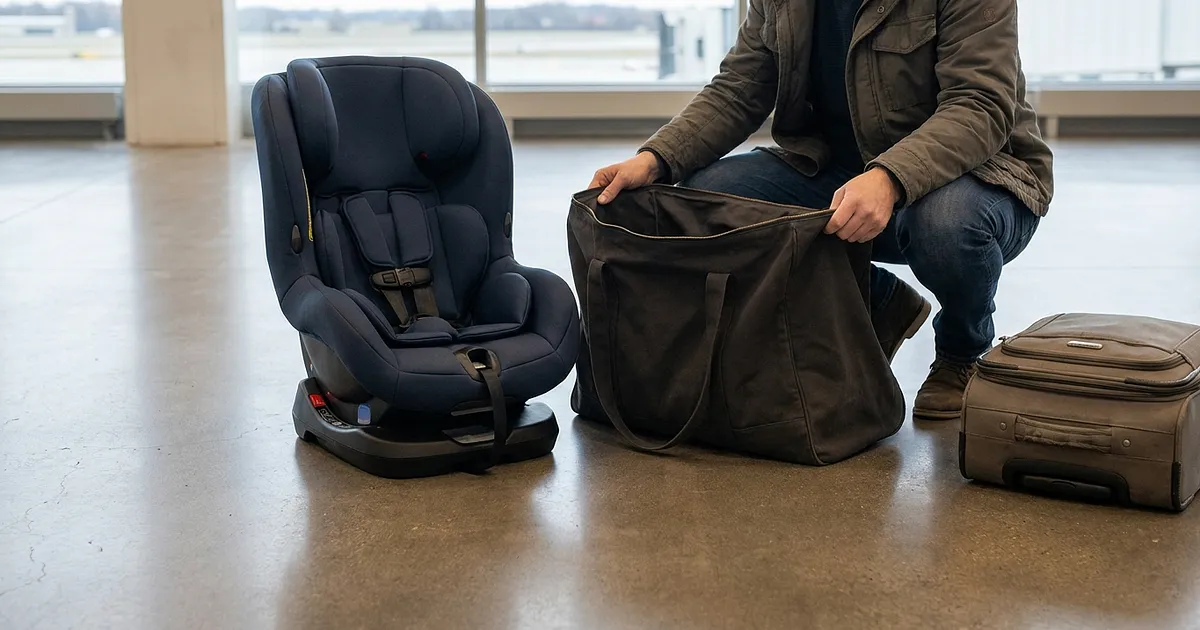
A child seat on a plane needs more than the approval label used for road travel. The exact model must be approved for aircraft use, and the airline operating your flight must accept it. Only then do the assigned passenger seat, installation direction, and belt path come into play. If the seat is travelling in the hold instead, a different set of rules applies. Keeping those decisions apart helps prevent a vague promise from falling apart at the gate.
Quick answer: Can you take a child seat on a plane?
Usually, yes, but carriage and cabin use aren't the same. Cabin use requires an aircraft-approved model, a separately booked passenger seat, and acceptance by the operating carrier. The child seat must fit the assigned place and install exactly as its manual requires. Free carriage in the hold only means the airline will transport it. It doesn't give you permission to use it onboard. The airline policies in this guide were checked on 11 October 2026 and can change.
The quick decision before you book
Will your child sit in the restraint during the flight? Start by matching the model number, manual, and aircraft label. Then contact the airline actually operating the flight and book a separate passenger seat. If the restraint doesn't suit the lap belt, permitted direction, or assigned place, don't improvise. You need an accepted alternative, or the child seat travels as baggage. If you already plan to check it, focus instead on fees, registration, and the handover point. Cabin approval and baggage allowance are separate questions.
Which evidence matters for cabin use?
The word “approved” causes much of the confusion. Approved for a car? Tested with an aircraft lap belt? Accepted by this airline on this aircraft? One answer doesn't settle the others.
| Check | The practical question | Evidence to look for |
|---|---|---|
| Road use | Is the restraint approved for use in a car? | A legible ECE R44-03/04 or R129 marking that matches the model |
| Aircraft use | Has this exact model passed an accepted aircraft test? | For example, “For Use in Aircraft” under TÜV/958-01/2001, or another certificate recognised by the airline |
| This flight | Will the operating airline accept it on the assigned seat? | Carrier confirmation, a booked seat, permitted direction, and installation that follows the manual |
The EASA child-restraint FAQ, last updated on 31 October 2019, says a European child seat needs more than road approval. The exact model also needs recognised qualification for aircraft use.
How can you identify an aircraft-approved child seat?
Find the aircraft-use statement on the restraint, then match its model name and number to the manual. A photo helps when you ask the airline, but the original label on the seat still needs to be readable. Under the German test route, the TÜV “For Use in Aircraft” label, checked on 11 October 2026, identifies an additional test with an aircraft-style two-point lap belt.
That test has a practical purpose. Cars usually secure a child seat with a three-point belt or ISOFIX. A passenger aircraft seat normally has a lap belt with a different buckle. The route through the child seat specified by its maker must work with that belt.
An ISOFIX-only model doesn't become aircraft-compatible because someone can push the lap belt through an opening. If the manual doesn't authorise that installation, it isn't an option.
The label isn't an airline promise
The operating airline decides whether you may use the restraint on a particular flight. According to the EASA FAQ, dated 31 October 2019, cabin layout, seat spacing, belt and buckle position, and evacuation access all matter.
A hypothetical codeshare shows the problem. Airline A sells the ticket and confirms your model by email, but Airline B operates the aircraft. Airline B's policy applies. A late aircraft change may reduce the available space too. The restraint keeps its qualification, yet a correct installation may no longer be possible in that seat.
Book the passenger seat and child seat together
A child restraint used in the cabin needs its own booked passenger seat. A lap-infant booking doesn't create a spare place for a car seat. The FAA says an approved restraint suited to the child, page dated 10 March 2025, is the safest place on an aircraft for a child under two. That's guidance from a US authority, not a blanket booking rule for European carriers.
A two-year-old doesn't fit one universal policy either. The child must remain within the exact model's height and weight limits. A separate seat, allowed installation direction, and carrier acceptance still matter. Inferring an age-only rule would be convenient, but the cited sources don't support one.
Ask the operating carrier before you commit to the final booking. A booking website or marketing airline can't settle every detail of a codeshare. Include the child-seat model and number, aircraft-label wording, flight number, date, installation direction, and external width. Add the child's age, height, and weight where the manual ties its limits to them.
Request a written reply or a note in the booking. Neither can freeze the aircraft type. Still, it's more useful than a broad phone assurance that “car seats are fine”.
Where can the restraint be placed?
The EASA guidance, dated 31 October 2019, prefers a window seat. Exit rows aren't suitable, and the restraint must not obstruct anyone's escape route. The airline assigns the actual place.
EASA doesn't ban rear-facing restraints as a class. A rear-facing child seat goes on a forward-facing passenger seat if the manual, available spacing, and airline policy allow it. Seat pitch can rule it out. Some carriers apply a stricter policy and accept only forward-facing models.
Keep the manual, airline reply, approval-label photo, and reservation within reach when boarding. Not buried in the checked suitcase. Ground staff can then inspect your exact model rather than debate car seats in general.
How do you install a child seat on a plane?
Cabin crew decide on the spot whether the restraint can be fitted correctly in the assigned place. Follow the manufacturer's aircraft instructions. The lap belt runs through the specified path, and its buckle must not interfere with the restraint's lock or shell.
Find that section of the manual before travel. Save it offline or print the relevant pages. Cabin internet is a terrible backup for safety instructions.
If the installation fails, stop. Don't substitute another belt route, improvise an ISOFIX replacement, or brace the shell against the seat ahead. Use the alternative agreed with the airline, or transport the child seat as baggage.
Which child restraint system works on an aircraft?
A car seat, CARES, a loop belt, and a booster aren't interchangeable.
| System | What it is | What remains to be checked |
|---|---|---|
| Aircraft-approved car seat | A road restraint with additional aircraft qualification | exact model, separate seat, belt path, direction, and carrier acceptance |
| CARES | A dedicated aviation restraint | approved child size, airline acceptance, and a compatible passenger seat |
| Loop belt | An additional belt supplied by some airlines for a lap infant | use only as the airline directs; it isn't CARES or a car seat |
| Backless booster cushion | Raises a child for a vehicle's three-point belt | EASA doesn't treat an ordinary cushion as suitable for normal aircraft use |
The FAA lists CARES, page dated 10 March 2025, for children up to 40 inches, or 101.6 cm, and from 22 to 44 pounds, roughly 10 to 20 kg. Those are US approval figures. The product instructions and operating airline still govern your flight.
A standard backless booster relies on the shoulder section of a car's three-point belt. A typical aircraft passenger seat doesn't have one. The EASA Flying with Children leaflet, published in 2019, therefore doesn't treat an ordinary booster cushion as an aircraft restraint. A product called a high-back booster isn't automatically different. Check the exact model's aircraft qualification.
Airline rules and evidence on 11 October 2026
The source quality isn't the same for every airline. For some carriers, only the short preview shown in search results was available, not the full policy page. We label those entries “search-preview only”. They're leads to confirm with the airline, not settled policy.
| Airline | Cabin use | Checked carriage | Evidence status on 11 October 2026 |
|---|---|---|---|
| Lufthansa | Its official PDF lists suitable models and says other FAA or CAA certified systems may qualify when secured correctly using only the lap belt | The checked-carriage rule on the blocked webpage wasn't directly readable | Official Lufthansa PDF reachable; checked on 11 October 2026, text wasn't fully extractable |
| easyJet | The page read during research allowed forward-facing car seats when crew could secure them safely | It stated that up to two selected child items per infant or child could travel in the hold free | easyJet family page; read during research on 11 October 2026, blocked in the current check |
| Eurowings | Not directly confirmed | Its official search preview said up to two selected child items per child aged up to 11 travelled in the hold free | Eurowings baggage page; search-preview only on 11 October 2026, current check blocked |
| Ryanair | Its official search preview specified forward-facing seats no wider than 17 inches, or 43 cm | The preview said two items of baby equipment travelled free | Ryanair help page; search-preview only on 11 October 2026, current check blocked |
| Condor | Cabin use wasn't directly confirmed | The Condor family page says up to two selected items per baby or child travel free | Page reachable in the current check; checked on 11 October 2026 |
For a codeshare, check the operating carrier. Check again after a change of flight number, aircraft type, or operator. The table points you towards the next question. It doesn't promise acceptance at boarding.
How should you pack a child seat for checked transport?
When checking a car seat, cabin approval no longer decides the baggage process. An airline may carry the restraint free while refusing it for onboard use. Aircraft qualification doesn't determine the handover point either.
Whether you hand it over at check-in, oversized baggage, or the gate depends on the airline and airport. easyJet's family page, read during research on 11 October 2026, described bag drop or collection before boarding. Don't assume another carrier follows the same process. Confirm the handover point before travel.
A soft child-seat bag can keep dirt off and contain loose pieces. It doesn't guarantee protection from hard impacts or hidden damage to the shell and foam. If you must check the seat, a plain documentation routine helps:
Photograph the shell, padding, belt, buckle, approval label, and serial number before handover.
Secure detachable parts only as the manual permits. The straps aren't packing ties.
If you still have the original box and fitted padding, it is a practical rigid container. A sturdy box holds its shape better than a thin bag, but it still isn't a damage guarantee.
Fill empty spaces lightly without pressing on the headrest, shell, adjusters, or foam.
Put contact and flight details inside and outside the package, and remove old baggage labels. At collection, inspect the shell, foam, belt, buckle, and moving parts. Report visible damage immediately. After a hard impact or when genuine doubt remains, ask the manufacturer or a qualified retailer to assess the seat before it goes back into a car.
For everything else that must reach security, the gate, and the cabin, use our baby packing list for flying. Other bulky child equipment has its own process, covered in our stroller and buggy rules for flying. Those allowances don't automatically apply to a car seat.
Our guide to organising family luggage helps when the restraint is only one of several bags. If your child also has their own luggage, compare a trolley or backpack for children.
Build the backup plan before the airport
Decide what happens after an aircraft swap, a refusal by the operating crew, or an installation that doesn't work despite earlier confirmation. Depending on the child and carrier, an accepted CARES restraint may suit. Perhaps the car seat travels in the hold and another confirmed option waits at the destination.
An unfamiliar backup restraint shouldn't make its debut at the gate. Read its instructions, confirm acceptance, and understand it beforehand. A precise question gets a more useful reply: “Will you accept model X on flight Y, forward-facing on its own booked seat and installed with the aircraft lap belt?”
Once the restraint plan is settled, our guide helps with planning a long-haul flight with children, including sleep and the journey itself.
Frequently Asked Questions
Is a child seat mandatory on a plane?
There isn't one universal rule for every flight. The answer depends on the booking, jurisdiction, and airline. To use your own car seat in the cabin, you normally need a separate passenger seat, aircraft qualification for the exact model, and acceptance from the operating carrier.
Is ECE R129 approval enough for aircraft use?
No. R129 is a road approval. EASA's FAQ dated 31 October 2019 says a European model also needs recognised aircraft qualification. The airline and crew must still allow correct installation on the assigned passenger seat.
Can a two-year-old fly in their own child seat?
Potentially, if the child remains within the model's height and weight limits, a separate seat is booked, and the operating carrier accepts it. Age alone doesn't settle the question. Direction, belt path, dimensions, and placement must also work.
Can a rear-facing child seat be used on a plane?
EASA's FAQ dated 31 October 2019 doesn't exclude rear-facing restraints as a category. Available spacing, the manual, or a stricter airline policy may still prevent use. Ask for confirmation covering the model, flight, direction, and operating carrier.
Can I check a child seat for free?
It depends on the airline, fare, and number of child-equipment items. Some carriers include selected items, but checked carriage says nothing about cabin use. Confirm the fee, registration requirement, and handover point with the operating carrier shortly before travel.
Does a child-seat travel bag prevent damage?
A soft bag can keep a child seat clean when it travels on a plane and contain loose parts. It doesn't guarantee protection from hard impacts or hidden damage. Photograph it before handover, then ask the manufacturer or a qualified retailer if damage or doubt remains.
Sources
- EASA child-restraint FAQ easa.europa.eu
- TÜV “For Use in Aircraft” label tuv.com
- FAA says an approved restraint suited to the child faa.gov
- EASA Flying with Children leaflet easa.europa.eu
- Official Lufthansa PDF reachable lufthansa.com
- easyJet family page easyjet.com
- Eurowings baggage page eurowings.com
- Ryanair help page help.ryanair.com
- Condor family page condor.com