Camping Gear on a Plane: Tent, Stove and Fuel Rules
 11 min read
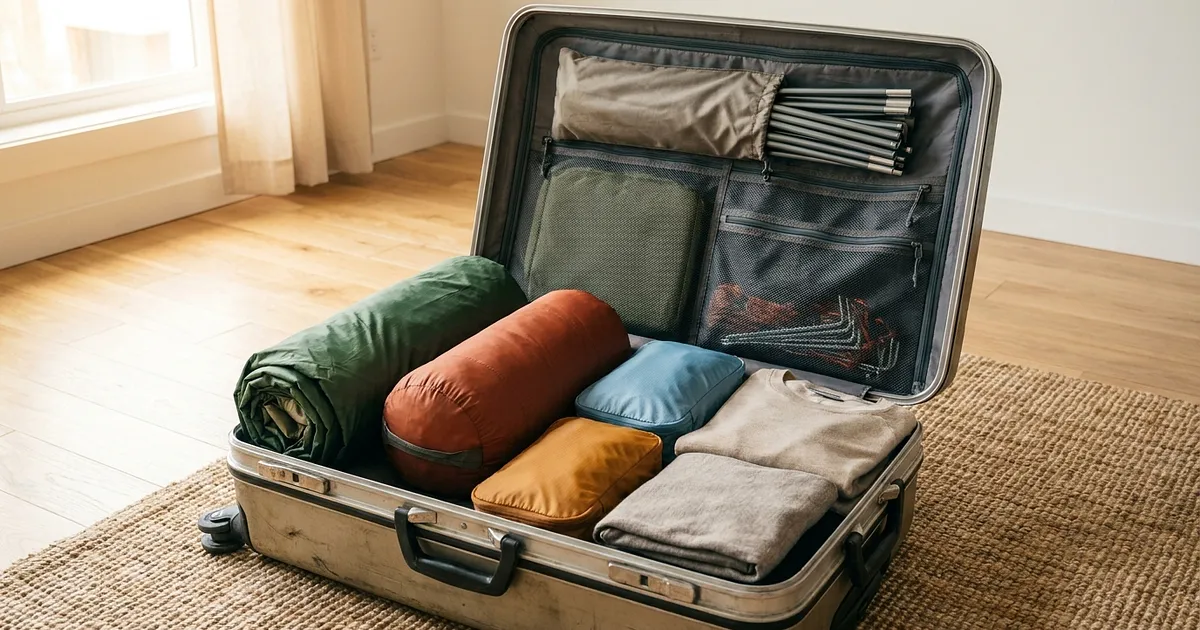
Tent fabric and sleeping bags take up space. Stakes and stoves need a separate check before they can fly. Packing camping gear on a plane starts with sorting those items rather than treating the whole kit as one bag: fabric and sleeping kit, poles and stakes, then the stove and its fuel. This guidance was checked on 12 October 2026 against sources including the IATA passenger table, 67th edition, effective from 1 January 2026.
The useful question isn't simply “Can my tent fly?” Ask where each part belongs: the cabin, the hold, or a rental or shop at your destination.
The packing decision at a glance
| Item | Sensible plan | What still needs checking |
|---|---|---|
| Tent fabric and inner tent | Carry-on or checked baggage, dry and packed down | Your airline's size, weight, and bag-count allowance |
| Sleeping bag and mat | Inside an allowed bag | They aren't automatically free extra items |
| Tent poles | Bundle and protect them in checked baggage for fewer disputes | Length, material, and departure-screening rules |
| Tent stakes | Cover the points, secure the bundle, and check it | Rules at the airport where screening takes place |
| New, unused burner | Ask the operating airline about the exact type and model | Design and dangerous-goods conditions |
| Previously liquid-fuelled stove | Carry only if the operator expressly accepts it under the required conditions | The cited IATA row is checked-only and requires approval |
| Gas cartridge, petrol, or methylated spirit | Keep it out of passenger baggage and arrange fuel at the destination | Lawful purchase, return, or disposal locally |
These are cautious packing recommendations, not blanket permissions. Checked bags are screened too, and every item still has to meet security and dangerous-goods rules.
One more trap: a compression sack reduces a sleeping bag's bulk, not its weight. A bag dangling outside your backpack may also count as another piece. Our carry-on packing list helps with ordinary cabin essentials, but camping hardware still needs its own check.
Flying with a tent means separating its parts
Keeping the whole tent in its original stuff sack makes sense on the trail. At an airport, that tidy bundle hides very different items from view: soft fabric, long poles, and pointed metal stakes. Sorting by function and risk gives you more control.
Tent fabric is ordinary but vulnerable baggage
The flysheet, inner tent, and footprint aren't sharp objects. Pack them dry so moisture doesn't sit inside a sealed bag for hours. A separate inner bag also keeps mud and tree resin away from your clothes. The fabric still has to fit inside a bag included in your booking.
On a cabin-only fare with a small allowance, packing the fabric and sleeping bag inside your backpack while checking the hardware is often easier. A tent bag over your shoulder isn't automatically a free extra.
Tent poles and stakes get different answers
A pole isn't judged by material alone. Its length, ends, shape, and the officer's assessment may matter. In the United States, TSA lists tent poles as conditionally allowed in carry-on baggage, subject to special instructions and the officer's final decision. That is why “all tent poles are banned worldwide” would be wrong. It isn't permission for a departure from Germany or another country.
For fewer arguments, bundle the pole sections and put them where they can't puncture the suitcase wall or tent fabric. Along the inside frame of a checked case is usually safer than loose under a zip. That is practical packing advice, not a damage guarantee.
Stakes are clearer. TSA's tent-spike guidance excludes them from carry-on baggage and tells passengers to cover or wrap sharp objects in checked bags to protect baggage handlers and inspectors. Again, that is US guidance. It is still a useful conservative packing standard.
Loose stakes in an outer pocket are asking for trouble. Use a firm sleeve or puncture-resistant pouch that keeps every point together. Make it easy to open for inspection. A cocoon of tape that needs a knife creates exactly the next problem you were trying to avoid.
A mallet, knife, or multitool needs a separate decision. A tent doesn't grant automatic permission for every tool used to pitch it. If you are also taking sports gear, our guide to sports equipment on a plane helps you plan that separate baggage. It does not create a special allowance for camping equipment or fuel.
Sleeping bags and mats: bulk isn't allowance
Security screening is rarely the hard part with a sleeping bag. Packed size is.
A down bag may compress dramatically, while a bulky synthetic one often doesn't. Compression only changes volume. The weight remains, and your fare doesn't gain another piece of baggage because the sack became smaller. The same applies to a mat strapped outside a backpack. Handy on a walking route, potentially a second item at the gate.
Tuck away cords and straps so they can't snag in the baggage system. In checked luggage, a closed inner liner adds protection from moisture. It isn't automatically waterproof. Dry, enclosed inner packing is more practical than leaving the sleeping bag exposed outside your luggage.
For a cabin-only trip, test the actual backpack included in your booking. Put the sleeping bag and clothing inside, then measure and weigh the packed bag. If the poles don't fit, or the stakes and stove remain unresolved, hiring equipment after arrival may be more sensible than arguing at security.
That sounds less adventurous than arriving completely self-sufficient. It also avoids abandoning part of your kit at the airport.
Camp stoves on planes: separate the burner from the fuel
This is where unsafe shortcuts start. A gas-stove burner isn't its fuel cartridge. A new burner isn't the same as a petrol stove that has already been fuelled. And “empty” doesn't necessarily mean free from vapour or residue.
Keep camping fuel out of passenger baggage
Keep camping gas cartridges, petrol, and methylated spirit out of both carry-on and checked bags. The IATA passenger table, 67th edition, effective from 1 January 2026 starts from the rule that dangerous goods are forbidden in passenger baggage unless a specific exception applies. Its separate provision for certain small non-flammable gas cartridges is not a camping-gas loophole.
Find out before leaving whether compatible fuel can be bought lawfully at your destination. Think about the return flight too. This guide doesn't treat a supposedly empty, used cartridge as proven safe to fly. Arrange local return or disposal under local rules. Don't vent it or attempt improvised cleaning at the airport.
Lighters, batteries, and vapes follow other rules. Our guide to lighters, vapes and batteries on a plane deals with those items separately.
A used liquid-fuel stove needs an explicit yes
The IATA passenger table for 2026 provides a narrow exception for camping stoves and containers that have held flammable liquid fuel. The relevant row specifies an empty tank or container, checked baggage only, operator approval, and further conditions in the linked subsection. Here, “operator” means the operating airline. State or operator variations may be more restrictive.
It isn't a cleaning manual. Don't invent a process involving detergent, solvents, airing for a particular number of hours, or any other home recipe to claim the stove is safe. Ask the operating airline for its required process. If the airline won't clearly confirm acceptance, leave the stove behind.
The UK Civil Aviation Authority also treats camping stoves as restricted checked baggage and directs passengers to obtain airline approval. Its guidance distinguishes new equipment from items that have been fuelled. The source is British, but it makes the division of responsibility clear: airport screening and airline acceptance answer different questions.
Why TSA clearance isn't enough
TSA's camp-stove entry conditionally allows stoves that are empty and cleaned of fuel vapours and residue, while leaving the final screening decision to the officer. That describes US security screening. It doesn't force an airline to accept the item under dangerous-goods rules.
On a route crossing several countries, you need an answer that works for the whole journey. The operating airline matters more than the brand shown on a codeshare ticket. Send the carrier the model, fuel type, whether it has ever been used, and the full outbound and return itinerary. Keep the reply offline. An email can't guarantee passage, but it is far more useful at the counter than a vague forum quote.
Packing without false confidence
For a trip with a tent and sleeping bag but no cooking system, the split is fairly simple. Fabric and sleeping kit go dry inside your booked baggage. Poles sit bundled and padded in the checked case. Stakes stay in a firm, closed sleeve. Then compare the finished bag with your fare rather than a generic average.
Add a stove, and packing becomes an approval problem:
Record the manufacturer, model, fuel type, and whether the stove has ever been filled.
Ask the operating airline about the outbound flight, connections, and return.
If the airline hasn't confirmed that it will accept your stove, plan to hire, borrow, or buy a compatible burner at the destination.
Buy fuel only after arrival, where sale and use are lawful.
Before returning, arrange local return or disposal. No airport experiments.
A cabin-only booking may simply be the wrong match for the full kit. Checking a bag or hiring hardware locally are more practical alternatives. If you are using Lufthansa, our Lufthansa checked-baggage guide explains that airline's general allowance. For another carrier, use its current rules instead. That link covers baggage allowance, not acceptance of a stove or fuel.
Check both the outward and return journeys
Permission on the outbound leg doesn't settle the way home. Fuel may remain, gear may be wet or muddy, and the foreign departure airport can apply different screening rules.
Check the operating airline, the security authority at each departure point, the rules at connecting airports, and the destination's entry requirements. Check the destination's rules for soil or plant material on outdoor equipment too. For a stove, ask in writing and name the exact model. For fabric and sleeping kit, focus on bag size, weight, and count.
Editorial note: Rules vary by country, airport, airline, and equipment type. For stoves and fuel, rely on written guidance from the operating carrier for your specific journey.
Frequently Asked Questions
Can I take a tent in carry-on luggage?
The soft tent fabric may fit inside your booked carry-on allowance. Poles and stakes are assessed separately, and protected stakes are better planned in checked baggage. The departure-screening authority and your airline's baggage rules control the final answer.
Where should tent stakes and poles go when flying?
Covered stakes and bundled poles are best planned in checked baggage. Some authorities treat poles less strictly than stakes, but that doesn't create permission to take poles into the cabin everywhere. Check your departure airport and airline.
Does a sleeping bag count as an extra carry-on item?
Not automatically. It must fit inside an allowed bag or be expressly accepted by the airline as another piece. Compression reduces bulk, but it doesn't change weight or the number of bags included in your fare.
Can an empty camp stove go on a plane?
“Empty” alone isn't enough. The design, previous use, possible residue, and operating airline's rules all matter. IATA's exception for previously liquid-fuelled stoves is conditional, checked-only, and requires operator approval.
Can a gas cartridge go in checked baggage?
No. Keep camping gas cartridges, petrol, and methylated spirit out of both checked and carry-on baggage. Buy compatible fuel after arrival if local law allows it, then arrange lawful return or disposal before the flight home.
Is airport security approval enough for a camp stove?
No. Security staff assess the checkpoint rules, while the airline separately decides dangerous-goods acceptance. Your plan must work for the operating carrier and every departure point on the itinerary.
Sources
- IATA passenger table, 67th edition, effective from 1 January 2026 iata.org
- TSA lists tent poles as conditionally allowed in carry-on baggage tsa.gov
- TSA's tent-spike guidance excludes them from carry-on baggage tsa.gov
- UK Civil Aviation Authority also treats camping stoves as restricted checked baggage caa.co.uk
- TSA's camp-stove entry tsa.gov