
Lost Luggage at the Airport 2026: Why Europe's Hubs Are Still the Weak Spot
 6 min read
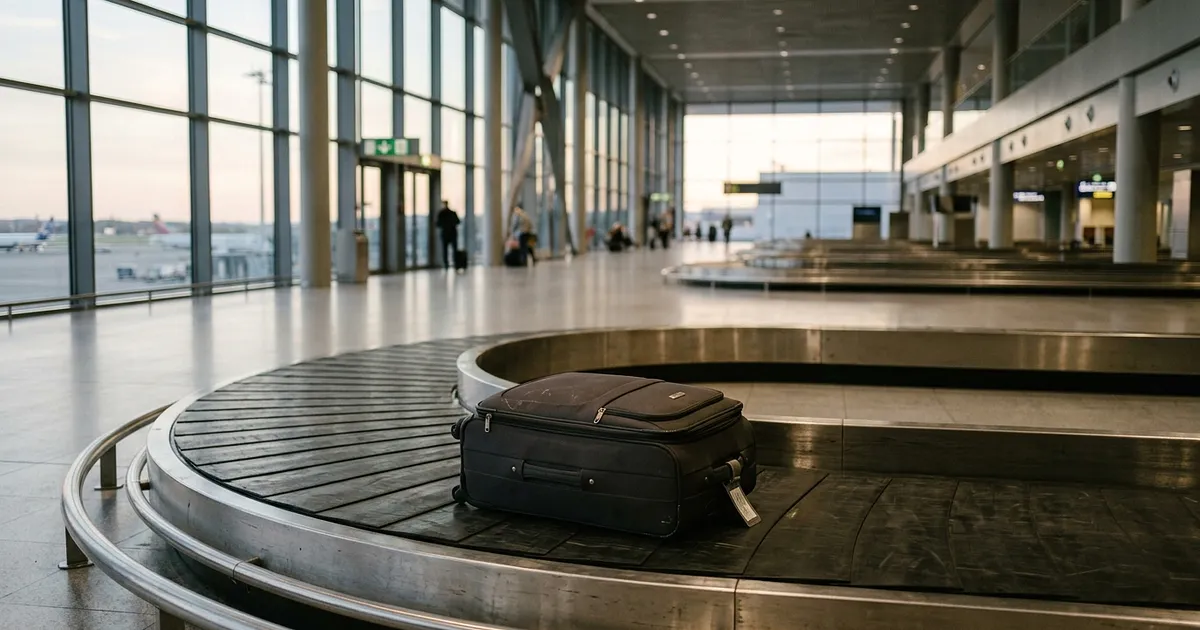
Globally, baggage handling is actually getting better. And yet the risk of lost luggage at the airport in 2026 is higher in Europe than almost anywhere else. Sounds contradictory? Only at first glance.
Picture Frankfurt on a strike day. Your connecting flight gets rebooked, the gate changes a third time, and you're sprinting to a new terminal with half a boarding pass in hand. Your bag often doesn't make that sprint with you. That's happening more often at Germany's big hubs this summer, even as the worldwide number of misrouted bags dropped 23 percent in 2025. Europe's hubs remain the problem child regardless.
The short version: According to the SITA Baggage IT Insights Report 2026, Europe records 10.5 mishandled bags per 1,000 passengers. That's more than double the global average of 4.9. An AirTag in your bag, a photo before check-in, and travelling with hand luggage only where you can will cut your risk of lost luggage sharply. If your bag still goes missing, file a PIR at the desk right away. You've got 21 days to report a delay, and compensation runs up to roughly €1,300.
Why now? Strikes are hitting Frankfurt and Munich
The reason for the raised risk isn't the flying. It's the connecting.
Transfers accounted for 39 percent of all baggage mishandling, according to SITA, and on international flights the error rate runs almost six times higher than on direct flights. That's exactly where things get tight this year: strikes by the pilots' union Vereinigung Cockpit and the cabin-crew union UFO repeatedly caused hundreds of delays and dozens of cancellations in 2026, according to reporting from TravelPirates, with Frankfurt hit hardest of Lufthansa's hubs. If you're connecting through an overloaded hub this summer, you're statistically in the risk group for lost luggage.
How to protect your suitcase
A little prep makes the biggest difference here. Four things genuinely help.
A Bluetooth tracker sounds like gadget-nerd nonsense, until it saves your trip once. Since SITA built Apple's Find My into its WorldTracer system, the share of permanently lost bags fell by 90 percent, and delayed bags came back 26 percent faster. A luggage tracker for the plane like an AirTag costs around €30 and shows you live where your suitcase is sitting, in the hold or on the belt. Is an AirTag even allowed in checked luggage? Short answer, yes, the entire Lufthansa Group now supports Apple's Find My network for baggage tracing. Our AirTag in checked luggage guide has the full picture, and if you're not sure which tracker fits your phone, check our AirTag and tracker test.
Also grab a quick photo of your packed bag and the baggage tag before check-in. Sounds trivial, but it helps enormously with any later claim. And make your bag stand out with a bright luggage strap. Nobody mixes up your plain black case with the thousandth one on the belt that way.
Where you can: hand luggage only. What doesn't go in the hold can't get lost. On short trips, it's the simplest insurance there is.
Suitcase didn't arrive? Here's what to do now
First, breathe. The vast majority of bags aren't lost, just delayed, and there are clear compensation rules for delayed baggage. They usually turn up within 24 to 48 hours, and a bag only counts as officially "lost" after 21 days.
Still, every minute at the desk matters now:
- Go straight to the airline's baggage desk, before you leave the airport.
- Get a PIR issued. This Property Irregularity Report is the basis for any later compensation. No PIR number, no claim. The full step-by-step process, deadlines included, is in your rights when luggage is lost.
- Have your photos and baggage tag ready. That's exactly why you took the picture.
- Follow up in writing. Under EU rules you must report baggage damage within 7 days and a delay within 21 days, in writing, to the airline. Compensation is capped at roughly €1,300, according to Your Europe.
Miss those deadlines and your claim can vanish entirely. Document once too often rather than once too little.
At Kofferly, we get these questions every summer, usually only after the bag is already sitting at the wrong airport. With a tracker, a photo, and a grip on your rights, you're better prepared against lost luggage than most people at the belt. And if your suitcase does take a detour through Palma this summer, 5 days without a suitcase in Barcelona shows you what it actually feels like, and how it turned out fine in the end.
Frequently Asked Questions
Is an AirTag allowed in checked luggage?
Yes, an Apple AirTag in checked luggage is allowed. AirTags run on a small coin-cell battery well below aviation lithium limits. No major airline bans them, and many actively use Find My tracking. The entire Lufthansa Group supports the network.
What do I do if my suitcase doesn't arrive?
Go straight to the airline's baggage desk before you leave the airport. Get a PIR (Property Irregularity Report) issued and note the number. Without that report you can't claim compensation later. Keep your photos and baggage tag handy.
How much compensation is there for delayed baggage?
Under the Montreal Convention, the airline is liable for loss, damage, or delay up to roughly €1,300 (1,288 SDR, depending on the exchange rate). You must report damage within 7 days and delays within 21 days of receiving the bag, or the claim expires.
How long does it take to find lost luggage?
Most misrouted bags are only delayed and come back within 24 to 48 hours. A bag counts as officially lost only after 21 days. A tracker like an AirTag speeds up returns by 26 percent on average, according to SITA.
Where are you most likely to lose your luggage?
At big transfer hubs. Connections cause 39 percent of all baggage mishandling, and Europe's hubs have the highest error rate worldwide. Direct flights and generous layover times cut your risk the most.
*Last updated: July 2026*