CPAP on a plane 2026: Carry-on bags, batteries and onboard use
 15 min read
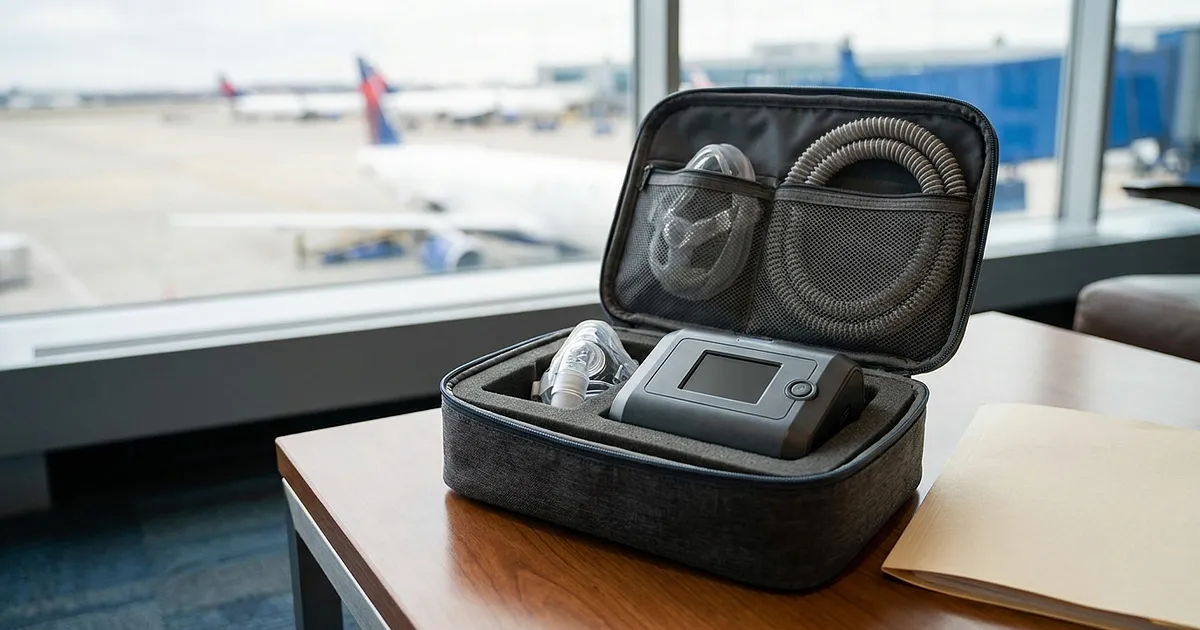
Taking a CPAP on a plane isn't the same as getting permission to use it during the flight. Your separate equipment bag and battery bring their own questions. An airline reply saying the machine can travel might cover carriage only, even if you meant to ask about running it on an overnight flight.
This Kofferly guide covers baggage and travel preparation, not treatment. Whether you need to use your machine during a particular flight, and which medical documents fit your circumstances, are questions for your treating team. A baggage guide can't assess fitness to fly or advise changes to therapy settings.
Which permission does your trip need?
The useful starting question is whether the machine is travelling to your destination or needs to run along the way. A switched-off CPAP in its case raises baggage questions and, if it has a battery, dangerous-goods questions. Operation brings in the exact equipment setup and the airline's conditions for use.
There are separate answers to get:
| Question | What to confirm | What it doesn't settle |
|---|---|---|
| Can the CPAP travel? | Carriage of the named model in cabin baggage | Permission for an extra bag |
| Can I bring a separate medical bag? | Whether it travels outside the ordinary allowance, and on what terms | Battery acceptance |
| Can this battery travel? | Its construction, energy, installed or spare status, and any required approval | Permission to switch on the machine |
| Can I use the CPAP in flight? | Operation on this flight with the proposed power supply | Your medical fitness to travel |
That's more than a paperwork distinction. Ryanair's CPAP carriage page discusses normal cabin baggage and an extra medical bag. A separate page explains its review of medical-device requests and written confirmation when approved. Both were checked on 11 October 2026. A baggage reply alone leaves the operation question unanswered.
For a connecting itinerary, the operating airline on each leg matters. The name on the booking website may not be the carrier flying the aircraft. A useful enquiry includes the route and actual operator, not just the booking reference. The return flight needs its own check if a different carrier operates it.
A written answer naming the machine and battery is more useful than a generic statement that medical equipment is allowed. If the reply only discusses the bag, a follow-up about operation is still needed. Better to find that gap while you're at home than when boarding has started.
Cabin baggage and extra medical bags by airline
Free medical carriage doesn't automatically mean an extra bag without advance contact. These examples show where the distinctions appear in airline policies. The pages were checked on 11 October 2026; that's the access date, not a claimed publication date.
| Airline | Carriage and a separate bag | Notification and onboard operation |
|---|---|---|
| Eurowings | Its medical FAQ allows CPAP in addition to normal hand baggage, subject to large cabin-bag rules. The CPAP paragraph says no advance reservation is needed for carriage alone; the general equipment paragraph asks for details by email. | For use, Eurowings asks for its form and supporting documents at least 72 hours before departure. Battery operation is required; the FAQ says onboard power isn't available. Eurowings policy, checked 11 October 2026. |
| Ryanair | Its CPAP page says no prior notification is needed if the machine fits within your permitted cabin baggage. An extra bag requires a medical baggage waiver from Assisted Travel. Carriage rule, checked 11 October 2026. | Its medical-device page describes review and written confirmation if approved. Confirm operation and power separately; these sources don't establish a universal CPAP-use deadline. Device request, checked 11 October 2026. |
| easyJet | For a small extra medical bag, the airline specifies no more than 56 × 45 × 25 cm and notification to Special Assistance at least 48 hours before the flight. Equipment policy, checked 11 October 2026. | The 48-hour notice concerns the extra bag, not a confirmed deadline for onboard use. The linked page doesn't clearly answer whether you may run your CPAP or which power supply is permitted. Confirm both with easyJet before travel. |
| Lufthansa | The checked policy for flights to and from the USA lists CPAP among battery-powered assistive devices that may travel. It doesn't establish an extra baggage allowance for every route. US-route assistive-device policy, checked 11 October 2026. | Ask its medical service about the actual route, extra bag, documents, operation and power. This source doesn't establish a universal CPAP notification deadline. |
Carriage alone with Eurowings and Ryanair
Eurowings has a nuance worth retaining. Its CPAP-specific paragraph says carriage alone doesn't need an advance reservation. Elsewhere, the general medical-equipment paragraph requests an email giving the brand, model, weight and dimensions. I'd confirm the separate bag and its size rather than rely on whichever sentence sounds easier.
Ryanair ties its carriage answer to your booked allowance. If your switched-off machine fits inside the cabin baggage you're already entitled to bring, the CPAP page gives an explicit no-notification exception. An equipment bag outside that allowance is where the medical baggage waiver comes in. This is a baggage document from the airline, not a manufacturer's compliance letter or a doctor's note.
The ordinary Ryanair cabin-bag allowance helps you identify what your booking includes; the CPAP extra-bag provision and permission to operate remain separate checks.
An equipment bag should contain the machine and its relevant accessories. Permission for medical baggage isn't a reasonable basis for adding an ordinary holiday bag. Listing the contents in your request helps establish what the airline has actually accepted, without guessing how far the exemption stretches.
What the easyJet and Lufthansa information leaves open
The easyJet equipment page, checked on 11 October 2026, lists CPAP among ordinary devices that generally don't require a healthcare-practitioner letter, subject to its other conditions and dangerous-goods rules. That doesn't settle acceptance of a battery requiring separate approval.
The dimensions in the table belong to easyJet's medical extra-bag provision. They aren't a replacement for the airline's ordinary cabin-bag limits. Nor does the extra-bag notice period become an operation deadline just because both questions concern the same machine.
Lufthansa's linked policy covers flights to and from the USA. For another route, ask the carrier about your separate bag and onboard use rather than assuming the same conditions apply.
CPAP batteries: establish the category before checking watt-hours
A battery doesn't gain a medical-device exception simply because you want to power a CPAP with it. First establish what the battery actually is. A retailer's “CPAP battery” label isn't enough to decide its transport category.
The IATA passenger guidance dated 31 March 2026 distinguishes universal external power sources for multiple devices from device-specific spare batteries designed to fit into, or attach directly to, a particular device. A universal power bank doesn't automatically qualify for the device-specific spare-battery rules, even when you plan to use it with a CPAP.
Our guide to power banks on planes covers that neighbouring topic. Here, the task is to classify your medical equipment and its exact battery. This isn't a recommendation to buy a generic USB pack for your machine.
Lithium-ion batteries and operator approval
For lithium-ion batteries in portable electronic devices, including medical equipment, the IATA Table 2.3.A effective 1 January 2026 gives these bands. State and operator variations may be more restrictive.
| Lithium-ion battery | What the IATA table dated 1 January 2026 says | What remains to confirm |
|---|---|---|
| Up to and including 100 Wh in the device | Within the basic energy band; protection against damage and accidental activation still applies. | Does the operator impose further conditions? |
| Above 100 Wh and up to 160 Wh in the device | Operator approval is required. | Does the written approval cover this model and itinerary? |
| Device-specific spare above 100 Wh and up to 160 Wh | Operator approval, no more than two such spares, cabin baggage only, individually protected against short circuits. | Has its spare-battery classification been confirmed? |
| Above 160 Wh | Outside this passenger provision for portable medical or electronic devices. | Don't assume medical use alone makes it acceptable. |
Spare lithium batteries belong in cabin baggage and need short-circuit protection under the IATA passenger guidance dated 31 March 2026. Exposed terminals need suitable protection following the manufacturer's instructions; separate protective packaging keeps them away from metal objects. Medical need doesn't remove the need to protect the battery from damage or short circuits.
Lithium-metal batteries use a different measure: lithium content in grams. The IATA table dated 1 January 2026 gives up to 2 g as the basic band and above 2 g up to 8 g as an approval-required exception for portable medical electronic devices only. Those gram limits aren't another way of measuring a rechargeable lithium-ion pack.
The label matters more than a sales description
The watt-hour marking on the battery casing is the simplest evidence. The IATA guidance dated 31 March 2026 gives the calculation as Ah × nominal V = Wh. It uses the battery's nominal voltage, not an arbitrary USB output voltage. If the energy rating can't be established from the marking or documentation, the operator may refuse carriage.
A readable label photograph and the manufacturer's data sheet make the enquiry easier. The airline also needs the number of batteries and whether they're installed, removable or carried separately. Missing information is a reason to ask the manufacturer, rather than estimate generously and hope nobody asks.
Hypothetical example: A device-specific lithium-ion spare rated at 120 Wh falls within the approval-required band in the IATA table dated 1 January 2026. That doesn't approve onboard use. It also doesn't make a universal power bank with the same energy rating automatically acceptable. Classification still matters.
The March IATA passenger guidance describes some power-bank restrictions as upcoming or proposed provisions and discusses early adoption by airlines. It shouldn't be presented as an identical new worldwide law already applying to every carrier. The operator's current power-bank policy needs checking; a medical purpose doesn't bypass it.
E-bike and power-tool batteries are a separate category again. Special wheelchair-battery provisions don't transfer to CPAP either. One generous-looking battery figure taken from another device category can be worse than having no figure at all.
Documents and power for using the CPAP in flight
A doctor's letter, a manufacturer's compliance document and an airline approval do different jobs. Evidence of medical need doesn't decide whether a battery can travel. A statement about the machine's flight compatibility isn't an assessment of your personal fitness to fly.
ResMed's travel FAQs provide flight-compliance information for specified models, checked on 11 October 2026. A letter matching your device belongs with the equipment paperwork. It doesn't replace the operating carrier's answer or permission for an additional bag.
A useful enquiry gives the airline concrete information:
The model, weight and outer dimensions of the packed equipment bag.
Whether the CPAP is travelling switched off or you want to use it in flight.
The battery data sheet or readable label, plus the number and installation arrangement.
The operating carriers and flight legs for which you need an answer.
Any medical forms requested for your circumstances come alongside those details. The Eurowings medical FAQ, checked on 11 October 2026, requires its form and supporting documentation at least 72 hours before departure for onboard use. Its passage discusses CPAP and oxygen concentrators together. Which medical statement applies to you belongs in a conversation with the airline and treating team, not a generic internet template.
If you're also travelling with medication in cabin baggage, that brings separate documentation and screening questions. A CPAP letter doesn't automatically answer them.
A seat socket isn't a power plan
Seeing a socket doesn't establish permission to use your machine or compatibility with its power supply. Eurowings explicitly says battery operation is required and onboard power isn't provided for this purpose in the FAQ linked above. The checked easyJet and Lufthansa material doesn't establish a general power promise for your itinerary.
For another flight, the permitted power source, power-supply compatibility and any restrictions during particular flight phases need confirmation. Your manufacturer or equipment provider can explain the right combination for the machine; the airline controls its use on the aircraft. A travel adaptor can't resolve either unanswered question.
Battery runtime depends on the machine, the accepted battery and the operating conditions. Reserve requirements for another type of device don't automatically apply to CPAP. Plan around the conditions confirmed for your setup; don't change therapy settings yourself to stretch battery life.
Packing, screening and a bag sent to the hold at the gate
The machine's own travel case is a sensible starting point if it fits the confirmed baggage arrangement. Padding protects the equipment, and accessible paperwork helps when staff ask about its label or approval. An approval email won't help much if you can't get online at the airport. Keep a copy you can open offline.
For a machine with a water chamber, the manual matters. ResMed advises emptying the humidifier tub before transport and placing it separately in the bag's compartment, checked on 11 October 2026. It also warns against water in the humidifier during a flight because turbulence can cause spills and damage. These are equipment-handling instructions, not advice to change therapeutic pressure.
For relevant wireless models, ResMed describes using airplane mode according to the user guide. The original manual identifies the controls for your actual model. Instructions for a similar-looking machine aren't a reliable substitute.
Passing security doesn't give airline approval
The checkpoint decides how to screen the equipment, not whether your ticket includes another bag or whether you may use the machine at your seat. A medical case needs to be easy to open if requested. The local screening team decides how the equipment must be presented; this guide doesn't establish one procedure for every airport.
At US checkpoints, the TSA page covering CPAP, BiPAP and APAP equipment, checked on 11 October 2026, says the device, mask and tubing may remain in their case for X-ray screening. TSA may still ask you to remove them for further screening. The old blanket instruction to unpack every CPAP every time isn't what this source says. Nor does it establish a European liquids exemption.
That's a small distinction, but a useful one: equipment permitted through a US checkpoint hasn't gained permission for every other airport or for in-flight operation.
When your ordinary cabin bag is gate-checked
The IATA passenger guidance dated 31 March 2026 reminds passengers to remove lithium batteries and relevant devices when cabin baggage is taken for the hold. Having originally booked a carry-on-only trip isn't a reason to leave the battery in a trolley once that trolley becomes checked baggage.
For the CPAP, an early conversation with staff helps establish where the accepted equipment bag can remain safely in the cabin. A medical label doesn't make obstructing an aisle acceptable. Stowage needs to fit the crew's instructions as well as the baggage approval.
If you also need help getting through the airport, arrange that assistance separately. Booking assistance doesn't grant CPAP-operation approval or change the battery category.
Frequently Asked Questions
Does my CPAP count as a free extra carry-on bag?
Not automatically. Ryanair requires a medical baggage waiver for equipment outside the normal allowance. Eurowings lists CPAP in addition to normal cabin baggage, with other equipment conditions. easyJet requires advance contact for the additional medical bag. Sources: the airlines' equipment policies, checked on 11 October 2026.
Do I need a doctor's letter to take a CPAP on a plane?
It depends on the airline and whether you're carrying or using it. easyJet generally doesn't require a healthcare-practitioner letter for ordinary CPAP carriage, subject to other conditions. Eurowings requires further documents for onboard use. A manufacturer's compliance letter isn't a personal medical certificate. Sources: easyJet, Eurowings and ResMed, checked on 11 October 2026.
Can a 120 Wh CPAP spare battery travel?
A device-specific 120 Wh lithium-ion spare needs operator approval in the relevant IATA band. It belongs in cabin baggage with short-circuit protection. That answer doesn't automatically apply to a universal power bank. Source: IATA Table 2.3.A, effective 1 January 2026. The airline may impose stricter conditions.
Can I connect my CPAP to the seat socket?
Not without confirming permission and compatibility with the airline and manufacturer. Eurowings requires battery operation and says onboard power isn't available for this purpose. Other airlines need to confirm the allowed supply and operation for your flight. Eurowings source: medical FAQ, checked on 11 October 2026.
Must I unpack my CPAP at airport security?
Follow the checkpoint's instructions. At US checkpoints, TSA says the machine and accessories may generally stay in their case, but staff can request removal for further screening. This isn't a worldwide procedure. Source: TSA's CPAP, BiPAP and APAP screening page, checked on 11 October 2026.
Sources
- Ryanair's CPAP carriage page help.ryanair.com
- review of medical-device requests and written confirmation when approved help.ryanair.com
- Eurowings policy eurowings.com
- Equipment policy easyjet.com
- US-route assistive-device policy lufthansa.com
- IATA passenger guidance dated 31 March 2026 iata.org
- IATA Table 2.3.A effective 1 January 2026 iata.org
- ResMed's travel FAQs provide flight-compliance information for specified models support.resmed.com
- TSA page covering CPAP, BiPAP and APAP equipment tsa.gov