Bike on a Plane 2026: Airline Rules, Fees and the Best Bike Travel Cases Compared
 18 min read
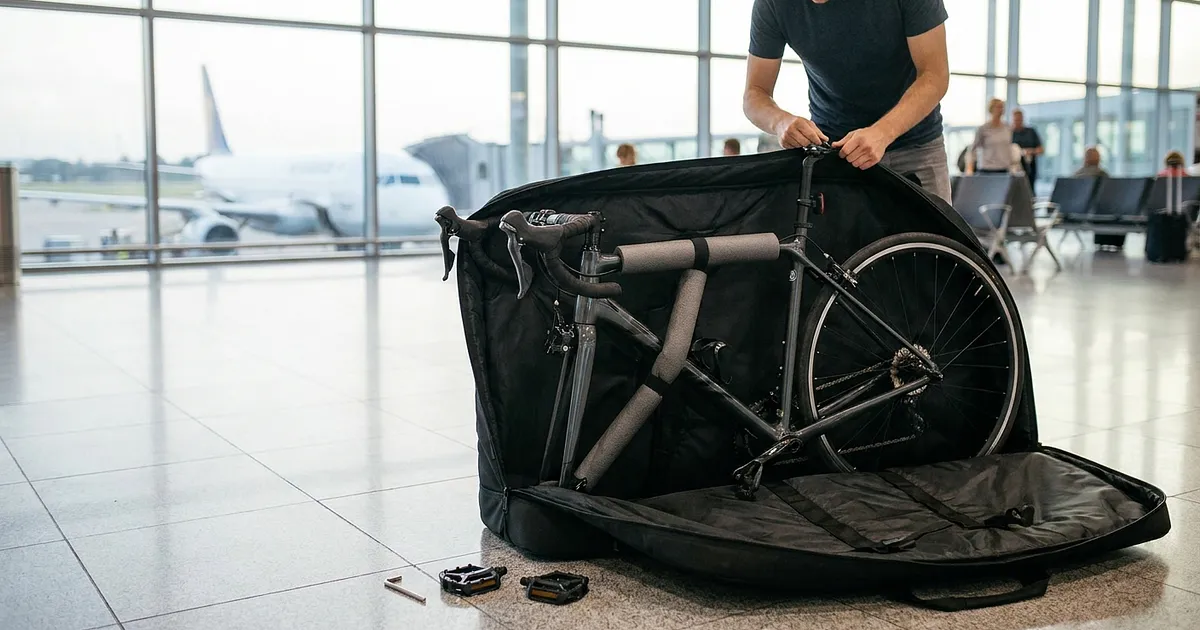
Taking a bike on a plane works with almost every major airline in 2026. The catch is the fine print, and there's a lot of it: every carrier books your bike as sports equipment, with its own fee, its own weight cap and its own booking deadline. The price spread is honestly a bit ridiculous. Ryanair charges £60 online for a boxed bike according to road.cc, while Lufthansa wants €320 for a bike over 2 m on a long-haul flight (both as of September 2026).
We've put the sports baggage rules of Lufthansa, Condor, Eurowings, Ryanair and easyJet side by side. On top of that you'll find the battery rules for e-bikes, four bike bags from dirt cheap to seriously pricey, and the awkward question of who pays when your frame arrives in two pieces. One thing up front: e-bike batteries fail the 160 watt-hour limit that IATA sets for passenger flights.
Can I take my bike on a plane?
Just like that? No. A bike counts as sports baggage, not regular checked luggage, and it has to be registered and paid for ahead of time. Turn up at the check-in desk with it unannounced and there's a real chance it stays on the ground.
The reason is dull, not dramatic. There's only so much room in the hold for bulky items, and your bike shares it with golf bags, skis and surfboards. Once the allocation for your flight is full, it's full, no matter how nicely you smile at the desk. That's why cycle touring forums and the German Radreise-Wiki all give pretty much the same advice: add the bike as early as you can, ideally when you buy the ticket.
What practically every airline wants from you when you take a bike on a plane:
registration and payment in advance, usually during booking or later through "Manage my booking"
packaging, meaning a box, bag or case (plain plastic wrap isn't enough for many airlines, more on that below)
a prepared bike: pedals off, handlebars turned, tyres partly deflated
a weight under the limit, which sits at 30 kg or 32 kg depending on the airline (as of September 2026, details in the table)
Then there's the codeshare trap. Bought your ticket from airline A but you're actually flying on a plane operated by airline B? The bike rules of the operating carrier usually apply. The Radreise-Wiki flags exactly this as a common stumbling block. I'd always check with the operating airline before taping up the box.
One more tip from the same forums: save your airline's current sports baggage terms offline or print them. Sounds like overkill? Plenty of travellers report that a lot depends on how strictly the individual agent at the desk reads the rules.
How much does it cost to take a bike on a plane? Sports baggage fees for 2026
Anywhere from £60 at Ryanair to €320 at Lufthansa, depending on the airline, the route and the size of your bike (as of September 2026). Long-haul with Lufthansa is the most expensive option. Ryanair and easyJet come out cheapest, as long as you book online. Pay at the airport and most airlines will charge you extra.
| Airline | Bike fee (as of September 2026) | Max. weight | Booking deadline | Booking at the airport |
|---|---|---|---|---|
| Lufthansa | €80 short/medium-haul (€130 for bikes over 2 m); €200 long-haul (€320 for bikes over 2 m) | 30 kg | at least 72 hours before departure | €5 to €15 surcharge |
| Condor | zone-based price under a six-zone model, no flat fee | not stated | at least 8 hours before departure | not stated |
| Eurowings | approx. €40 to €95 per direction; free for Eurowings credit card holders plus one companion (not for e-bikes) | 32 kg | not stated | price depends on booking channel |
| Ryanair | £60 online | 30 kg, boxed | not stated | £70 at the airport or by phone |
| easyJet | £45 online | 32 kg | not stated | £55 at the airport |
All prices as of September 2026, taken from the linked pages of Lufthansa, Condor and Eurowings, and from road.cc for Ryanair and easyJet. Airlines change sports baggage fees without much warning, so double-check the amount before you book. Eurowings explicitly quotes its fee per direction. With the others, check during booking whether the price covers one leg or the return trip.
Lufthansa sports baggage: pricey, but clearly laid out
According to Lufthansa, your bike costs €80 on short and medium-haul routes, or €130 if it's longer than 2 m. Long-haul it's €200 or €320. The limit is 30 kg, and booking at the airport adds €5 to €15.
The real hurdle is the deadline. You have to register the bike at least 72 hours before departure. Flying out Thursday evening? Then Monday evening is your cut-off.
Condor sports baggage: zones instead of a fixed price
Condor uses a six-zone model, so what you pay depends on the type and size of your sports equipment and on the destination zone. There's no flat rate. You'll only see the exact figure while booking. The deadline is a relaxed eight hours before departure. I still wouldn't leave it to the last minute, because hold space is finite on every flight.
Eurowings: free with the right credit card
At Eurowings, sports baggage up to 32 kg costs roughly €40 to €95 per direction depending on route and booking channel. The interesting bit is further down the page: with the Eurowings credit card, your bike flies free for you and one travel companion. E-bikes and other devices with lithium batteries are excluded from that perk. If you fly with a bike twice a year, it's worth doing the maths on whether the card pays off.
Ryanair and easyJet: cheap, as long as you book online
Taking a bike on a plane is cheapest with Ryanair or easyJet, as long as you book online. According to road.cc, Ryanair charges £60 online and £70 at the airport or by phone for a boxed bike up to 30 kg. easyJet charges £45 online and £55 at the airport, up to 32 kg (both as of September 2026). Both figures come from a British source in pounds, so the euro price when booking from elsewhere may differ. Both airlines explicitly exclude e-bikes.
How to pack a bike for a flight
Let the tyres down, turn the handlebars, take the pedals off, pad anything that sticks out and put the lot in a box, bag or case. That's really most of it. The parts at risk when you fly with a bike are the ones that stick out: derailleur, brake rotors, bar ends.
First, the question of what the bike travels in. Some people swear by plain plastic wrap, on the theory that baggage handlers treat a recognisable bike more gently. That's hotly debated on forums. The bigger problem is elsewhere: Ryanair, easyJet and Lufthansa require a box or protective bag as a condition of carriage in their terms. Under-packing doesn't get you gentler handling. It can get you refused.
Bike shops will often hand you an old bike box for free if you ask. They get one with every new bike delivered.
Here's how to prep the bike:
- Take the pedals off. The left pedal has a reverse thread, so you loosen it clockwise. More people get stuck on this than you'd think.
- Turn the handlebars sideways, or remove them and zip-tie them to the top tube.
- Let some air out of the tyres. Not necessarily all of it, but well below your usual pressure.
- Unbolt the rear derailleur and tie it to the frame, or at least pad it heavily. It's the most fragile part of the whole bike.
- Wrap the frame and fork in foam pipe insulation from the hardware store or in bubble wrap. With disc brakes, put a pad spacer between the pads so nobody squeezes the lever by accident.
- Slip an AirTag or other tracker into the frame or bag. We'll get to why in the damage section.
- Weigh it. A kitchen scale won't cut it, but a luggage scale or your bathroom scale (once with the bike, once without) does the job.
A word on helmet, shoes and tools. Lots of cyclists stuff all of that into the bike bag, since sports baggage is charged per item and a second bag costs real money. On easyJet, that's exactly what you can't do, according to road.cc: nothing but the bike is allowed in the packaging, not even clothing. With other airlines it's worth reading the terms before you cram your shoes in.
Can you take an e-bike on a plane? Why the battery stays home
An e-bike with its battery isn't getting on the plane. Under IATA rules, lithium batteries up to 100 watt-hours are generally allowed in carry-on baggage, and between 100 and 160 Wh only with the airline's approval. Above that, they're not permitted on passenger aircraft, and an e-bike battery is practically always far above that.
You can do the maths yourself. Every battery lists its voltage and capacity, and watt-hours are simply volts times amp-hours. A 36 V, 14 Ah pack comes to 504 Wh, more than three times the absolute ceiling. No special approval gets you around that.
As our sister blog Ampcarry explains using power banks as the example, 100 Wh at the standard cell voltage of 3.7 V works out to roughly 27,000 mAh. That's already a seriously chunky power bank. And lithium-powered devices and spare batteries aren't allowed in checked baggage anyway, according to IATA, they belong in the cabin only. So there's no place on the aircraft for an e-bike battery, upstairs or down.
That makes the e-bike the one genuine exception when it comes to taking a bike on a plane. Ryanair and easyJet explicitly exclude e-bikes according to road.cc, and Eurowings leaves them out of its free-bike perk for cardholders. So what are your options?
Fly the frame without the battery as sports baggage. Some airlines accept this, but ask in writing first and bring the reply to the desk.
Ship the battery by freight. It's classed as dangerous goods, so not something a regular parcel service handles, and it's a hassle.
Rent an e-bike at your destination. Honestly, for most holidays that's the more relaxed option.
If you want to go deeper on the watt-hour maths, Ampcarry also covers individual airlines' battery rules. For this article the short version is enough: leave the battery at home.
Bike travel case for flying: hard case or soft bag?
Taking a bike on a plane safely comes down largely to the bike travel case for flying you choose. Hard cases protect best. Soft bags are lighter, cheaper and fold down once you arrive. For an expensive carbon bike I'd go for a hard case or at least a heavily padded bag. For an old aluminium touring bike, the bike shop's cardboard box often does the trick.
As road.cc reports, tour organiser Andy Cook, who says he has handled thousands of bikes on hundreds of flights, is pretty clear about it: rigid bike boxes give the best protection there is, in his view, while padded bags, though lighter, have led to damaged parts at the hands of baggage handlers more than once on his trips. He accepts the extra work of taking the bike apart and the higher price in exchange.
You only notice the downside of a hard case once you've landed. Where do you put the thing while you spend three weeks riding around Andalusia? Hotels will sometimes store one for you. Campsites, probably not. A soft bag rolls up and straps to your rack.
Search online for a "bike bag for flights" and you'll keep landing on the same handful of brands: Evoc, Scicon, B&W and Thule. Quality cases and good bags from them mostly sit between €300 and €500 based on our research (as of September 2026). There's room above and below that. We haven't had any of the four bags below in our own hands. Our take is based on product listings, prices and ratings on Amazon.de.
| Model | Type | Price (Amazon.de, as of September 2026) | Rating (Amazon.de, as of September 2026) |
|---|---|---|---|
| CamGo Foldable Bike Bag 20 Inch | foldable transport bag, going by the name for 20-inch bikes | €37.43 | 4.4 out of 5 stars from 778 ratings |
| Scicon Travel Basic | basic transport cover | €92.00 | 4.3 out of 5 stars from 104 ratings |
| VAUDE Big Bike Bag | transport bag | €129.44 | 4.0 out of 5 stars from 162 ratings |
| SCICON AeroComfort 3.0 TSA Route | premium transport bag | €599.00 | 4.3 out of 5 stars from 134 ratings |
Cheap and foldable: the CamGo bag
The CamGo Faltbare Fahrradtasche 20 Zoll, Fahrrad-Transporttasche für Flugreisen is by far the cheapest option here at €37.43, and with 778 ratings it's also collected the most reviews. But watch out, the name says 20 inch. That sounds like a folding bike or kids' bike, not a road bike or tourer. So check your bike actually fits before you order. At this price you'll probably need to bring your own padding too.
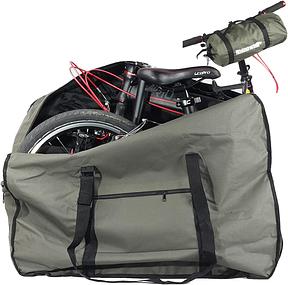
CamGo Faltbare Fahrradtasche 20 Zoll, Fahrrad-Transporttasche für Flugreisen
View at Amazon (as of Oct 02)Affiliate link. Buying through it earns us a commission; the price stays the same for you.
A simple cover: Scicon Travel Basic
The Scicon Travel Basic Transporthülle für Fahrrad costs €92.00, and it's called a transport cover for a reason. I'd see it more as protection against scratches and dirt than against knocks. With extra pipe insulation on the frame and the derailleur tucked away safely, that can be enough for a sturdy everyday bike.
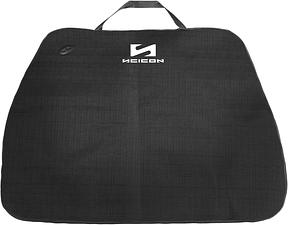
Scicon Travel Basic Transporthülle für Fahrrad
View at Amazon (as of Oct 02)Affiliate link. Buying through it earns us a commission; the price stays the same for you.
Mid-range: VAUDE Big Bike Bag
Vaude is an outdoor brand from Lake Constance in southern Germany, and the VAUDE Big Bike Bag, Transporttasche fürs Fahrrad goes for €129.44. The name suggests it's built for full-size bikes. At 4.0 out of 5 stars from 162 ratings it's the lowest-rated option on this list. That doesn't have to mean much, but skimming the critical reviews before you buy can't hurt.
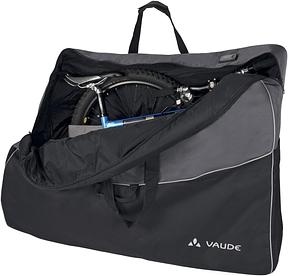
VAUDE Big Bike Bag, Transporttasche fürs Fahrrad
View at Amazon (as of Oct 02)Affiliate link. Buying through it earns us a commission; the price stays the same for you.
Top end: Scicon AeroComfort 3.0
At €599.00, the SCICON AeroComfort 3.0 TSA Route Transporttasche für Fahrrad sits above even the usual price band for quality cases. The "TSA" in the name points to a TSA-approved lock, meaning US security staff can open it with a master key instead of cutting it off. If you fly an expensive road bike several times a year, you're getting a padded bag rather than a cover here. For a single holiday, though, that's a lot of money.
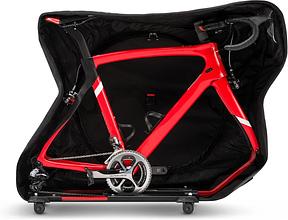
SCICON AeroComfort 3.0 TSA Route Transporttasche für Fahrrad
View at Amazon (as of Oct 02)Affiliate link. Buying through it earns us a commission; the price stays the same for you.
When is a hard-shell bike case worth it?
Your bike on a plane is only ever as well protected as the case around it. When your bike is worth more than the airline's liability limit (more on that in a second), when you fly regularly and when you've got somewhere to put the case at your destination. If all of that applies, I wouldn't think about it for long. When buying, look for a lockable case with a TSA lock and wheels, because a bike travel case for flying gets heavy fast once the bike's inside, and the packaging counts towards the weight limit.
Buy or rent?
Hardly anyone talks about this, yet it's the question that saves the most money. If you only take a bike on a plane once a year, spending €300 to €500 on a bike travel case for flying means paying a lot for something that sits in the basement 51 weeks a year. Some bike shops and specialist rental services hire out bike cases for flights, and someone at your local cycling club often has one they'll lend. Ask around before you buy.
Damage, loss, insurance: who pays if your bike arrives broken?
The airline is liable, but only up to a cap. Since the ICAO raised it on 28 December 2024, the limit under the Montreal Convention is 1,519 Special Drawing Rights (SDR) per passenger, roughly €1,800. If your bike is worth more than that, you're underinsured without your own cover.
Two details worth knowing. The cap applies per passenger, not per item, so your suitcase and your bike share the same pot. And the euro figure moves with exchange rates, because the SDR is an artificial currency unit run by the International Monetary Fund. According to law firm Condon & Forsyth, that was a 17.9% rise on the previous 1,288 SDR.
The case of pro cyclist Peter Koning shows that damage to a bike on a plane is very real. After a race in Dunkirk, his team bike came off an easyJet flight snapped in two, Sports Illustrated reported in May 2017. Koning posted at the time that easyJet had destroyed his bike and was now refusing to help him. easyJet said it had been trying to contact him since 5 May. (Side note: back in March 2017 a video had already surfaced of baggage handlers dropping bike boxes from an easyJet aircraft. Once you've seen something like that, you pad differently.)
And not every bike arrives broken. Some don't arrive at all. AOL reported on a traveller whose bike went missing on an Air France connection and only turned up five days later. In the end he found it himself, using an AirTag. That's exactly why the tracker made the packing list above.
The common belief that a premium airline treats your bike more carefully than a budget carrier? I wouldn't buy that. The Radreise-Wiki points out that what really matters is the ground handling at each airport, and the same company can do that job for both.
Your bike on a plane can't be fully insured against everything, but here's what you can actually do:
Photograph the bike from every side before packing it, with the date visible.
Report any damage at the airport before leaving the baggage hall, and get the report in writing.
Check your own insurance. Some home contents policies cover bikes while travelling, but often only against theft, not transport damage. For an expensive bike, travel luggage cover or dedicated bike insurance that explicitly names transport damage is the cleaner solution.
My take: book early, pad well, leave the battery at home
If I take one thing from all those fee tables, it's this: when you fly with a bike, you mostly lose money not to the airline but to your own procrastination. Registered too late, paid at the airport, and in the worst case the bike never makes it into the hold. It's annoying, and it's completely avoidable.
So here's what we at Kofferly recommend: book the bike together with your flight, double-check the fee with your airline, and only then decide between box, bag and case. For a trip with your old touring bike, the cardboard box is fine. For the carbon bike that's worth more than the liability cap? I wouldn't take any chances.
All products from this post
The ones we named above are marked; the rest are alternatives in the same category.
Affiliate notice: As an Amazon Associate, we earn from qualifying purchases. Product prices and availability are subject to change.
Frequently Asked Questions
Is plastic wrap enough, or does my bike need a box or case?
Wrap alone isn't enough for many airlines. Ryanair, easyJet and Lufthansa require a box or protective bag as a condition of carriage in their terms (as of September 2026). A bike box from a shop is the cheapest option, while a padded bag or hard case gives better protection.
Can I register my bike at check-in?
Better not. Lufthansa requires registration at least 72 hours before departure and Condor at least 8 hours (as of September 2026). Leave it later and you risk the bike not flying because the hold is full, and paying at the airport usually costs more, at Ryanair for example £70 instead of £60.
Is there a weight limit for a bike on a plane?
Yes. Lufthansa and Ryanair allow up to 30 kg, Eurowings and easyJet up to 32 kg (as of September 2026). The packaging counts, so a heavy case eats into the limit. We couldn't find a fixed limit for Condor, so ask when you book.
How much does a bike travel case cost, and is renting worth it?
Quality cases and good bags usually cost €300 to €500, while basic bags start at around €37 on Amazon.de (as of September 2026). If you only fly with your bike once or twice a year, renting from a bike shop or borrowing from your cycling club is often cheaper.
Is my bike insured during the flight?
Only up to a point. Under the Montreal Convention, since 28 December 2024 the airline is liable for no more than 1,519 Special Drawing Rights per passenger, roughly €1,800. For a more expensive bike, it's worth getting your own travel luggage or bike insurance that explicitly covers transport damage.
Sources
- Ryanair help.ryanair.com
- road.cc road.cc
- Lufthansa lufthansa.com
- IATA iata.org
- Radreise-Wiki radreise-wiki.de
- Condor condor.com
- Eurowings eurowings.com
- Ampcarry explains using power banks as the example ampcarry.com
- ICAO icao.int
- Condon & Forsyth condonlaw.com
- easyJet flight snapped in two si.com
- AOL reported aol.com