Can You Bring Medication in Carry-On Luggage? All Rules 2026
 10 min read
My neighbor Petra packed her insulin pen in her checked luggage last summer. Sounded reasonable, that way she wouldn't need to show it at security. What she didn't know: cargo holds can drop below minus 20 degrees Celsius. The insulin was destroyed after landing.
It was so easy to avoid. Medication in carry-on luggage is not just allowed, it's the only right call. For temperature-sensitive meds especially, it's mandatory.
Quick answer: Yes, medication is allowed in carry-on luggage and is exempt from the 100ml rule. Tablets with no quantity limit, liquid medication with proof of need, syringes with a doctor's certificate. Temperature-sensitive medications like insulin must go in carry-on, never in checked baggage.
Quick Overview: What You Can Bring
Here's what you can take as medication in carry-on luggage on a flight, at a glance:
| Medication Type | Allowed in Carry-On? | Notes |
|---|---|---|
| Tablets, capsules, pills | Yes, no quantity limit | Original packaging recommended |
| Liquid medication (syrups, drops) | Yes, even over 100 ml | Exempt from the 100 ml rule |
| Syringes, pens (insulin etc.) | Yes, with doctor's letter | Show separately at security |
| Temperature-sensitive medication | Yes, with cooling bag | Never put in checked luggage! |
| Controlled substances | Yes, with official certificate | Schengen area: max 30 days |
The table looks simple. But the details matter. I'll walk through each category below.
The Official Rules: What EU Law Says About Medication on Flights
A lot of travelers think the 100 ml liquid rule applies to everything. It doesn't.
According to EU travel regulations (Your Europe), medication is explicitly exempt from the 100 ml restriction. This applies across the EU, including German airports. You just need to be able to demonstrate the medical need. A prescription usually works. A doctor's certificate is better.
What counts as proof? In doubt: original packaging with the patient information leaflet. The ADAC offers a free certificate template in German, English, French, and Spanish. Genuinely useful for international flights.
Tablets on a plane? Easiest category. No limits, no paperwork needed for over-the-counter items like ibuprofen or acetaminophen. For prescription medication, bring the original packaging with the patient information leaflet.
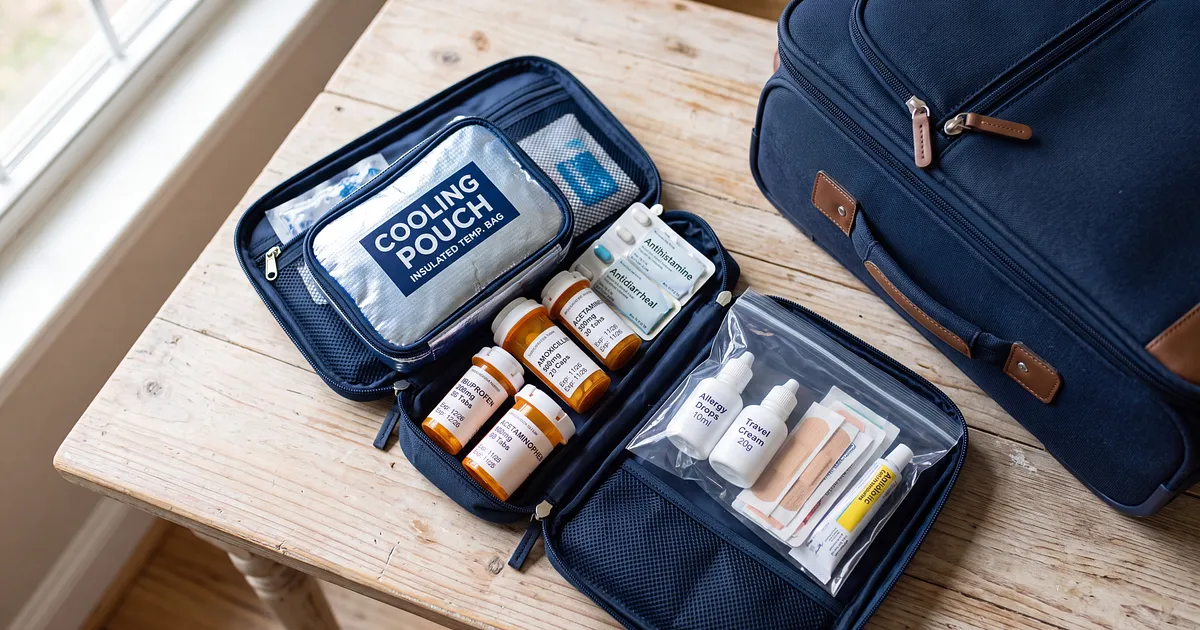
One more tip: the ADAC recommends packing 1.5 to 2 times the amount you expect to need. Flight delays happen. Connections get missed. A well-stocked travel medicine bag in your carry-on means you're covered for anything.
Medication in Carry-On: What Actually Happens at Security
This is the part that stresses people out. So here's what to expect when you bring medication in carry-on luggage through the flight security scanner.
Step 1: Pack your liquid medications and syringes in a separate transparent bag. Not your regular liquids bag. A separate one. This way security can see everything right away. If you want to know what else counts as liquid (toothpaste, deodorant, spreads), our liquids guide covers all the rules.
The Lermende Transparent Toiletry Bag, Liquid Bag, Hand Luggage, TSA Approved Cosmetic Bag works well for this. TSA-approved, transparent, and you don't have to dig through your suitcase when asked.
Step 2: Tell the security officer before your bag goes through the scanner. "I have liquid medication in my bag." Sounds basic, but it helps. Bottom line: travelers who arrive prepared are typically through in two minutes. Someone who shows up with an insulin pen and no documentation has a very different experience.
Step 3: Have your certificate or prescription ready. Since 2014, liquid medications at German airports are checked with special screening technology rather than confiscated.
Honestly? Security staff at European airports are generally well trained. As Dialetics reports, most personnel react professionally to medical equipment. Some are even curious about insulin pumps or CGM sensors. Problems mostly come from travelers who aren't prepared.
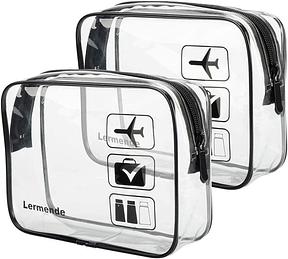
Lermende Transparent Toiletry Bag, Liquid Bag, Hand Luggage, TSA Approved Cosmetic Bag
View at Amazon (as of Aug 11)Affiliate link. Buying through it earns us a commission; the price stays the same for you.
Airline Comparison: Ryanair vs. easyJet vs. Eurowings vs. Lufthansa
The EU rule applies to every flight everywhere. But individual airlines still have different specifics for medication carry-on luggage, especially if you're flying with insulin or biologics. Knowing the Ryanair hand luggage rules before your flight helps you avoid unpleasant surprises at the gate.
| Ryanair | easyJet | Eurowings | Lufthansa | |
|---|---|---|---|---|
| Liquid medication over 100 ml | Yes | Yes | Yes | Yes |
| Doctor's letter for syringes | Recommended | Recommended | Recommended | Recommended |
| Pre-registration required? | No | No | No | No |
| Cooling service on board? | No | No | No | Yes (Tec4Med Cube) |
| Special note | Unlimited liquid medicine | Insulin always in carry-on | English certificate recommended | Free Tec4Med Cube |
easyJet explicitly recommends keeping insulin in carry-on luggage at all times. You'll find all the easyJet baggage rules in detail in our dedicated guide.
Lufthansa stands out here. They're the only major German airline that partners with Tec4Med. Their Cube cooling box (2 to 6 degrees, 60-hour battery) can be brought on board for free as carry-on. Every other airline? You're on your own for cooling.
Insulin, Biologics, and GLP-1: Transporting Temperature-Sensitive Medication
This is where most guides stop. But it affects millions of travelers.
Insulin needs to stay between 2 and 8 degrees Celsius. Biologics like Humira, Enbrel, or Cosentyx have the same requirement. And the increasingly popular GLP-1 medications (Ozempic, Wegovy, Mounjaro) too. In the cargo hold? Temperatures can drop below minus 20 degrees. That permanently destroys insulin and makes biologic syringes unusable.
So: always carry-on. Always with a cooling bag.
Which cooling bag? Depends on your trip. Here's the fast answer:
For short flights up to four hours, something compact works. The ACWOO Insulin Kühltasche, Insulin Pen kühltasche mit 2 Kühlakku, TSA Diabetiker Tasche für Insulin Pen, Diabetikerzubehör, Epipen, Spritzen, Insulin, Reisen Diabetikertasche is our budget pick. Small, light, TSA-approved, under 8 euros. Good enough for a weekend trip with one insulin pen.
Need more space or traveling longer? The ALLCAMP Insulin Kühltasche Kühlbox für Tragbarer Organizer Diabetiker Medikamente mit 4 Eisbeuteln, Isolierfutter und Stiftaufbewahrung comes with four ice packs, insulated lining, and compartments for pens plus accessories. Around 20 euros, solid value.
Then there's FRIO technology. The FRIO DOPPEL Diabetiker Insulin Kühltasche 18 x 8 cm Blau | Für bis zu 2 Insulin Pens | Kühlbeutel nur mit Wasser aktivierbar | Kein Eis, kein Kühlakku nötig works without ice, without cooling packs. You activate it with water, and it cools for up to 45 hours. Sounds unlikely, but it works. I heard about it from a diabetic traveler in an online forum who flew to Thailand with one. For long-haul flights or multi-day trips, it's probably the best option. It does cost around 30 euros though.
A good mid-range option is the YOUSHARES Insulin Kühltasche mit 2 Kühlakku - TSA Diabetiker Tasche für Diabetikerzubehör, Epipen, Spritzen, Insulin und andere Medikamente Zubehör, Medikamententasche Pen Kühlbox auf Reisen. TSA-approved, includes 2 ice packs, fits insulin pens, syringes, and epipens too.
One important detail about ice packs: if they're partially thawed (slushy, not fully frozen), they technically count as a liquid and fall under the 100 ml rule. Make sure your ice packs are completely frozen when you enter security.
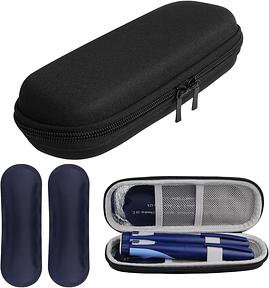
Affiliate link. Buying through it earns us a commission; the price stays the same for you.
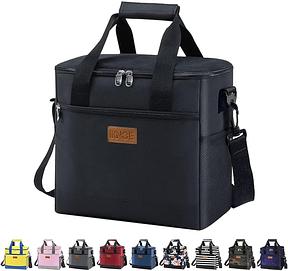
Not available in your region — closest match
View at Amazon (as of Aug 15)Affiliate link. Buying through it earns us a commission; the price stays the same for you.
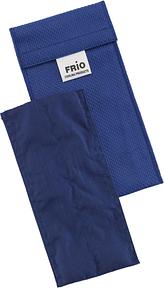
Affiliate link. Buying through it earns us a commission; the price stays the same for you.
Not available in your region — closest match
View at Amazon (as of Aug 15)Affiliate link. Buying through it earns us a commission; the price stays the same for you.
Controlled Substances and Non-Schengen Travel: When You Need the Official Form
This part matters a lot.
If you take medication classified as a controlled substance and want to carry it in your hand luggage on a flight, you need a special certificate for travel within the Schengen area. This covers strong opioids like oxycodone or fentanyl, certain sedatives, and ADHD medication like Ritalin.
The German Federal Institute for Drugs and Medical Devices (BfArM) provides the official form. It's valid for a maximum of 30 days and needs to be certified by your regional health authority. You need a separate certificate for each controlled substance.
Traveling outside the Schengen area? The form doesn't automatically apply.
Here's what many people don't realize: some medications that are legal in Germany, even available over the counter, can get you into serious trouble abroad. In the UAE, Ritalin cannot be imported even with a doctor's letter. In Singapore, certain painkillers that are prescription-free in Germany require a prescription. In Japan, some cold medicines containing pseudoephedrine are prohibited.
My advice: before traveling outside the Schengen area, contact the embassy of your destination country. It's extra work. But it's less work than dealing with customs authorities in a country where your medication is classified as an illegal substance.
The 5 Most Common Mistakes With Medication in Carry-On Luggage
Travelers who bring medication in carry-on luggage on a flight make the same mistakes surprisingly often. Here are the five I see most:
Putting medication in checked luggage. Petra did this (more at the start of this article). For temperature-sensitive meds, this can destroy them. For any medication, you also risk your bag getting lost in transit and ending up without your prescription.
Not bringing a doctor's certificate. You don't need one for basic OTC tablets. But for syringes in carry-on luggage on a flight, and for large quantities of prescription medication, a certificate saves a lot of explaining.
Not keeping medication in original packaging. Security needs to identify what you're carrying. Original packaging with the patient information leaflet is the easiest proof.
Bringing partially thawed ice packs. Once an ice pack isn't fully frozen, it's classified as a liquid. Then the 100 ml rule kicks in. Freeze them well in advance.
Not researching destination-specific rules. What's legal in Germany might be illegal somewhere else. This is especially true for opioids and ADHD medication. And keep in mind how expensive it can get at the gate when something in your carry-on doesn't pass.
All products from this post
The ones we named above are marked; the rest are alternatives in the same category.
Affiliate notice: As an Amazon Associate, we earn from qualifying purchases. Product prices and availability are subject to change.
Frequently Asked Questions
Can you bring medication in carry-on luggage on a flight?
Yes, and for temperature-sensitive medication like insulin, carry-on is the only safe option. Tablets with no limit, liquid medication exempt from the 100ml rule. Have a prescription or doctor's certificate ready so you don't get held up at security.
Do I need a doctor's certificate for medication on a flight?
Not for basic over-the-counter medication. For syringes in carry-on luggage, prescription drugs, and controlled substances, a doctor's certificate is strongly recommended. The ADAC offers a free multilingual template that covers most situations.
Does the 100 ml rule apply to liquid medication?
No. EU aviation security regulations explicitly exempt medication from the 100 ml liquid restriction. You need to be able to credibly demonstrate the medical need, for example with a prescription or doctor's letter.
How do I transport insulin in carry-on luggage on a flight?
Insulin must stay between 2 and 8 degrees Celsius. Use a cooling bag with frozen ice packs. Never put insulin in checked luggage, as cargo hold temperatures can destroy it. Have your doctor's letter ready and show insulin pens separately at security.
Can airport X-ray scanners damage medication?
No. The X-ray radiation at airport security checkpoints is too weak to damage medication. However, insulin pumps and CGM sensors should not go through the scanner and should be inspected manually instead.
What happens if I have syringes in my carry-on?
Security staff will ask about them. Show your doctor's certificate and briefly explain what the syringes are for. In most cases, this goes smoothly. Proactively telling staff before your bag goes through the scanner speeds up the process.
How much medication can I bring in carry-on luggage?
There is no upper limit for personal medical needs during your trip. The ADAC recommends packing 1.5 to 2 times the expected amount as a buffer. For controlled substances within the Schengen area, the BfArM's 30-day rule applies.
Whether it's tablets, insulin pens, or liquid medication: everything belongs in carry-on luggage, not in the aircraft cargo hold. With the right preparation, you'll get through security without stress. Still have questions about your specific medications or a partic...
Sources
- EU travel regulations (Your Europe) europa.eu
- ADAC offers a free certificate template adac.de
- ADAC recommends adac.de
- Dialetics reports dialetics.com
- Unlimited liquid medicine help.ryanair.com
- Insulin always in carry-on easyjet.com
- English certificate recommended eurowings.com
- Free Tec4Med Cube lufthansa.com
- permanently destroys insulin internisten-im-netz.de
- German Federal Institute for Drugs and Medical Devices (BfArM) bfarm.de