Power Banks on Planes 2026: Every Airline Rule and the Best Models for Travelers
 16 min read
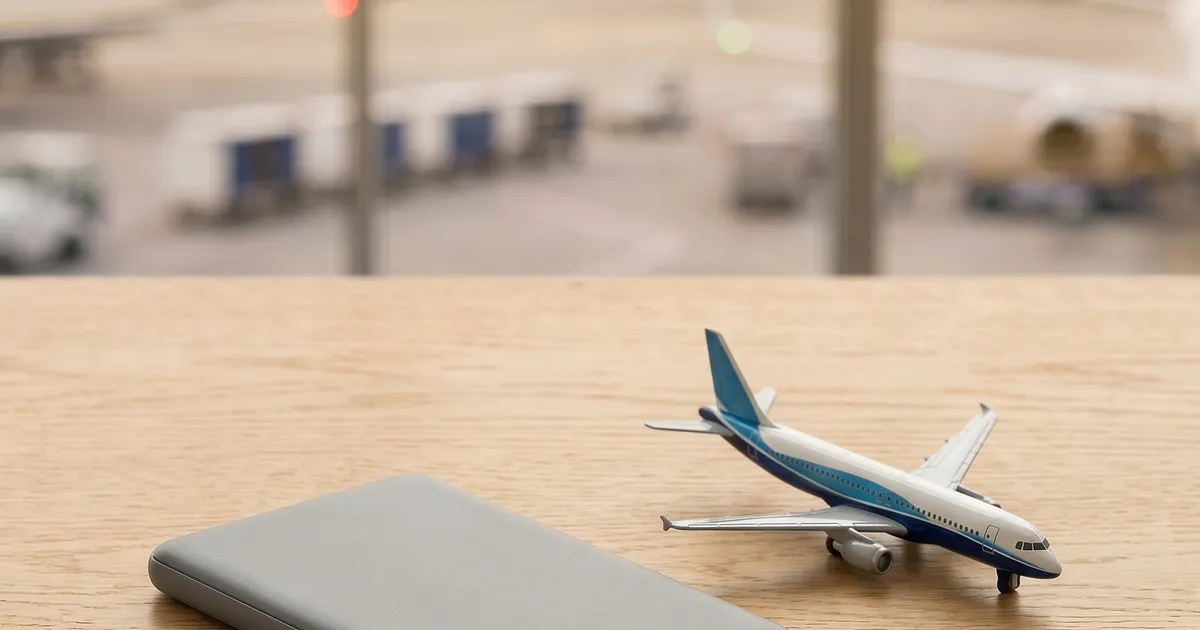
On 28 January 2025, an Air Busan Airbus A321 burned out completely at Gimhae Airport. 170 passengers, six crew, evacuation slides, chaos. The suspected cause was a single power bank in the overhead bin: the unit overheated, thermal runaway as engineers call it, and within minutes the aircraft was beyond saving. Aero.de covered it in detail.
Since then, the rules for power banks on planes have changed more than in the previous decade — and unevenly enough that the important question in 2026 is no longer whether you can bring one. It is whether you are allowed to touch it once the door closes. That answer depends on your airline, and the gap between carriers is wider than most travelers realise.
This guide settles it, airline by airline, with a source and a date attached to every figure.
The base rule: power banks belong in your carry-on
Before the detail, the one thing that never changes: your power bank may travel only in carry-on baggage. Full stop.
In checked luggage it is prohibited. Every airline, worldwide, no exceptions. The IATA mandates it and airport security enforces it. If a power bank turns up in your suitcase during baggage screening, it gets confiscated — and your bag can be pulled from the flight and follow on a later one.
Why so strict? If a lithium battery ignites in the cabin, the crew can act immediately. In the cargo hold, nobody notices in time. The Air Busan fire in January 2025 is the case study.
It is also one more reason the carry-on-only strategy pays off for a lot of travelers. Power bank included, at no extra cost.
What changed in 2026: the new ICAO rules
On 27 March 2026, the first globally harmonised power bank rules came into force, set by the ICAO for all 193 member states. Two things are new:
- A maximum of two power banks per passenger. No more.
- Passengers may not recharge a power bank during the flight.
Point 2 gets misreported constantly, so to be precise: the ICAO standard bans recharging the power bank itself on board — plugging it into the seat outlet. Whether you may use it to charge your phone is something each airline regulates on top of that, and that is exactly where carriers diverged in 2026.
Why now? The numbers make the case. The FAA recorded 89 lithium battery incidents on board in 2024, 16 percent more than the year before. Across five years, such incidents rose 15 percent, as documented by UL Standards & Engagement. On average it happens somewhere in the world twice a week.
Which power bank is allowed: converting mAh to Wh
This is where it gets confusing, because your power bank is almost certainly labelled in mAh while airlines think in Wh (watt-hours). The formula is simple:
mAh × volts ÷ 1000 = Wh
Most power banks use lithium cells at 3.7 volts, which gives:
| Capacity | Wh (at 3.7 V) | Allowed? |
|---|---|---|
| 5,000 mAh | ~18.5 Wh | Yes, no approval needed |
| 10,000 mAh | ~37 Wh | Yes, no approval needed |
| 20,000 mAh | ~74 Wh | Yes, no approval needed |
| 26,800 mAh | ~99 Wh | Yes (just under 100 Wh) |
| 27,000 mAh | ~100 Wh | Borderline, check the printed rating |
| 30,000 mAh | ~111 Wh | Airline approval required |
| 50,000 mAh | ~185 Wh | Prohibited outright |
The threshold that matters: 100 Wh. Below it you need no approval. Between 100 Wh and 160 Wh you must clear it with your airline in advance — with the Lufthansa Group that runs through the Service Center and has to be registered when you book. Above 160 Wh the power bank cannot fly at all.
So what decides whether a power bank is allowed on a plane is the Wh figure, not the mAh number on the box. The part travelers routinely get wrong: a 20,000 mAh power bank sounds enormous but is only 74 Wh, and is fine on any flight.
Tip: check the back of your unit. Decent brands like INIU, Baseus and Anker print the Wh value directly on the casing. If nothing is printed, security can confiscate it, because they have no way to verify the rating. When buying, make sure the figure is on the device, not just the packaging.
Power banks on planes: 2026 airline rules compared
Here is the core of it, because "can I bring it?" and "can I use it?" are two completely different questions in 2026.
| Airline | Max Wh | Max units | Charge a device with it | Recharge the power bank | In the overhead bin | In checked bags |
|---|---|---|---|---|---|---|
| Lufthansa | 100 Wh (160 Wh with approval) | 2 | Prohibited | Prohibited | Prohibited | Prohibited |
| Eurowings | 100 Wh (160 Wh with approval) | 2 | Prohibited | Prohibited | Prohibited | Prohibited |
| SWISS | 100 Wh (160 Wh with approval) | 2 | Prohibited | Prohibited | Prohibited | Prohibited |
| Austrian | 100 Wh (160 Wh with approval) | 2 | Prohibited | Prohibited | Prohibited | Prohibited |
| Brussels Airlines | 100 Wh (160 Wh with approval) | 2 | Prohibited | Prohibited | Prohibited | Prohibited |
| easyJet | 160 Wh | 2 | Prohibited | Prohibited | Allowed, not recommended | Prohibited |
| Ryanair | 100 Wh | 2 | Allowed, except taxi/take-off/landing | Prohibited | Prohibited | Prohibited |
| Wizz Air | 100 Wh | 2 | Prohibited | Prohibited | Allowed, not recommended | Prohibited |
As of August 2026, taken from each airline's own pages (sources below). Subject to change. For 100–160 Wh, always get approval first.
Lufthansa Group: use ban since 15 January 2026
Since 15 January 2026, passengers on Lufthansa, Eurowings, SWISS, Austrian and Brussels Airlines may neither use nor recharge a power bank on board. Carriage is capped at two units per person. Documented by Lufthansa, Eurowings and the SWISS newsroom.
Bring it, yes. Use it, no.
One rule in that package gets missed constantly: the Lufthansa Group does not allow power banks in the overhead bin. It has to stay under the seat in front of you, in the seat pocket, on your person, or in a jacket pocket. The logic is the same as the checked-baggage ban: what you cannot see, you cannot extinguish.
One exception: battery-powered medical devices, which must be declared to the airline in advance.
easyJet: use prohibited entirely
This is the rule most often stated incorrectly online, including in older guides. easyJet's own dangerous goods page is unambiguous: "Power banks are prohibited from use on easyJet aircraft and must not be used to charge other devices."
So: no topping up your phone from a power bank, in any phase of flight. Beyond that, a maximum of two per customer, up to 160 Wh, and each unit must be individually protected — original retail packaging or a plastic bag. easyJet also recommends keeping it on your person where you can monitor it.
Ryanair: use allowed, recharging not
Ryanair is the one carrier in this comparison where you can still charge your phone from a power bank during cruise. The conditions, per the Ryanair Help Centre:
A maximum of two power banks per passenger (counted within an overall limit of 20 spare batteries — that 20 covers spare batteries in general, not power banks)
The power bank itself may not be recharged on board at any time
Charging devices is permitted, except during taxi, take-off and landing or when the crew says otherwise
It must be kept on your person or in the under-seat cabin bag, not in the overhead locker
The widely repeated claim that "Ryanair allows 20 power banks" comes from confusing it with that spare-battery limit. The two-unit cap applies at Ryanair as well.
How long use stays permitted is anyone's guess. The ICAO standard pushes the other way and pressure on carriers is building. If you fly Ryanair, it is worth knowing what else gets checked at the gate — those fees are substantial.
Wizz Air: use prohibited
Wizz Air states in its help centre that power banks may not be charged, nor used to charge another device, during all phases of flight. Carrying one in your cabin bag is fine; using it is not.
Why the overhead bin is the wrong place
At the Lufthansa Group and Ryanair it is explicitly banned. But even where it is still permitted, the closed bin above you is the worst available spot. The Australian Transport Safety Bureau ATSB explicitly recommends keeping power banks within easy reach.
The reason is a specific incident. On 21 July 2025, a power bank caught fire in the overhead bin above row 7 on a Virgin Australia flight from Sydney to Hobart. White smoke first, then flames. The crew put it out — but only because they could get to it fast.
Inside a closed bin, everything takes longer. With lithium batteries, seconds count.
The practical takeaway: seat pocket or jacket pocket, not a backpack in the bin. If something happens, you want to reach it immediately. If in-flight comfort is your concern more broadly, our guide to compression socks on long-haul covers what is actually evidence-backed.
Power bank rules outside Europe
The 100 Wh threshold applies worldwide, but on-board usage rules vary by region.
United States (FAA rules): the FAA follows the ICAO standard. Under 100 Wh permitted in carry-on, prohibited in checked bags. Whether and how you may charge on board is set by the individual US carrier — check their page before you fly.
Asia: South Korea was among the first countries to add its own rules after the Air Busan incident: power banks must be kept accessible, not in the overhead bin. Japan and Singapore largely follow the ICAO standard. China applies stricter requirements for certain battery sizes.
Middle East: Emirates, Qatar Airways and Etihad follow the IATA standard. The on-board usage detail is changing frequently at the moment.
In short: flying outside Europe, check the specific airline's own page first. The base rules (carry-on, under 100 Wh, never checked) hold everywhere. Everything else can differ.
The best flight-safe power banks for 2026
The models below all sit under 100 Wh, so they are permitted on any flight without approval. Beyond capacity and charging speed, the selection criterion was one specific thing: the Wh rating is printed clearly on the casing, not just on the box. That is precisely where most power banks fail at security.
Compact and cheap: 10,000 mAh (~37 Wh)
The INIU Power Bank, Kleiner 45W Schnellladen 10000mAh Powerbank mit Abnehmbar USB C Kabel, Flugtauglich & Reise-Essential, Externe Handyakkus is the obvious pick for short-haul. 10,000 mAh covers roughly one full smartphone charge, and 45 W fast charging makes it quick. At around EUR 24 it is the cheapest entry point with a clean printed rating.
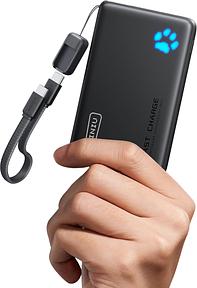
Affiliate link. Buying through it earns us a commission; the price stays the same for you.
More capacity for long-haul: 20,000 mAh (~74 Wh)
If you need to keep several devices alive on a long-haul flight, you need more capacity — and you should know that on Lufthansa, easyJet and Wizz Air you will not be allowed to draw from it on board. Charging everything beforehand is half the battle. For more on what actually helps on long flights, see our guide to sleeping on a plane.
The Power Bank, 22.5W Mini PowerBank 20000mAh (USB-C Input & Output), PD 3.0 QC 3.0 Externe Handyakkus mit LED Display, Kompatibel mit iPhone 17 16 15 14 13 12 Pro Max und mehr offers 20,000 mAh for around EUR 21. USB-C, LED display, solid ratings. Enough for occasional travelers.
A step up: the Baseus QPow3 Powerbank 45W 20000mAh mit 2 integriertem USB-C Kabel, Power Bank PD3.0 QC4.0, 3 USB C und 1 USB A, LED Display Schnellladefunktion für iPhone 17/16/15 Pro Max, iPad, Galaxy, Schwarz with 45 W, 20,000 mAh and two integrated USB-C cables. No separate cable to hunt for, which genuinely matters when traveling. Around EUR 32.
Not available in your region — closest match
View at Amazon (as of Aug 15)Affiliate link. Buying through it earns us a commission; the price stays the same for you.
Not available in your region — closest match
View at Amazon (as of Aug 15)Affiliate link. Buying through it earns us a commission; the price stays the same for you.
Ultra-compact for iPhone users: MagSafe 5,000 mAh (~18.5 Wh)
If you carry an iPhone and only need an emergency top-up, the Baseus Mini MagSafe Powerbank 5000mAh Qi2-zertifiziertes mit Klappbarer Ständer, PD 20W Magnetische Power Bank USB C Wireless Powerbank Kompatibel mit iPhone 17/16/15/14/13/12/Pro/Pro Max Serie, Grau is the most convenient option: 5,000 mAh, MagSafe-compatible, with a fold-out stand. At around EUR 34 you are mostly paying for convenience — snap it onto the back of the phone and you are done. No cable, fits any pocket.
For a broader look at what electronics earn their place in your bag, see our roundup of airplane travel essentials.
Not available in your region — closest match
View at Amazon (as of Aug 15)Affiliate link. Buying through it earns us a commission; the price stays the same for you.
The five most common power bank mistakes at the airport
1. Power bank in checked luggage. The classic. Security spots lithium batteries on the X-ray, the bag gets opened, and in the worst case it misses the flight.
2. An unreadable capacity rating. If the printed figure is worn off or missing, security may confiscate the unit — they simply cannot verify it.
3. Charging on an airline that has banned it. The most common new mistake of 2026, because the Lufthansa Group, easyJet and Wizz Air all changed their rules recently. Nothing dramatic happens, but the crew will stop you.
4. Stowing it in the overhead bin. Explicitly prohibited at the Lufthansa Group and Ryanair, and a bad idea everywhere else.
5. Traveling with a damaged unit. Swollen, deformed or visibly damaged: no airline will accept it. Dispose of it at a recycling point, not in household waste.
What to do if the power bank is already in your suitcase
If you notice at the desk or the gate, tell ground staff before the bag disappears into the system. In most cases the bag is reopened and the power bank removed — you get it back. It can take time, though, so say so directly if your connection is tight.
Once the bag is through and the power bank is found during screening, it is out of your hands: it gets removed, and in the worst case the bag is not loaded.
The simplest protection is a fixed habit: the power bank always goes in the same place in your cabin bag, alongside your passport or boarding pass. For what else earns a spot, see our carry-on packing list.
What happens if your power bank is confiscated
If your power bank is judged non-compliant at the airport (too large, no Wh rating, damaged), here is what follows:
It is confiscated. You will not get it back.
There is no compensation.
Some airports (Frankfurt and Munich among them) run a postal service you can use to mail the device home. That costs extra and takes time.
Swollen or visibly damaged units are removed immediately, without discussion.
Prevention takes ten seconds: before you fly, check that the Wh rating on the casing is legible. If it is not, the unit has effectively become unusable for air travel — a sticker with figures you wrote yourself is not evidence security has to accept.
In short: carry-on, never checked. Under 100 Wh and you are safe on any flight. Two units maximum. And before you plug anything in on board, check whether your airline still permits it at all — on Lufthansa, easyJet and Wizz Air, the 2026 answer is no.
All products from this post
The ones we named above are marked; the rest are alternatives in the same category.
Not available in your region — closest match
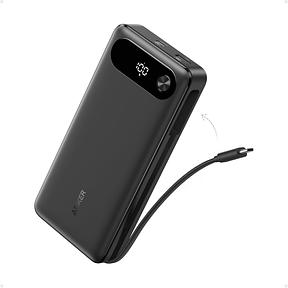
Anker Powerbank, 20.000mAh tragbares Ladegerät mit integriertem USB-C-Kabel, 87W Max Schnellladung, kompatibel mit MacBook, iPhone, Samsung und mehr
View at Amazon (as of Aug 15)
Not available in your region — closest match
Anker Powerbank, 20.000mAh tragbares Ladegerät mit integriertem USB-C-Kabel, 87W Max Schnellladung, kompatibel mit MacBook, iPhone, Samsung und mehr
View at Amazon (as of Aug 15)
Not available in your region — closest match
Anker Powerbank, 20.000mAh tragbares Ladegerät mit integriertem USB-C-Kabel, 87W Max Schnellladung, kompatibel mit MacBook, iPhone, Samsung und mehr
View at Amazon (as of Aug 15)Affiliate notice: As an Amazon Associate, we earn from qualifying purchases. Product prices and availability are subject to change.
Frequently Asked Questions
Which power bank is allowed on a plane, and what mAh limit applies in 2026?
There is no fixed mAh limit. What counts is the Wh rating. Up to 100 Wh a power bank is allowed on a plane without approval, which at 3.7 volts is roughly 27,000 mAh. A 20,000 mAh unit is only 74 Wh and is fine on any flight. Between 100 Wh and 160 Wh you need approval from the airline.
Can I put a power bank in checked luggage?
No. Power banks are prohibited in checked baggage worldwide, on every airline, without exception. If one is found in your suitcase it will be confiscated and your bag can be pulled from the flight.
Can I use my power bank on a Lufthansa flight?
No. Since 15 January 2026, using or recharging a power bank is prohibited on all Lufthansa Group flights, covering Lufthansa, Eurowings, SWISS, Austrian and Brussels Airlines. You may still carry it in your cabin bag, but not in the overhead bin.
Which airlines still let me charge my phone from a power bank in flight?
Among the major European carriers, as of August 2026 only Ryanair — and not during taxi, take-off or landing. The Lufthansa Group, easyJet and Wizz Air have banned on-board use outright. Recharging the power bank itself is prohibited at all four.
How many power banks can I bring?
Since 27 March 2026 the ICAO standard applies internationally: a maximum of two power banks per passenger, in carry-on. The Lufthansa Group, easyJet, Ryanair and Wizz Air each apply the same two-unit cap.
What if there is no Wh rating on my power bank?
Without a legible Wh or mAh marking, security can confiscate the unit because they cannot verify its capacity. A sticker you write yourself does not substitute for the manufacturer's printed rating. Check before you fly, and when buying a new one, make sure the figure is on the casing.
Can I bring a damaged or swollen power bank on a plane?
No. Damaged, swollen or visibly defective power banks are removed at security immediately. A swollen cell is a sign the battery is close to failing.
*All airline details as of August 2026, verified against each airline's own pages.*
Sources
- Aero.de covered it in detail aero.de
- IATA iata.org
- ICAO icao.int
- FAA faa.gov
- UL Standards & Engagement ulse.org
- Lufthansa lufthansa.com
- Eurowings eurowings.com
- SWISS newsroom newsroom.swiss.com
- dangerous goods page easyjet.com
- Ryanair Help Centre help.ryanair.com
- help centre wizzair.com
- ATSB atsb.gov.au