Baby Packing List for Flying 2026: What Has to Get Through Security and the Gate
 17 min read
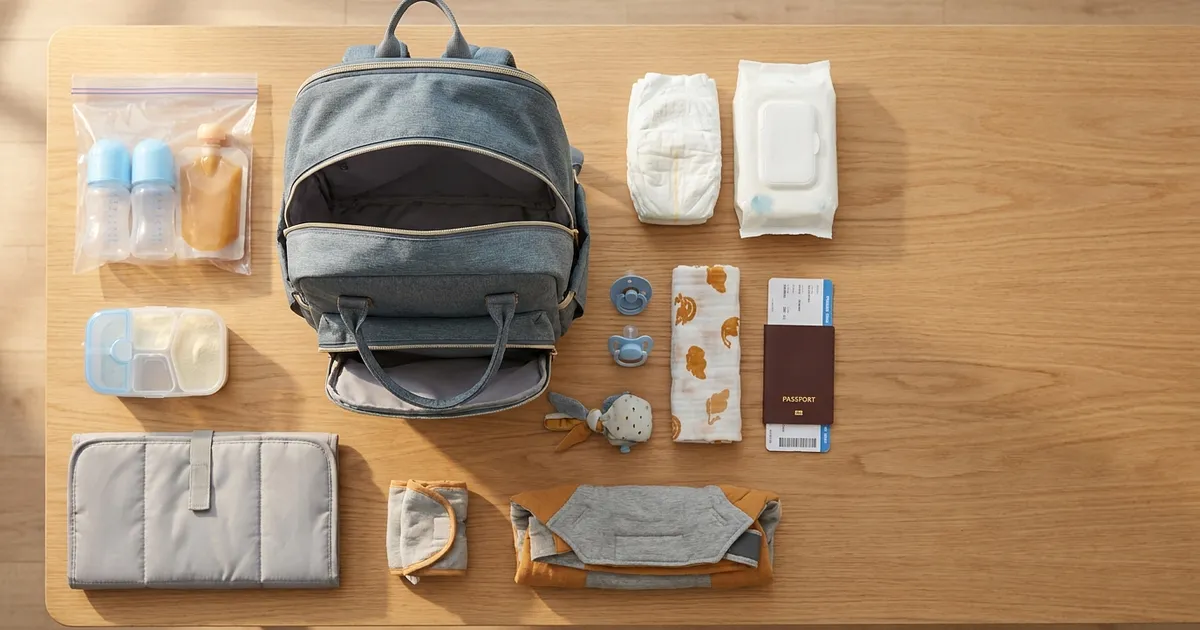
You've probably got a vacation packing list for the baby already. Sun hat, onesies, swim diapers, the favorite cuddly toy. The airport doesn't care about any of it. It cares about other things. Can the full bottle go through security? Does the diaper bag count as hand luggage? Where do you hand over the stroller? And how many diapers do you need if the departure slips by a couple of hours?
That's the part this post covers. A good baby packing list for flying only has to plan the stretch between your front door and the baggage belt: security, the gate, the cabin and the airline rules in between. Everything else goes in the suitcase like it always does.
You're not the only one asking, either. In a Little Travel Society survey of 942 traveling families (November 2025), 53 percent said they travel with babies or toddlers. It isn't a representative sample, since respondents came from the community's own followers. As a snapshot, though, it holds up.
When can babies fly?
You'll get two answers here, and they don't quite line up. Airlines set their own minimum age in their conditions of carriage, and it often kicks in much earlier than the medical advice. The German association of pediatricians (BVKJ), as reported by Deutsches Ärzteblatt, advises against flying with infants before the 4th to 6th week of life except in exceptional cases.
The association's reasoning: a baby's lungs may not be fully developed in those first weeks, and oxygen saturation in the cabin is lower than on the ground.
Our take? The airline answers the question of who it will carry. Your pediatrician answers what's good for your child. Those are different questions, and if you're unsure, a quick appointment before you book is probably the best half hour you'll spend on this trip. Your airline's exact minimum age is in its terms and can vary by route. Still pregnant and planning the last trip before the birth? Our flying while pregnant guide covers the deadlines and airline rules for that stage.
Stroller on a plane: checked bag or hand luggage?
Usually neither. On all five major airlines whose rules we compared, a stroller travels as a free extra in the hold and doesn't count against your baggage allowance. The differences are in how many items you can bring, where you hand them over, and how much hand luggage the baby gets.
Search for stroller rules and you'll end up on five different help pages using five different words for the same thing. So here's everything side by side:
| Airline | Stroller & car seat | Checked baggage for the baby | Hand luggage for the baby | Advance notice needed? |
|---|---|---|---|---|
| Lufthansa | one stroller, car seat or baby carrier free; bulky models go through the special baggage counter | usually included, depending on fare | no information found | no information found |
| Eurowings | up to two items per child up to age 11 free (stroller, buggy, travel cot, car seat), usually handed over at the gate | depends on the fare booked | lap infant on a Basic fare: small extra bag up to 40×30×25cm under the seat | no information found |
| Ryanair | two items of baby equipment free, such as a pushchair plus car seat; tagged at bag drop or the gate | no information found | baby bag up to 5kg (45×35×20cm), but no cabin bag of its own | no information found |
| Condor | stroller, buggy, travel cot, baby carrier and car seat free in the hold | under 2: up to 10kg checked baggage | no hand luggage of its own; baby food and medication allowed on top within the EU | no |
| TUI fly | stroller and buggy free in the hold, usable until boarding | Pure fare: none, Perfect fare: 20kg | no hand luggage of its own under 2, diaper bag allowed on top | no |
As of September 2026, based on the linked airline pages, no guarantee of accuracy. Fare conditions tend to change quietly, so it's worth checking the airline's page right before you book. "No information found" just means we couldn't find anything reliable in the public info. It doesn't mean there's no rule.
One thing that stood out in the comparison: on strollers, Ryanair is more generous than its reputation. On hand luggage for the baby, not so much. For more models, costs and airline details, see our full guide to strollers and travel buggies on a plane.
Gate, check-in desk or baggage belt?
Most airlines take the stroller at the gate, so you can push it through the whole terminal. Lufthansa sends bulky models to the special baggage counter instead. And TUI fly says you'll get the stroller back either at the gate or at the baggage belt.
That last one catches people out. (Baggage belts are surprisingly long when you've got a sleeping baby on one arm and two bags on your shoulder. Honestly, a baby carrier in your hand luggage is the best idea we know of for exactly that moment.)
A light travel buggy makes the whole gate routine less stressful, since it folds fast and takes up little space. One example is hauck federleichter Reisebuggy 5,9 kg schnell klappbar, Sport Blue, which weighs 5.9 kg according to the manufacturer's listing and folds quickly. With roughly 14,600 Amazon reviews it sits at 4.0 out of 5 stars (as of September 2026), solid, not spectacular. Whether a buggy suits your baby yet depends on the manufacturer's age rating; plenty of travel buggies aren't meant for newborns.
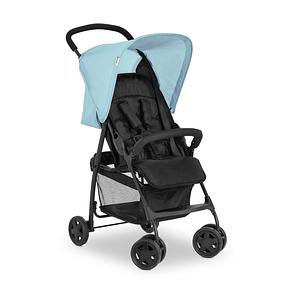
hauck federleichter Reisebuggy 5,9 kg schnell klappbar, Sport Blue
View at Amazon (as of Oct 02)Affiliate link. Buying through it earns us a commission; the price stays the same for you.
Lap infant, own seat or bassinet?
In Europe, babies under two usually fly as lap infants without a seat of their own (that's how Ryanair and Condor define it, for example). Even then, your child is listed as a separate passenger on the booking. Ryanair's rules add one more condition: one infant per adult, and the adult has to be at least 18.
A car seat only comes to your row if you've booked the baby a seat of its own and the airline accepts that model. Otherwise it flies free in the hold, see the table.
On long-haul routes some airlines offer a bassinet that clips onto the bulkhead in front of the first row. Depending on the airline it's called a bassinet or a skycot. There are only a few per flight, they come with weight and size limits, and you have to request one in advance. Ask early.
Baby food on a plane: what gets through security?
Baby food, milk and medication you need during the journey can go into your hand luggage in quantities above 100 ml. Germany's Federal Police and the European Commission both confirm this. That doesn't make the exemption unlimited.
For regular liquids, Germany's Federal Police sets a maximum of 100 ml per container, and all containers together have to fit into one resealable 1-liter clear bag. Special food such as baby food, and medication you need for the duration of the trip, are exempt from that limit.
It's the same at EU level. The European Commission's Your Europe portal puts it plainly: the quantity restriction doesn't apply to medication and baby food. So this isn't a German quirk. It applies at every EU airport. For how the regular 100 ml rule works for everything else, see our carry-on liquids guide.
Now for the catch hardly anyone mentions. The exemption lifts the 100 ml cap, but it's not a free pass for any amount you like. "For the duration of the trip" means exactly that. A week's worth of baby food jars for a short-haul flight? Expect questions. Parents on forums also report, again and again, that security takes a closer look at a bottle or asks them to taste the milk. Annoying, but it's a normal part of the check.
What saves time at security:
Everything for the baby goes in its own pouch, right at the top of your bag. You pull it out first, before anyone asks.
Formula powder isn't a liquid, so the 100 ml rule doesn't apply to it. Pre-portioned in a formula dispenser, it still moves faster than an opened tub.
Expressed breast milk and ready-made formula fall under the same exemption as baby food.
Water for mixing is a gray area. Whether boiled water counts as part of the baby food is up to the security staff on the day, and we wouldn't count on it. You can buy water once you're through.
Warming bottles on the go
Warm milk on board is a mixed bag. Whether the crew hands out hot water varies from airline to airline, so it's best to ask when you board.
If you'd rather be independent, take a portable bottle warmer, such as Momcozy Flaschenwärmer Baby unterwegs, schnell erwärmen. Portable warmers like this one usually run on a rechargeable battery, so it's best packed in your hand luggage. Airlines don't like lithium batteries in the hold, and you'll want the thing on board anyway. To be honest, a warmer like this isn't cheap, and the reviews on Amazon (4.1 out of 5 stars, as of September 2026) are more mixed than for the other products in this article. For plenty of families, a good thermos of hot water does the job just as well.
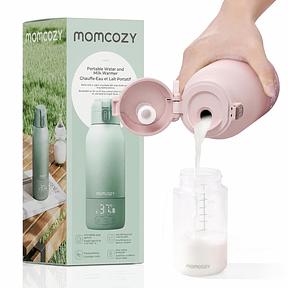
Momcozy Flaschenwärmer Baby unterwegs, schnell erwärmen
View at AmazonAffiliate link. Buying through it earns us a commission; the price stays the same for you.
Baby carry-on: what goes in the diaper bag?
The diaper bag holds everything you'll need to get your hands on between security and arrival. On TUI fly it's allowed on top of your own hand luggage, according to the airline, and Ryanair permits a baby bag up to 5kg (45×35×20cm). For other airlines, it's worth checking size and weight beforehand.
Here's exactly what belongs in the baby packing list for flying when it comes to hand luggage. Sorted by situation rather than category, because that's how you think at an airport.
Within reach for security
baby food, milk and bottles in their own pouch
the baby's medication, ideally with the leaflet (we've rounded up the full rules on medication in carry-on luggage separately)
passport or child passport, plus the baby's boarding pass
the baby carrier (remember the baggage belt)
For changes on the go
diapers, using the formula in the next section
one pack of wet wipes, no more
a changing mat
a few bags for dirty diapers. Sounds obvious, gets forgotten surprisingly often.
diaper cream in travel size, because skincare doesn't count as baby food and falls under the normal 100 ml rule
For take-off, landing and the hours in between
a pacifier plus a spare, since the first one will end up under the seat in front
burp cloths, better one too many
a thin wrap or light blanket, as cabins are often chilly
one or two toys that don't make noise
And for you? A spare T-shirt. Seriously. After the first spit-up, you'll know why.
A backpack works better as a diaper bag than a shoulder bag, because it leaves both hands free. The RUVALINO Baby Wickelrucksack Wickeltasche Rucksack mit tragbarer Wickelauflage, Schnullerhalter und Kinderwagengurten, Babytasche Multifunktional für Mama und Papa, Schwarz comes with a changing pad, a pacifier holder and stroller straps built in. More than 20,000 Amazon reviews and 4.7 out of 5 stars (as of September 2026) speak for themselves. Whether it fits Ryanair's 45×35×20cm depends on how full you stuff it. Worth a look at the dimensions in the product listing.
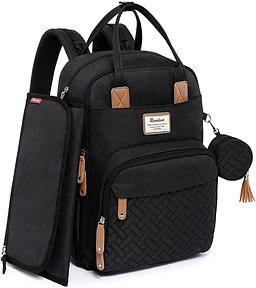
Affiliate link. Buying through it earns us a commission; the price stays the same for you.
How many diapers per flight hour?
Don't count flight time. Count your total door-to-door travel time. Our rule of thumb: one diaper for every two hours of travel (or part of it), plus three spares. That's on the generous side, and that's the whole point.
The flight itself is often the shorter part. Getting to the airport, check-in, security, waiting at the gate, taxiing, the baggage belt, the transfer. It adds up. Delays aren't in any timetable. And since we write quite a lot about lost luggage at Kofferly, here's one thought most baby packing lists for flying miss: if your suitcase doesn't turn up, the diaper bag has to get you through the first night on its own.
The formula (our own rule of thumb, not an official guideline):
Diapers = travel time in hours ÷ 2, rounded up, + 3 spares
Outfits for the baby = travel time in hours ÷ 6, rounded up, + 1
| Route | assumed door-to-door travel time | Diapers | Outfits for the baby |
|---|---|---|---|
| Short-haul, up to about 2 hrs flight | 6 hrs | 6 | 2 |
| Medium-haul, about 3 to 5 hrs flight | 9 hrs | 8 | 3 |
| Long-haul, about 10 hrs flight | 16 hrs | 11 | 4 |
The travel times in the table are example assumptions, not measurements. Plug in your own. With a newborn who goes through diapers fast, feel free to add two more. They weigh next to nothing.
One more word on changing on board. The fold-down changing tables in aircraft toilets are often tiny, and not every toilet has one. A foldable mat of your own, like Bambino Mio Wickelunterlage für unterwegs - Leichte, faltbare und tragbare Wickelunterlage, Kleine Gärtner, is more hygienic than the bare table and fits into any side pocket when folded. More than 1,800 Amazon reviews and 4.7 out of 5 stars (as of September 2026) are a good sign it holds up to daily use.
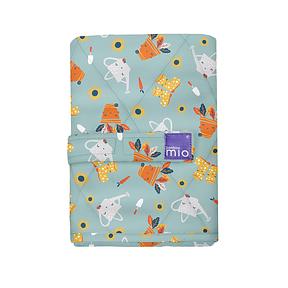
Affiliate link. Buying through it earns us a commission; the price stays the same for you.
What shouldn't you pack when flying with a baby?
Anything heavy, breakable or likely to hold up security. Most baby packing lists for flying only tell you what goes in. You'll save at least as much hassle with what stays out.
A week's supply of glass baby food jars. Heavy, breakable, and the exemption doesn't stretch beyond what you need "for the duration of the trip." Buy the rest when you arrive.
Your whole vacation stock of wet wipes. One pack covers the flight.
Formula in an opened original tub, since pre-portioned containers get through security faster.
The full-size travel-system stroller when a buggy would do. Lufthansa sends bulky models to the special baggage counter rather than the gate.
Those are the classics. The next few come up less often, but they cost just as much time or patience:
Full-size creams and lotions. Skincare isn't baby food, so the normal 100 ml rule applies.
Toys with music, flashing lights or lots of small parts. The people around you will thank you, and you'll never find the bits under the seat anyway.
Loose stroller accessories like sunshades, cup holders or rain covers. They tend to go missing in the hold, so take them off before handing the stroller over and stick them in your bag.
A car seat as hand luggage when you haven't booked the baby its own seat. You usually can't use it in the cabin then, so it belongs in the hold.
Ear pressure: what helps a baby during take-off and landing?
Sucking and swallowing. The ADAC, Germany's largest motoring and travel club, recommends letting babies breastfeed, drink from a bottle or suck on a pacifier during take-off and landing, because active swallowing helps equalize the pressure in the ear. That's usually all it takes.
The exception matters more. A child with an acute middle ear infection shouldn't fly, according to the ADAC, because of the risk of a painful barotrauma. Sounds dramatic. It's also exactly the situation where a call to your pediatrician before departure pays off.
A small timing tip: don't let the bottle get finished during boarding. The descent starts well before touchdown, and that's when you'll still want a few sips left.
And those pressure-relief earplugs you see everywhere? We wouldn't use them for babies, since sucking works better. For older siblings, though, earplugs like EarPlanes Kinder - Ohrstöpsel zum Druckausgleich im Flugzeug, 2 Stück can make sense. The manufacturer's minimum age is in the product description, so it's worth checking before you buy.
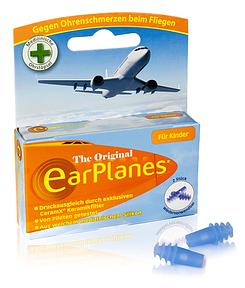
EarPlanes Kinder - Ohrstöpsel zum Druckausgleich im Flugzeug, 2 Stück
View at AmazonAffiliate link. Buying through it earns us a commission; the price stays the same for you.
Baby Packing List for Flying: Order Beats Perfection
The most tiring part of flying with a baby is rarely the flight itself. It's those minutes at security when the bottle is at the very bottom of the backpack, and the moment at the gate when you're not sure where the stroller goes. If the baby things are on top and you know your airline's rules, you've done most of the work on your baby packing list for flying. Once your baby grows out of this stage and starts traveling with an older sibling, our field report Flying with Kids: How to Beat the Luggage Chaos with 2 Children shows how to organize the baggage chaos with two kids.
Bookmark this page and check your airline's site again a week before departure. The table above is as of September 2026, and airlines tweak their fares more often than anyone would like. Spot a rule that's changed? Let us know and we'll update the list.
And if the baby cries anyway: most people on the plane are more understanding than it feels in that moment.
All products from this post
The ones we named above are marked; the rest are alternatives in the same category.
Affiliate notice: As an Amazon Associate, we earn from qualifying purchases. Product prices and availability are subject to change.
Frequently Asked Questions
How much baby food can I take in my hand luggage?
Baby food, milk and expressed breast milk are exempt from the 100 ml liquids rule, according to Germany's Federal Police and the European Commission, as long as you need them for the duration of the trip. There's no fixed upper limit, but the amount should match your travel time. Expect security to ask questions or check individual containers more closely.
Does a stroller count towards the baggage allowance?
No. On Lufthansa, Eurowings, Ryanair, Condor and TUI fly, a stroller travels free on top of your baggage allowance according to the airlines' rules (as of September 2026). The differences are in how many items are allowed and where you hand them over. Eurowings and Ryanair, for example, allow two items of baby equipment, usually handed over at the gate.
How old does a baby have to be to fly?
Each airline sets its own minimum age, and it's often well below the medical recommendation. The German association of pediatricians, as reported by Deutsches Ärzteblatt, advises against flying with babies before the 4th to 6th week of life except in exceptional cases, because their lungs may not be fully developed and cabin oxygen saturation is lower.
Does a lap infant need its own boarding pass?
Usually, yes. Even without a seat of its own, a lap infant is listed as a separate passenger on the booking and gets its own boarding pass. On Ryanair there's an extra rule: one infant per adult, and the adult has to be at least 18 years old.
How many diapers do I need for the flight?
Go by your door-to-door travel time, not the flight time. Our rule of thumb: one diaper for every two hours or part of it, plus three spares. For a short-haul trip with around six hours of total travel time, that's six diapers; for long-haul, more like eleven. The spares also cover you for a delay or a suitcase that doesn't arrive on time.
What helps a baby with ear pressure on a plane?
Sucking and swallowing. The ADAC recommends letting babies breastfeed, drink from a bottle or use a pacifier during take-off and landing. If your child has an acute middle ear infection, the ADAC advises against flying at all because of the risk of a painful barotrauma. When in doubt, call your pediatrician before you go.