Self-Transfer Baggage on Separate Tickets: Do You Have to Re-Check?
 14 min read
Two cheap one-way tickets, a connection in between, and a suitcase that somehow has to come along. If you've typed "self-transfer baggage separate tickets" into a search bar, you're probably in exactly that spot and hoping for a simple yes. For a self-transfer, the honest answer is different: book the tickets separately and you've signed two contracts, and usually neither airline owes you the connection. We explain what that means for your bag and your rights (as of 8 November 2026).
Check your bag through or collect it yourself?
Whether your bag rides through mostly comes down to one question. One booking or two separate ones? That tells you more than the airline names on the ticket.
| Scenario | Bag checked through? | Scope / source |
|---|---|---|
| One ticket, one booking with a connection | Through-check is possible | Under that airline's conditions of carriage, so check per route |
| Two tickets via a self-transfer seller (Kiwi.com, Wizz Link, Connections by easyJet) | No, collect and re-check | According to these three sellers' help pages (links below) |
| Two tickets you booked yourself with different airlines | No commitment found, plan to collect | No official commitment found, so ask at the desk |
| Cabin bag only | No bag drop needed | Immigration, customs, and security still apply, and the second airline's cabin bag rules apply |
This article is about row two. Kiwi.com's self-transfer help page (German) says you have to collect your bag at the connecting airport and check it in again for the next flight. Wizz Link says much the same: at the transit airport you collect any checked bags, exit customs, and check in again. And the Connections by easyJet FAQ keeps it short: bags won't automatically be checked through to your final destination.
Row three is the awkward one. For two tickets you bought yourself from two different airlines, we didn't find a single official airline page that promises a through-check. It might work now and then. We wouldn't plan on it.
What does "separate tickets" actually mean?
Separate tickets means two contracts of carriage, often with two different airlines, and each one usually only knows about its own flight. The first airline mostly has no idea a second flight exists. If it lands late, nobody normally waits for you.
Kiwi.com is fairly blunt about this on its German help page: it describes a self-transfer as not being an official itinerary of the airlines (our translation). The seller stitches the trip together, not the airlines. The industry likes to call it "virtual interlining", which sounds a lot friendlier than it feels at the baggage belt.
A through-check, by contrast, means your bag gets a tag to the final destination at the first check-in and is moved behind the scenes at the connecting airport. In our research that usually required a single through ticket. With two separate bookings, there's nothing to base the tag on.
With Kiwi.com you see it before you book: if the layover is too short for a re-check, the seller doesn't offer checked baggage on that itinerary at all, according to its help page. So if Kiwi.com doesn't offer you a checked bag on a combination, a tight connection may be behind it.
Re-checking luggage at the connection: four steps
People searching "collect baggage at layover" probably want to know what actually happens at the airport. In short, you repeat almost everything you already did at your departure airport. Just under time pressure.
1. Layover: collect your bag at the belt
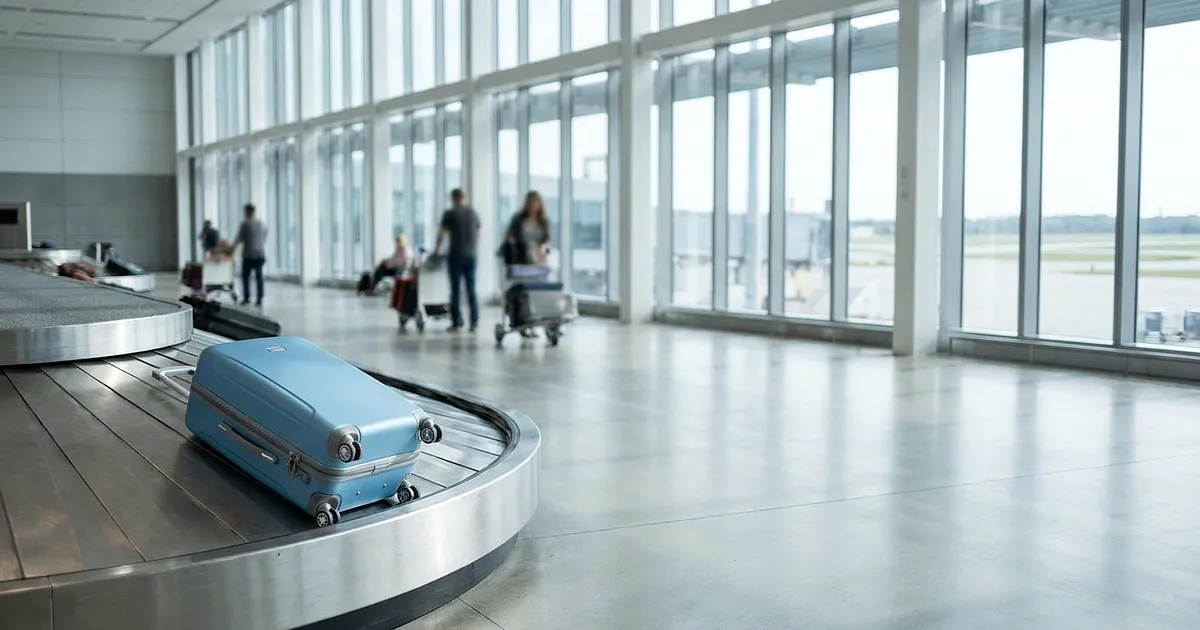
On a self-transfer, don't follow the signs for transfers or connecting flights after landing. Follow the ones for baggage reclaim. Your bag comes out on the normal belt, like on any arrival, and nobody can tell you in advance how long that takes.
In its article on rechecking your baggage between flights, Kiwi.com says carriers don't transfer your baggage on a self-transfer and that you'll likely need to leave the transit zone. Its German help page also covers the case where the airline puts your cabin bag in the hold: you collect it and check it in again then too.
2. Immigration and customs, if required
Whether a check is waiting for you depends on the airport and your nationality. It might be required, it might not. Three examples with official sources:
United Kingdom: GOV.UK explicitly names checking in luggage for a connecting flight as an example of going through UK border control. A Visitor in Transit visa costs £74.50 there (as of 8 November 2026), and you don't need one if you hold a valid ETA. Whether you need one at all depends on your nationality.
United States: The ESTA FAQ from US Customs and Border Protection requires either an ESTA or a visa for transit, too.
Schengen external border: According to the European Commission, the EU Entry/Exit System (EES) has been fully operational since 10 April 2026. It registers non-EU nationals on short stays and replaces passport stamping. How long entry takes depends on the airport.
A tag to your final destination doesn't override border rules. If you have to enter the country, you have to enter the country.
3. The second airline's bag drop
Now you're just a regular passenger arriving at the airport, as far as the second airline is concerned. On Connections by easyJet, each flight has its own booking and its own check-in, says the easyJet FAQ. The second airline sets its own bag drop closing time, and that's the one to look up on its website before you travel. There's no universal time, so we're deliberately not giving one here.
The law plays a part here too: EU Regulation 261/2004 (Art. 3(2)) ties your passenger rights to presenting yourself for check-in at the time the airline has stated. If it states none, the cut-off is 45 minutes before the published departure time. That's a legal floor, not the opening hours of the bag drop desk.
4. Security, one more time
The last step feels the most pointless and still costs time. You've only just been through security, and you have to go through again. At many airports, anything you bought after the first screening gets checked again.
Liquids are the big one. Why duty-free alcohol can cause trouble at a connection, and what the sealed bag is really for, is covered in our piece on duty-free alcohol in hand luggage. And since not every airport uses CT scanners yet, our article on the liquids rules for connecting flights with CT scanners gives an overview. What was allowed at your departure airport says nothing about what gets through at the connecting one.
Work out your buffer backwards, not with a magic number
How much time do you need between two separate flights? There's no number that holds for every airport and every airline, and anyone who gives you one is guessing. The method below is a Kofferly recommendation, not a rule.
Count backwards from the second flight's departure time:
- Note the departure time of flight two.
- Subtract the boarding or gate closing time shown in the second airline's booking or app.
- The security time at that specific airport comes off next. Some airports show live wait times, many don't.
- Subtract the second airline's bag drop closing time ... and this is where it gets tight, because every minute now counts twice.
- Subtract walking time, and if required, immigration and customs too.
- The wait at the baggage belt comes off as well.
- Finally, a buffer for delays on flight one, which you set yourself.
What's left is the latest time your first flight can land. If that's earlier than its scheduled arrival, it doesn't work. Honestly, if the buffer only works on paper, it doesn't work.
Some sellers do publish minimum times, but only for their own connections. The easyJet FAQ puts the minimum connection time for Connections by easyJet between 90 and 110 minutes. That applies only to itineraries sold as Connections by easyJet. Wizz Link says its minimum transfer times are designed to allow enough time for collecting and re-checking bags, but it doesn't give a number.
By the way, the "minimum connection time" booking sites sometimes show is, as far as we found, meant for connections on a single ticket. For a self-transfer, where you have to go out and come back in, it tells you very little. We think booking sites could say that much more clearly.
Exceptions: can you check bags through on two bookings after all?
The question "check bags through on two bookings" invites a follow-up: what if both airlines belong to the same group or alliance? In no official source we could read is there a commitment for separate tickets.
Asking costs nothing. At the first check-in desk, you can politely ask whether the bag can go through to your final destination. How the desk answers, we can't say. We found no commitment, so plan as if you'll be collecting it anyway.
And even if it works, a through tag doesn't turn two contracts into one.
Costs and the second airline's baggage rules
On separate bookings, only the second airline's own fare counts. Your allowance on the first flight usually doesn't carry over, and weight limits, sizes, and fees can be completely different. On Connections by easyJet, hold luggage has to be bought for each easyJet flight separately, according to the easyJet FAQ.
In practice, check both fares before you book, not just the first. A bag that's included with airline one can cost extra with airline two, or simply be too heavy. We couldn't read an official page on separate bookings from Ryanair or other low-cost carriers for this article, so check their rules on the airline's own site.
Two small things can make the connection easier without changing any rules. A document pouch that keeps your passport and both boarding passes together saves digging around at the bag drop, and luggage you can move from belt to desk without a struggle saves energy. Neither replaces a decent time buffer.
When the connection falls apart: rights and your bag
This is where the gap to a single-ticket trip is widest. Short version, and explicitly not legal advice.
If you miss a connecting flight, EU compensation applies only when the flights are part of a single booking. That's what Your Europe says. Verbraucherzentrale NRW, the German consumer advice centre (as of 28 July 2026), names the same condition: the whole journey has to be booked as one flight. On top of that comes a threshold of at least three hours' delay at the final destination. With two separate tickets, the claim for the missed second flight usually falls away, and sorting out a replacement flight is mostly up to you.
And your bag? The frame is the Montreal Convention. Carriage by several airlines only counts there as a single carriage if the parties agreed it as one operation (Art. 1(3)). Art. 36 sets out, for that kind of agreed carriage, which airline you can claim against for baggage.
Our reading, not legal advice: two tickets you booked yourself are probably not such an agreed single operation. In practice, the airline that flew the leg on which the bag was lost or damaged is then the one responsible.
According to ICAO, the baggage liability limit has been 1,519 Special Drawing Rights since 28 December 2024, up from 1,288. We're not giving a euro figure, since it moves with the exchange rate.
The deadlines are short. You have to report damaged baggage in writing within 7 days and delayed baggage within 21 days of receiving it, as Your Europe puts it. How to go about it is covered in our guide to lost luggage rights, deadlines, and compensation. And what you can do at the airport when a bag doesn't show up is in our piece on lost luggage at the airport.
Some sellers offer cover on top, and it's optional. On Wizz Link and Connections by easyJet it's called ConnectSure and comes from Dohop. Wizz Link says that if disruption causes you to miss your second flight, Dohop will help you get to your final destination. Kiwi.com has its own guarantee, which doesn't cover extraordinary circumstances such as strikes or airport closures. That's in its rules for disruption services. Adding baggage directly with the airline, or contacting the airline without Kiwi.com's approval, may void the cover.
None of these products is a general connection guarantee from the airline, and none of them changes who carries your bag.
From 23 October 2027: the air passenger rights reform
The EU air passenger rights reform, Regulation (EU) 2026/2202, applies from 23 October 2027. What it changes in detail for self-transfer tickets, we're deliberately leaving out until we've checked the full wording and the rules actually apply.
Before you pack: two things to look up
Look at your confirmations. One booking for the whole trip? Then your airline's conditions apply, done. Two separate ones? Then it pays to read up on the second airline's website before you pack: when its bag drop closes and what the bag costs there, and to work out the buffer backwards. Checking bags through on separate tickets isn't something we found promised anywhere, so build collecting and re-checking into your plan.
We don't think self-transfers are bad in themselves. Sometimes they save real money. Just don't assume your bag will find its own way.
Frequently Asked Questions
Is my luggage checked through on separate tickets or two bookings?
Usually not. Kiwi.com, Wizz Link, and Connections by easyJet say that on a self-transfer you collect your bag at the connecting airport and check it in again with the second airline. For tickets you booked yourself with different airlines, we found no commitment to a through-check.
Does it work if both airlines are in the same alliance?
We didn't find any official commitment for separate tickets within an alliance. You can ask at the first check-in desk whether your bag can go through to the final destination. But plan as if you'll have to collect it, because you can't rely on a yes.
Do I have to collect my bag at a layover and check it in again?
On a self-transfer with two tickets, yes. You pick the bag up from the normal belt, go through immigration and customs if required, drop it at the second airline's bag drop, and pass security again. With a cabin bag only, the bag drop falls away, unless the airline puts it in the hold.
How much time should I allow for a self-transfer?
There's no universal minimum. Count backwards from the second departure: gate closing, security, the bag drop closing time, walking, immigration, the wait at the belt, and a buffer for delays. Connections by easyJet gives 90 to 110 minutes, but only for its own itineraries.
Will I get compensation if I miss my second flight?
On separate tickets, usually not. According to Your Europe and Verbraucherzentrale NRW, compensation for a missed connection requires a single booking covering the whole journey. Arranging a replacement flight is then mostly up to you, unless an optional protection product kicks in.
Do I pay for my bag again with the second airline?
On separate bookings, usually yes, because only the second airline's fare applies. Your allowance from the first flight mostly doesn't count there, and weight, size, and prices can differ. On Connections by easyJet, easyJet says you buy hold luggage for each flight separately.
Sources
- Kiwi.com kiwi.com
- Wizz Link wizzlink.wizzair.com
- Connections by easyJet flightconnections.easyjet.com
- Your Europe europa.eu
- self-transfer help page kiwi.com
- GOV.UK gov.uk
- ESTA FAQ from US Customs and Border Protection cbp.gov
- European Commission home-affairs.ec.europa.eu
- EU Regulation 261/2004 eur-lex.europa.eu
- Verbraucherzentrale NRW verbraucherzentrale.nrw
- ICAO icao.int
- rules for disruption services kiwi.com
- EU air passenger rights reform, Regulation (EU) 2026/2202 eur-lex.europa.eu