Sewing Machine on a Plane: TSA Rules and Cabin Space
 12 min read
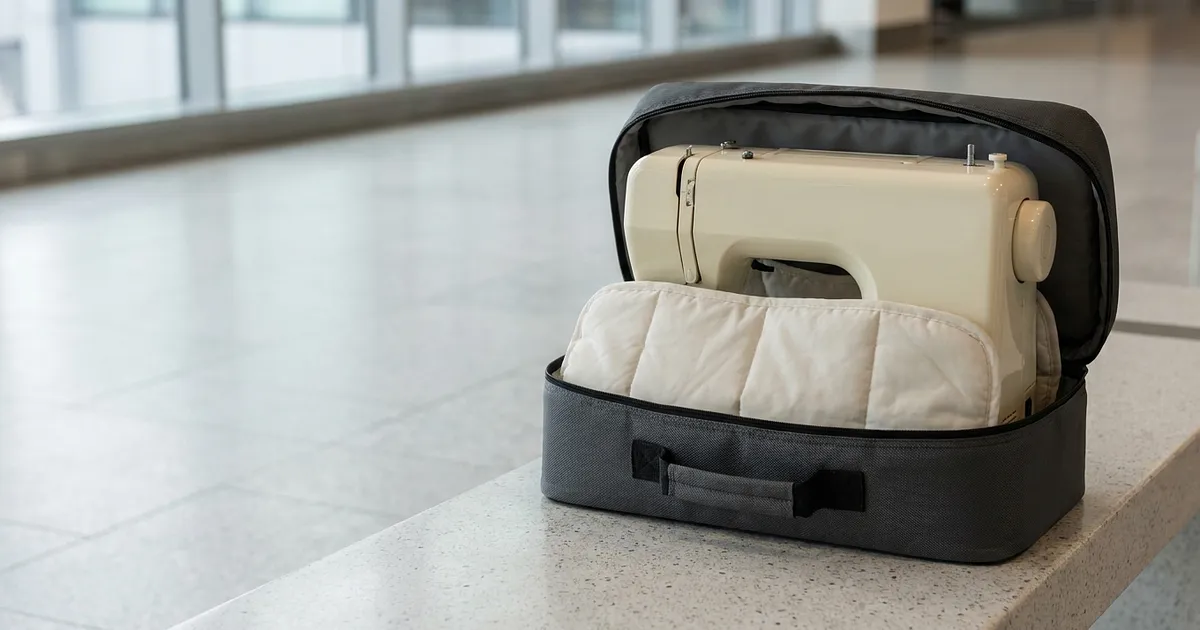
A sewing machine can be permitted at a US security checkpoint and still not make it into the aircraft cabin. TSA handles screening. The operating airline decides whether the packed machine fits your fare, its size limits, and the space available onboard.
What the TSA answer actually covers
The official TSA sewing machine page lists both “Carry On Bags” and “Checked Bags” as “Yes”. It immediately tells passengers with a carry-on item to ask the airline whether it will fit in the overhead bin or underneath the seat. TSA also says its officer makes the final checkpoint decision. The page was last updated on April 25, 2017 and freshly accessed on October 23, 2026.
That answers one narrow question. Is a sewing machine generally eligible to pass through a US checkpoint? Yes. TSA's page doesn't list the machine itself as a blanket prohibited item.
The “Yes” goes no further. It doesn't confirm that your fare includes a carry-on, and it doesn't approve any particular bag size. Nor does it reserve overhead space. TSA sends the fit question back to the airline on the same page.
So there are two separate decisions:
- Security screening: TSA decides whether the machine may pass through the US checkpoint. The officer there has the final say.
- Cabin carriage: The operating airline decides which baggage category your fare includes, whether the packed machine fits, and whether it can be stowed onboard.
It can sound like a minor wording issue. It isn't. The word “allowed” means different things depending on who says it.
TSA rules aren't a worldwide permission slip
TSA is responsible for US security checkpoints. If your journey begins outside the United States, you first pass through a checkpoint governed by the rules at that departure point. A connection may involve another screening. Check departure and transfer requirements independently rather than reading the TSA answer as worldwide permission.
Which authority handles a particular foreign checkpoint depends on the itinerary. A broad claim about every country would be shaky, so this guide doesn't make one. The useful boundary is simple: a US source answers the US checkpoint question, not every screening point along your route.
Connections deserve their own check anyway. Our guide to airport scanners and liquids on a connecting flight covers a different item, but the route problem is similar: what happens at one checkpoint doesn't settle what happens at the next.
Why the airline makes a separate decision
Once security eligibility is clear, the baggage question remains. There is no single answer attached to the phrase “US flight”. Your ticket and the carrier actually operating each flight matter.
The official JetBlue baggage page says a carry-on is included only “space permitting” and must fit in the overhead bin. Its published maximum is 22 × 14 × 9 inches, or 55.88 × 35.56 × 22.86 cm, including wheels and handles, as freshly accessed on October 23, 2026. A personal item must fit under the seat and may measure no more than 17 × 13 × 8 inches, or 43.2 × 33 × 20.32 cm, as of the same access date.
“Space permitting” does the heavy lifting. A fully packed machine within 22 × 14 × 9 inches still has no promised overhead spot. Meeting the dimensions gets you past one condition. It doesn't create reserved storage.
Southwest publishes different limits. Its official carry-on and personal item policy gives a carry-on limit of 24 × 16 × 10 inches, or 60.96 × 40.64 × 25.4 cm by direct conversion. Wheels, handles, and any attachments count. These figures were freshly accessed on October 23, 2026. Southwest assigns the carry-on to the overhead bin and the personal item to the space under the seat.
There is no single carry-on size for “US flights.” Use the current rule from the carrier operating your flight. Our carry-on dimensions comparison offers a wider orientation. For this decision, though, the current page of your operating carrier is the one that counts.
| Check | Official statement | What remains uncertain |
|---|---|---|
| TSA checkpoint | Sewing machine generally allowed in carry-on and checked baggage, page updated April 25, 2017 and accessed October 23, 2026 | Fare, packed size, and cabin space |
| JetBlue carry-on | maximum 22 × 14 × 9 inches, or 55.88 × 35.56 × 22.86 cm, including wheels and handles, “space permitting”, as of October 23, 2026 | Whether space is available on your flight |
| JetBlue personal item | maximum 17 × 13 × 8 inches, or 43.2 × 33 × 20.32 cm, as of October 23, 2026 | Whether the packed machine fits fully under the seat |
| Southwest carry-on | maximum 24 × 16 × 10 inches, or 60.96 × 40.64 × 25.4 cm, attachments included, as of October 23, 2026 | Whether another carrier accepts that size |
The airline on the ticket may not operate the flight
A familiar airline name can appear on the booking while a partner operates one segment. Both JetBlue and Southwest warn on their official pages that partner airlines may apply different baggage policies.
Check each flight separately. Look for “operated by” and identify the operating carrier. Its current baggage page belongs in your decision. If a different carrier operates the return, run the check again.
This matters when the measurements are close. Spare room under Carrier A's policy doesn't carry over to Carrier B if its limit is smaller. A change of fare can alter the baggage included too.
Measure the packed machine, not the bare casing
A manufacturer's dimensions for the machine alone aren't enough. At the airport, the airline sees the travel setup: machine, case or bag, extended handle, wheels, and anything else protruding from the outside.
Measure at the outermost points. JetBlue expressly includes wheels and handles. Southwest also includes any attachments. Put the tape around the unit exactly as it will travel.
A sensible measurement routine looks like this:
- Pack the machine for the journey. Don't remove anything for the measurement if it will remain outside on travel day.
- Record length, width, and height at the largest points. The tallest handle and widest outer part count.
- Weigh the complete unit. The two airline passages cited here don't establish one shared weight limit, but your booked carrier or fare may have one.
- Match it to the right category. Overhead and under-seat baggage aren't interchangeable. Compare against the category included in your fare.
- Keep a note or photo of the result. It isn't permission, but it helps you ask the airline an exact question.
Soft cabin bags can sometimes compress a little. I wouldn't plan around that with a sewing machine. A rigid shape, delicate mechanism, and protruding parts leave little honest wiggle room. That's judgement rather than a measured claim, but it's a poor place for optimistic rounding.
Our broader guide to what you can bring in carry-on luggage can help with the first sorting pass. For a sewing machine, it still doesn't replace the item-specific TSA page or your airline's measurements.
Don't forget the packed weight
The fresh sources used here support exact outer dimensions, but they don't establish a universal weight allowance for “US flights”. That's why this guide doesn't offer a catch-all figure in kilograms or pounds.
Read the conditions attached to your fare, not merely a general airline summary. Limits can vary by cabin, route, or fare. If the airline states a weight limit, weigh the bag with the machine inside. A case that just fits the measuring box still fails your plan if the complete unit exceeds the allowance you booked.
Cabin space remains uncertain until boarding
The machine can comply with TSA's basic rule. It can also meet the published dimensions. The cabin may still be full.
JetBlue makes this third layer unusually plain with “space permitting”. Carry-on carriage depends on available room. Later boarding may make that concern feel more immediate, but the source doesn't promise a bin to any particular boarding group. Arriving early may be sensible. It isn't a storage guarantee.
What happens if there is no suitable space? The airline may require the item to leave the cabin or be handled another way. The offered solution depends on the carrier, fare, airport, and circumstances. Southwest tells passengers with an oversized or extra item to check it at the ticket counter before heading to the gate. That doesn't create a universal promise that every sewing machine will be accepted at short notice or on identical terms.
And this is the awkward part. A plan that works only if the machine stays above your seat is fragile. Protective packing may reduce some knocks, but it can't guarantee damage-free transport or cabin acceptance. A “Fragile” label can't make that promise either.
Two hypothetical cases
Case A: Your fully packed machine stays within the carry-on category that applies to your JetBlue fare. TSA's basic answer is positive. JetBlue still says “space permitting”, so an available bin isn't assured. This is a hypothetical example, not an observed trip.
Case B: Carrier A operates the outbound flight, while a partner operates one return segment. The bag fits Carrier A's rule. The partner publishes a different limit. This is hypothetical too. It simply shows why the marketing airline on the ticket may not settle every segment.
How to ask the airline a useful question
“Can I bring a sewing machine?” invites a vague answer. Give the airline your route, flight number, operating carrier, fare, and complete packed measurements instead.
This template can be adapted:
I am travelling on [date] on flight [number], operated by [airline]. I want to bring a sewing machine in a closed bag as my [carry-on/personal item]. The fully packed unit measures [length] × [width] × [height] cm including all handles, wheels, and outer parts, and weighs [weight] kg. Is this baggage category included in my fare? Does this item require prior notice or special handling? What happens if suitable cabin stowage isn't available at boarding?
This is a precise request, not a special permit. Keep the reply and a screenshot of the baggage page. A written answer can reduce misunderstandings, but it doesn't automatically bind a TSA officer, the crew, or another checkpoint authority.
If Lufthansa operates a segment, check with Lufthansa directly. Its current official pages couldn't be freshly validated for this guide because access was blocked. We therefore don't quote Lufthansa dimensions or carry an older number across from another article.
The practical pre-flight check
You don't need a complicated formula. These questions should be settled before you rely on cabin carriage:
Which security authority applies at departure and at each transfer?
Which airline actually operates every segment?
What baggage category does your exact fare include?
What are the packed unit's outer dimensions and complete weight?
Does the carrier require prior notice or confirmation for the item?
What will you do if there is no suitable cabin space?
For everything else going into the cabin, our carry-on packing list can help. It won't change the sewing machine decision, but it may stop another personal item or extra cabin bag from unexpectedly exceeding your booked allowance.
Your booking supplies the final details
For a sewing machine on a plane, the TSA page is a useful start. If one detail is still missing, send the operating airline the finished packed dimensions and ask about the exact baggage category. Don't rely on cabin carriage until you have that answer.
Frequently Asked Questions
Can a sewing machine pass through TSA security?
Yes. TSA lists sewing machines as generally allowed in carry-on and checked baggage. Its page was updated on April 25, 2017 and accessed on October 23, 2026. The TSA officer makes the final checkpoint decision. This answers the US TSA question, not security screening in every country.
Does TSA approval guarantee overhead-bin space?
No. TSA answers the security question. The operating airline controls the fare, baggage category, dimensions, and stowage. JetBlue says carry-ons are accepted “space permitting”, as of October 23, 2026. Meeting its size limit doesn't reserve a bin.
What is JetBlue's carry-on size limit?
JetBlue publishes a maximum of 22 × 14 × 9 inches, or 55.88 × 35.56 × 22.86 cm, including wheels and handles, as of October 23, 2026. That is JetBlue's limit, not a general US rule. Carry-on carriage also remains subject to available space.
What is Southwest's carry-on size limit?
Southwest publishes a maximum of 24 × 16 × 10 inches, or 60.96 × 40.64 × 25.4 cm. Wheels, handles, and attachments count, as of October 23, 2026. Don't apply this limit to another airline.
Should I measure only the sewing machine itself?
No. Measure the fully packed unit at its outermost points. The case or bag, wheels, handles, and any parts left outside all count. Weigh the complete unit as well and compare it with the correct baggage category for your fare.
What should I check on a partner flight?
Check the operating carrier for every segment. JetBlue and Southwest both warn that partner-airline baggage rules may differ. The marketing airline shown most prominently on your ticket may not provide the rule that applies to the actual flight.