Power Bank on a Plane 2026: Rules, Wh Limits & Best Models
 12 min read
I watched a woman lose her portable charger at the gate in Munich last summer. Brand name, 20,000 mAh, perfectly fine capacity. The problem? The label on the back was scratched off. You couldn't read the watt-hour rating anymore. Security took it. Gone.
The rules for bringing a power bank on a plane got stricter in 2026 than they've ever been. Since January 15, 2026, the Lufthansa Group has completely banned using and charging them on board. And the IATA now caps you at two units per person. Confusing? Yeah. It really is.
I went through every current airline rule, broke down the Wh calculation so it actually makes sense, and picked four models that are guaranteed to fly without issues.
Quick Answer
Power banks are allowed on planes, but only in carry-on luggage. Capacity must stay under 100 Wh (roughly 27,000 mAh). Since January 2026, the Lufthansa Group has banned using and charging them during flights. Ryanair and easyJet still let you use them in the air. Maximum two per person under the new IATA rules. The capacity label must be readable on the device.
What Changed in 2026?
Here's what kicked all of this off. On January 28, 2025, an Air Busan Airbus A321 in South Korea caught fire after a lithium battery exploded on board. 170 passengers had to evacuate via emergency slides. The aircraft was destroyed.
That incident triggered a chain reaction across the industry.
The FAA documented 89 lithium battery incidents on aircraft in 2024. Back in 2016, it was 32. That's a 178% increase in eight years.
What actually changed:
IATA DGR 67th Edition (effective January 1, 2026): Maximum two portable chargers per person. This limit didn't exist before.
Lufthansa Group (from January 15, 2026): Complete ban on using and charging them on board. Applies to Lufthansa, Eurowings, Swiss, Austrian, and Brussels Airlines.
Overhead bins: The Lufthansa Group now bans battery packs from the overhead compartment. They must stay in your jacket pocket or under the seat in front of you.
I'll be honest, the overhead bin rule didn't click with me at first. But it makes sense once you think about it. If the unit starts smoldering inside a closed compartment above your head, nobody notices until it's too late.
If you want to read more about the Lufthansa ban specifically, we wrote a detailed breakdown when it was first announced.
The Basic Rules: Power Banks in Carry-On
No matter which airline you're flying, these four rules apply everywhere. Think of them as the non-negotiables.
1. Goes in carry-on. Always.
Battery packs are banned from checked luggage. No exceptions, no special permits. In the cargo hold, nobody catches a fire before it's too late. If you're still putting together your carry-on packing strategy, put the charger at the top of that list.
2. Under 100 Wh: Allowed without airline approval.
This covers the vast majority of devices you can buy in stores. Anything up to 27,000 mAh at 3.7 volts stays under 100 Wh. Pack it and fly.
3. Between 100 and 160 Wh: You need the airline's permission.
These are bigger units, roughly 27,000 to 43,000 mAh. You probably don't need this much for charging phones. More for laptops. You have to get approval BEFORE your flight.
4. Over 160 Wh: Completely banned.
Not in carry-on, not in checked luggage. Period.
And something a lot of people forget: the capacity label must be readable. If the print is worn off or there's no label at all, they'll probably confiscate it. Just like what happened to that woman at the gate in Munich.
How to Convert mAh to Wh
Most devices show capacity in mAh. Airlines and the IATA talk in Wh. Understanding the power bank Wh limit comes down to one simple formula.
Formula: Wh = (mAh x 3.7) / 1,000
The 3.7 volts is the standard nominal voltage for lithium-ion batteries. Inside Digital has a detailed explanation of the conversion.
| mAh | Wh (calculated) | Status |
|---|---|---|
| 5,000 mAh | ~18.5 Wh | Allowed |
| 10,000 mAh | ~37 Wh | Allowed |
| 20,000 mAh | ~74 Wh | Allowed |
| 26,800 mAh | ~99 Wh | Just under the limit |
| 27,000 mAh | ~100 Wh | Needs approval |
| 30,000 mAh | ~111 Wh | Approval required |
| 50,000 mAh | ~185 Wh | Banned |
My tip: buy a model that has the Wh number printed right on the case. Zero arguments at the airport. Most newer models from INIU and Anker already do this.
Power Bank Airplane Rules by Airline
This is where things get interesting, because airlines differ quite a bit. I checked the current power bank airplane rules of six carriers as of April 2026.
| Airline | Wh Limit | Max Units | Use on Board | Charge on Board |
|---|---|---|---|---|
| Lufthansa | 100 Wh | 2 | Banned | Banned |
| Eurowings | 100 Wh | 2 | Banned | Banned |
| Ryanair | 100 Wh | 20 | Allowed (cruise) | Not during taxi/takeoff/landing |
| easyJet | 100 Wh | 2 | Allowed (cruise) | Not during taxi/takeoff/landing |
| Wizz Air | 100 Wh | 2 | Allowed | Allowed |
| Turkish Airlines | 100 Wh | 20 | Allowed | Battery pack itself can't be charged |
Lufthansa Group (Lufthansa, Eurowings, Swiss, Austrian)
Since January 15, 2026: You can bring a power bank on board, but you're not allowed to use it or charge it. Not even to quickly plug in your phone. The device can't go in the overhead bin. It must stay in your jacket pocket or under the seat in front of you.
Exception: medical devices. If you need a battery-powered medical device, you have to register it with the airline beforehand.
I personally think the usage ban is overkill. Maybe I'm wrong, but most fires happen because of damaged or cheap no-name batteries, not because someone charges an iPhone with an Anker unit. Still, rules are rules.
Ryanair
Ryanair is surprisingly relaxed here. According to powerbanks.ie, you can bring up to 20 portable chargers on board. Yes, twenty. Usage is allowed during cruise flight. You just have to unplug everything during taxi, takeoff, and landing.
The 100 Wh limit still applies, of course.
easyJet
Maximum two units, usage allowed during cruise flight. The capacity label must be readable on your device. Otherwise, they'll take it at the gate. Worth knowing: easyJet actually checks this more consistently than some other budget carriers do, so don't count on slipping through with a worn label. The EU's push for free carry-on luggage might change other easyJet rules soon, but the battery policy is stable for now.
Wizz Air
Also a maximum of two. Usage is allowed. Wizz Air keeps things simple here.
Turkish Airlines
Up to 20 units allowed (like Ryanair). You can use them to charge other devices. But the charger itself can't be plugged into the seat power outlet. So no charging the charger, basically.
Best Travel Power Banks Under 100 Wh
I picked four models that all stay under the 100 Wh limit and work particularly well for flying. All of them have the Wh rating printed on the case.
Best Value: INIU 20,000 mAh
The INIU Power Bank, 20,000 mAh, Fast Charging, USB-C Input & Output, 22.5W External Mobile Phone Battery is my personal go-to. 22.5W fast charging via USB-C, roughly 74 Wh. That'll charge an iPhone 15 about four times. For around EUR 25, you're getting more than you need. And that's exactly the point.
74 Wh means: comfortably under the 100 Wh limit. Zero problems at any gate.
Not available in your region — closest match
View at Amazon (as of Aug 15)Affiliate link. Buying through it earns us a commission; the price stays the same for you.
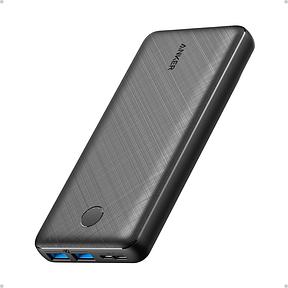
Proven Classic: Anker 325
The Anker 325 Powerbank 20000mAh has been around for what feels like forever, and it just works. 20,000 mAh, roughly 74 Wh, USB-A and USB-C. Anker gives you 18 months of warranty, which for a charger in the EUR 22 range is honestly pretty fair. It's also one of the easier models to read the capacity label on, since Anker prints the Wh figure prominently on the back (which matters at the gate).
No fast charging like the INIU model. But if that doesn't bother you, it's a solid pick.
Affiliate link. Buying through it earns us a commission; the price stays the same for you.
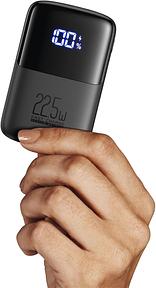
Compact for Short Trips: INIU 10,000 mAh
The INIU Powerbank 10000mAh 22.5W Kompakt is so light you'll forget it's in your pocket. Roughly 37 Wh, so not even half of the 100 Wh limit. For a long weekend or a day trip, that's more than enough.
I always grab this one when I'm traveling with just a carry-on and want to save every gram. Fits nicely in a jacket pocket too, which is now a requirement on Lufthansa flights.
INIU Powerbank 10000mAh 22.5W Kompakt
View at Amazon (as of Aug 10)Affiliate link. Buying through it earns us a commission; the price stays the same for you.
Premium Compact: Anker PowerCore 10,000
The Anker PowerCore 10000mAh Ultra-Kompakt weighs just 180 grams and has 4.8 stars across roughly 50,000 reviews. That speaks for itself. About 37 Wh, so well within the safe zone.
Costs around EUR 30, which is a bit more than the INIU alternative. But you get Anker's build quality, which I've personally trusted for five years of travel. Looking for more gear ideas? Our airplane travel essentials roundup covers some other favorites.
Anker PowerCore 10000mAh Ultra-Kompakt
View at AmazonAffiliate link. Buying through it earns us a commission; the price stays the same for you.
5 Common Power Bank Mistakes at the Airport
I've been watching what people get wrong at the gate and security on my recent flights. Here are the five most common blunders.
1. Packing it in checked luggage.
Happens more often than you'd think. Security pulls it out, your bag arrives late, and in the worst case, it doesn't get loaded at all. Battery packs belong in carry-on. No exceptions.
2. Unreadable capacity label.
If the Wh or mAh number on your device isn't legible anymore, security can confiscate it. Some people stick a small label with the specs on theirs. Not a bad trick, honestly.
3. Using it on Lufthansa flights.
This is the mistake most people make in 2026. Because a lot of travelers don't know yet that Lufthansa, Eurowings, and the rest of the group banned charging since January. Nothing terrible happens, but the cabin crew will ask you to unplug.
4. Storing it in the overhead bin.
Banned by the Lufthansa Group. The charger has to go under the seat in front of you or in your jacket. Sounds minor, but they check.
5. Bringing a damaged unit.
Is your device swollen, smells off, or has visible damage? You can't bring it. On any airline. A bloated lithium battery can spontaneously catch fire. Dispose of it at a proper recycling center, not in your regular trash.
Speaking of changing rules, have you seen the updated carry-on liquid rules for 2026? Quite a few things shifted there too.
What If the Power Bank Ends Up in Checked Luggage?
It can happen. You realize at the gate that you forgot to take it out. Stay calm. Tell the ground staff. In most cases, they'll open the suitcase and remove it. You get it back. But your flight could be delayed if the bag needs to be pulled off the belt.
Better approach: check before you pack. I've made it a habit to put the charger with my passport in my personal bag. That way I don't forget it.
If you're wondering what else is and isn't allowed in carry-on, the EU cabin baggage standard for 2026 has a good overview.
What You Actually Need to Remember
The rules for carrying a power bank on a plane aren't complicated once you know them. Keep it in your carry-on, always. Stay under 100 Wh (that's roughly 27,000 mAh for most devices). Check your specific airline before you fly, because the Lufthansa Group now bans using them on board while Ryanair and easyJet still let you charge during cruise. And make sure the capacity label is readable, or you risk losing the device at security just like that woman I saw in Munich.
If you buy one of the models I mentioned above, you'll have no issues on any carrier. They're all well under the limit, all clearly labeled, and all tried and tested on actual flights. For a full look at what else changed this year, the carry-on rules overview for 2026 is worth reading before your next trip.
All products from this post
The ones we named above are marked; the rest are alternatives in the same category.
Not available in your region — closest match
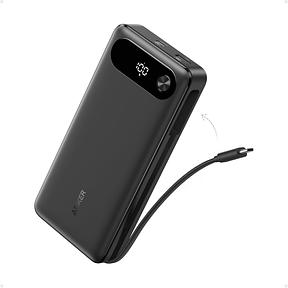
Anker Powerbank, 20.000mAh tragbares Ladegerät mit integriertem USB-C-Kabel, 87W Max Schnellladung, kompatibel mit MacBook, iPhone, Samsung und mehr
View at Amazon (as of Aug 15)
Affiliate notice: As an Amazon Associate, we earn from qualifying purchases. Product prices and availability are subject to change.
Frequently Asked Questions
Can I bring a power bank on a plane?
Yes, but only in carry-on luggage. Never in checked bags. The capacity must not exceed 100 Wh (roughly 27,000 mAh). The Wh or mAh rating must be readable on the device. Under the current IATA rules, you're limited to two per person.
Is a 20,000 mAh power bank allowed on flights?
Yes. A 20,000 mAh device has roughly 74 Wh and sits well below the 100 Wh limit. You can bring it in your carry-on without any special approval. On Lufthansa and Eurowings flights, though, you can't use or charge it since the January 2026 ban took effect.
What happens if my power bank is in checked luggage?
Security detects lithium batteries via X-ray scanning. Your suitcase gets opened and the device gets removed. This can delay your bag or, in a worst case, prevent it from being loaded. That's why battery packs must always go in carry-on.
Can I use my power bank on Lufthansa flights?
No. Since January 15, 2026, the entire Lufthansa Group (Lufthansa, Eurowings, Swiss, Austrian, Brussels Airlines) bans using and charging them on board. You can carry one, but it must remain switched off under the seat in front of you or in your jacket pocket.
How do I calculate the Wh of my power bank?
Check the back of your device. If only mAh is listed, use this formula: Wh = (mAh x 3.7) / 1,000. Example: 20,000 mAh x 3.7 / 1,000 = 74 Wh. The 3.7 volts is the standard nominal voltage for lithium-ion batteries.
*Last updated: April 2026*
Sources
- IATA now caps you at two units per person iata.org
- caught fire after a lithium battery exploded on board airliners.de
- 89 lithium battery incidents on aircraft in 2024 ingenieur.de
- Complete ban on using and charging them on board eurowings.com
- Inside Digital has a detailed explanation of the conversion. inside-digital.de
- According to powerbanks.ie powerbanks.ie