Camera and Drone Carry-On: DSLR, Lenses and Batteries in 2026
 14 min read
Short version: drone carry-on is fine as long as you get the battery rules right. Three separate rulebooks, one backpack. Fly with a camera body, a couple of lenses and a drone in your carry-on, and you normally end up reading three unrelated sets of rules: battery regulations, camera baggage policy, and drone law. I went through all of them for this piece, and honestly, the thing that surprised me most was how boring the camera half turns out to be.
Short version below. The rest of the article explains why.
Lithium battery rules in 2026, the short version
Let's start with the part that works identically for a camera and a drone. It isn't the device that gets regulated, it's the cell inside it.
Under the rules published by IATA, lithium batteries up to 100 Wh travel in carry-on with no approval needed. Between 100 and 160 Wh you need the airline's prior consent, and you're typically limited to two spares in that band. Above 160 Wh, a passenger aircraft is off the table entirely, and the battery has to ship as declared air cargo.
The TSA confirms the other half of it: spare batteries belong in your carry-on and never in checked baggage. That one isn't a suggestion.
Why the strictness? Because these things do catch fire. On 28 January 2025 an Air Busan A321 caught fire while taxiing at Busan, and investigators traced it to a short circuit in a passenger's power bank stored in an overhead bin. All 176 people on board got out and the aircraft was written off. Injury counts are inconsistent even within the writeup on Air Busan Flight 391 itself: the infobox lists 3, the body text describes seven minor injuries among crew and passengers. That incident is the reason batteries live in the cabin. Someone sees the smoke immediately.
Here's what a lot of the 2026 coverage buries: the crackdown is aimed at power banks. Not at your camera bag.
Want the specifics on power banks alone, including the new in-flight charging rules? We've covered that separately in Lufthansa power bank ban 2026. And if you want the general list of what's allowed in carry-on, that's in what's allowed in carry-on. I won't repeat it here.
Converting mAh into Wh in about ten seconds
Most batteries print mAh on the label, but the regulation is written in watt-hours. The formula is mAh times volts divided by 1000.
So a 5000 mAh cell at 15.4 V works out to 77 Wh. If the Wh figure is already printed on the battery, even better, no maths required. Photographers in forums also suggest carrying a printout of the spec sheet in case ground staff ask about a larger pack. Probably overkill on most trips. Costs nothing, though.
Camera and lenses: much calmer than the headlines suggest
Now the good news, which is a lot better than the 2026 news cycle would lead you to believe.
PhotoWorkout founder Andreas De Rosi puts it plainly: camera batteries sit at roughly 15 to 16 watt-hours, nowhere near the 100 Wh ceiling. A Sony NP-FZ100 comes in around 16.4 Wh, a Canon LP-E6NH around 15.3 Wh, a Nikon EN-EL15c around 16 Wh. Each of those is about a sixth of the threshold where anyone starts asking questions. The May 2026 tightening at US carriers, which De Rosi links to 97 reported lithium battery incidents on US aircraft during 2025, was written with large power banks in mind.
In practice that means your spares are fine. Five of them, six of them, the count isn't really the issue as long as each loose battery is protected against short circuit. Tape over the contacts, or the original plastic cap, and you're done.
Quick answer: Camera batteries run around 15 to 16 Wh, well under the 100 Wh line. No approval, no permission form, no special handling. The only requirement is short-circuit protection on every loose spare.
Bodies, lenses, tripods
There's no rule that singles out the hardware itself. As far as baggage policy goes, a DSLR is just an object, and it counts against your carry-on weight and dimensions like anything else. That's where things actually get tight on some airlines, because of the kilos, not the camera.
Lenses work the same way. A 70-200 f/2.8 weighs a kilo and a half and eats your allowance, but nobody is going to confiscate it.
Tripods are the ambiguous one. Small travel tripods usually sail through, while big ones with a heavy centre column occasionally get pulled at security as a potential blunt weapon. My rule of thumb, and I'll admit it's a judgement call rather than a policy: anything longer than about 60 cm or built around a thick metal column goes in the hold. Annoying with expensive carbon, I know. Still less annoying than losing it at the checkpoint.
Carry-on or checked?
Camera body and lenses go in the cabin. Always.
Not because of a regulation, but because checked bags get thrown, left out in the rain, and occasionally show up three days later. The only part that legally has to be in the cabin is the batteries. Everything else is your call, and it's an easy one.
Drone Carry-On: what changes per airline
This is where it gets more interesting, because drone batteries play in a different league.
As drohnen.de explains, most drone batteries use lithium-polymer cells, which airlines classify as dangerous goods, so they travel in carry-on only. The common consumer models stay comfortably under the limit: DJI Mini, Air and Mavic 3 packs sit below 50 Wh each according to the same source.
One model deserves a second look. The DJI Mavic 4 Pro's main battery is reported at roughly 102 Wh across several specialist outlets, which puts it just past the threshold. I wasn't able to confirm that on a single official page, so treat it as "around 102 Wh" rather than gospel. If that's your drone, I'd contact the airline before booking. The DJI Inspire 2 with the TB50 pack, at roughly 130 Wh, is clearly in approval territory either way.
Quick answer: Yes, a drone can go in your carry-on, and its batteries have to. Under 100 Wh you don't need to ask anyone. From 100 Wh up, contact the airline in advance and expect a two-spare limit.
The airline comparison
One caveat first, and I mean it seriously. This table is built on the IATA baseline that every airline listed here follows. The individual carrier policy pages couldn't be retrieved directly while researching this article, so the figures come from the IATA framework and from secondary sources such as drohnen.de. Airline policy changes. Check your own carrier before you fly.
| Airline | Drone in carry-on | Batteries (IATA baseline) | What to check first |
|---|---|---|---|
| Lufthansa | allowed, counts against carry-on size and weight | up to 100 Wh free, 100 to 160 Wh by prior approval | request approval early, not at the gate |
| Ryanair | allowed, but the free allowance is tight | IATA baseline | without a paid upgrade, often only a small backpack fits (verify the size limit) |
| easyJet | allowed | IATA baseline | confirm the carry-on weight limit for your fare |
| Condor | allowed | IATA baseline | on long-haul, asking about spares is worth the email |
| Eurowings | allowed | IATA baseline | allowance varies by fare type |
What none of them handles for you is the law at the other end.
Airline-compliant doesn't mean legal
This is the mistake that gets expensive. Photographer Ben Pipe had his DJI Mavic Pro confiscated at Managua airport on 30 December 2024 because Nicaragua bans drones outright. His airline paperwork was in order. It made no difference.
A second, independent case: a travel photographer had his drone pulled out of its case at an unusual exit-side scan in Marrakech and confiscated in Morocco, despite dozens of flights that year.
Two countries, two photographers, the same pattern. Airline clearance and national drone law are entirely separate things, and I'd check the destination using recent traveller reports rather than a government page that might be years old.
Packing so the gear survives the trip
So far this has been about what you're allowed to do. This part is about whether your kit arrives intact, which most guides skip completely, and I've never understood why. Real damage happens here.
The ground rules photography communities generally agree on: heavy items low and centred, padded dividers between everything, no empty gaps. Empty gaps are the enemy. In a half-full backpack, a lens slides right across the bag the moment someone sets it down in an overhead bin. The same logic applies to any suitcase, not just a camera bag, see our general packing tips for the rest of it.
Backpack or hard case?
A backpack makes sense if you're shooting as you travel and gear goes in and out constantly. A hard case makes sense when you're moving expensive kit from A to B and that's it. If you want the general tradeoffs spelled out, our full hard case vs. soft case comparison covers it.
For a well-padded budget option, a conventional photo backpack like the TARION Kamerarucksack Leicht, mit 15 Zoll Laptopfach, Regenschutz covers it, with a 15-inch laptop compartment and a rain cover included. If you're carrying camera and drone together and want more structure, the K&F CONCEPT Kamerarucksack mit Hartschale, 15,6 Zoll Laptopfach, für DSLR & Drohne is the sturdier answer: hard shell outside, laptop sleeve inside, explicitly built around a DSLR-plus-drone load.
And when you truly need impact protection, on rough roads or with four-figure kit, a waterproof hard case is the more honest choice. The NANUK 935 Pro Photo Kit Hartschalenkoffer für Kamera, wasserdicht, mit Rollen is marketed for exactly that, with wheels and carry-on dimensions.
A reality check on that last option, though. A hard case is heavy before you put anything in it. On airlines with a strict carry-on weight limit, that empty weight can cost you the very fee you were trying to avoid. Worth doing the arithmetic before you buy.
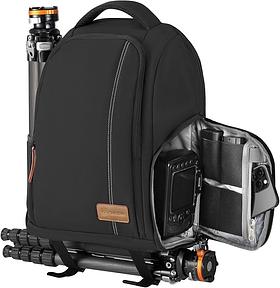
TARION Kamerarucksack Leicht, mit 15 Zoll Laptopfach, Regenschutz
View at AmazonAffiliate link. Buying through it earns us a commission; the price stays the same for you.
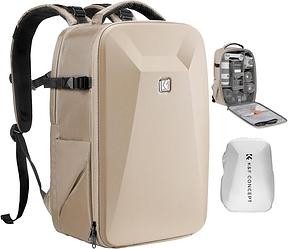
K&F CONCEPT Kamerarucksack mit Hartschale, 15,6 Zoll Laptopfach, für DSLR & Drohne
View at AmazonAffiliate link. Buying through it earns us a commission; the price stays the same for you.
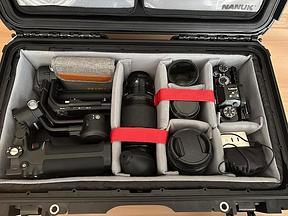
NANUK 935 Pro Photo Kit Hartschalenkoffer für Kamera, wasserdicht, mit Rollen
View at AmazonAffiliate link. Buying through it earns us a commission; the price stays the same for you.
Lenses and small parts
Lenses should be wrapped individually rather than just placed side by side. A set of soft pouches in mixed sizes, like K&F CONCEPT Objektivtaschen-Set, 4 Größen, weich, für Kameraobjektive, handles that without much thought and works in a normal backpack too, for the trips where you leave the camera bag at home.
Memory cards go in a rigid case that stays on your body, not in the bag. Sensor swabs, a blower and spare caps live in a small side pocket. And the batteries, which is the sentence that matters most in this section: individually wrapped, contacts taped, all of them in the cabin.
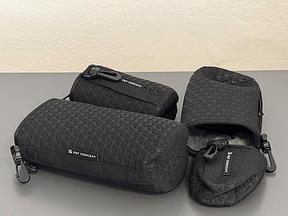
K&F CONCEPT Objektivtaschen-Set, 4 Größen, weich, für Kameraobjektive
View at AmazonAffiliate link. Buying through it earns us a commission; the price stays the same for you.
Locks and the security checkpoint
If something does end up in the hold, a tripod or accessories say, it's worth putting a TSA-approved lock on it. Security staff can open those with a master key instead of cutting them off. A two-pack such as Blendura TSA-Zahlenschloss, 2er-Set, 3-stelliger Code für Gepäck & Taschen covers a suitcase and a camera bag together.
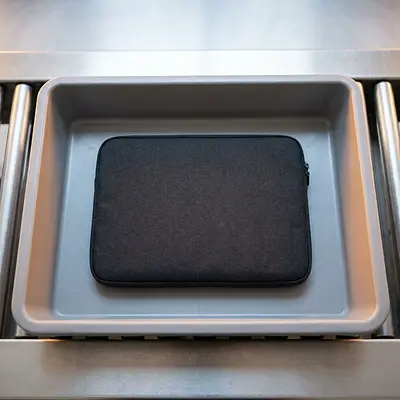
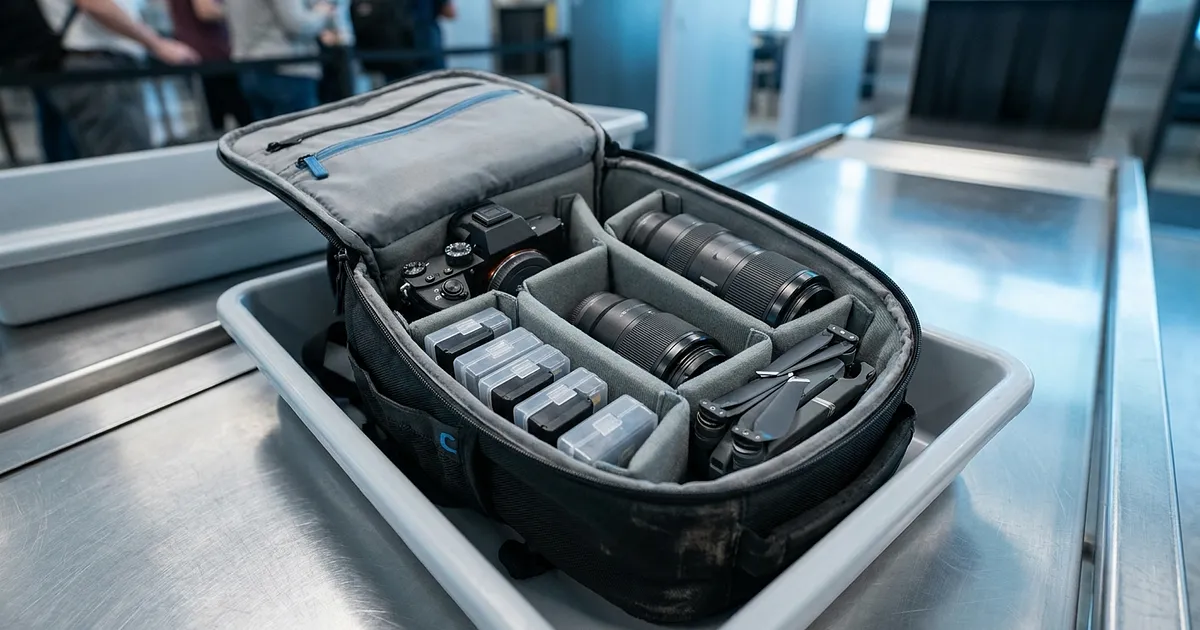
At the checkpoint itself, cameras and drones generally come out into their own tray, the same as a laptop. Sorting that out while you're queuing beats unpacking in a hurry with people waiting behind you. If you're also clearing security with a toiletry bag and liquids on the same trip, our guide to TSA-approved toiletry bags covers that side of the checkpoint.
The packing checklist, short version
Heavy items low and centred, no empty gaps
Lenses wrapped individually, never loose side by side
Memory cards in a rigid case on your body, not in the bag
Every battery individually taped and, without exception, in the cabin
A TSA lock on anything that does end up checked
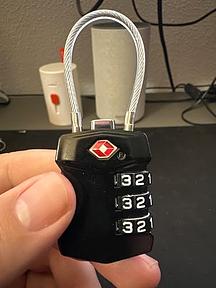
Blendura TSA-Zahlenschloss, 2er-Set, 3-stelliger Code für Gepäck & Taschen
View at AmazonAffiliate link. Buying through it earns us a commission; the price stays the same for you.
CT scanners, X-rays and film
A topic that keeps coming up and, for most readers here, genuinely isn't one.
A Kodak warning quoted by PetaPixel states that modern CT scanners can damage unprocessed film in a single pass. Digital camera sensors aren't affected by any of this. Neither are memory cards or drives.
Older conventional carry-on X-ray machines look milder. In testing by Bryan Hong, covered by Digital Camera World, only Kodak T-Max P3200 at ISO 3200 showed visible fogging after 19 separate scans. Slower stocks came through largely unmarked.
Here's why that matters more for checked bags specifically: more and more major airports run checked luggage through the same higher-powered CT scanners Kodak is warning about, because those systems have to screen bags automatically, without a human opening them. Check your film instead of carrying it on, and you've sent it straight into the higher-risk equipment class. Spare batteries can't go in a checked bag either, for a related reason. Both belong in the cabin, not the hold.
Shooting film? Take it out of your bag and ask for a hand inspection. Shooting digital? Put everything in the tray and forget about it.
Wrapping up
The rulebook turns out to be far less dramatic than the current headlines imply. Camera batteries at 15 to 16 Wh sit so far below every threshold that thinking about them is mostly wasted energy. Drones are worth a bit of attention: cabin only, know the Wh figure, and talk to the airline above 100 Wh.
The real risk sits somewhere else. Not in a watt-hour number, but in a destination that bans drones outright, and in a half-empty bag where a lens tips over the moment it gets stowed.
If you're mid-packing right now, the rest of the cabin baggage list, from liquids to tools, is in our guide to what's allowed in carry-on.
All products from this post
The ones we named above are marked; the rest are alternatives in the same category.
Affiliate notice: As an Amazon Associate, we earn from qualifying purchases. Product prices and availability are subject to change.
Frequently Asked Questions
Can I take my drone in my carry-on?
Yes. Drones are allowed in carry-on, and their batteries have to travel there, because lithium-polymer packs count as dangerous goods and are banned from checked bags. Below 100 Wh you don't need to clear anything with the airline. Separately from all of that, destination law still applies, and some countries ban drones outright no matter what your airline permits.
How many spare batteries can I bring in carry-on?
For batteries up to 100 Wh, the IATA framework sets no fixed count as long as they're for personal use and each one is protected against short circuit. Every camera battery falls into that band. Between 100 and 160 Wh it's different: you need airline approval and you're typically capped at two spares.
Should the camera go in carry-on or checked luggage?
Both are permitted, only one is sensible. Bodies and lenses belong in the cabin, because checked bags get thrown around, can get wet, and sometimes arrive late. The cabin is mandatory only for the batteries. Those must never go in checked luggage, whether they power a camera or a drone.
How do I convert mAh into watt-hours?
Milliamp-hours times volts divided by 1000 gives you watt-hours. A 5000 mAh pack at 15.4 V is therefore 77 Wh. Many camera and drone batteries print the Wh figure directly on the label, which saves the calculation. Otherwise both numbers appear on the manufacturer's spec sheet.
Will the X-ray scanner damage my camera or memory cards?
No. Digital sensors, memory cards and drives are unaffected by X-ray and CT scanners. The risk applies only to analogue film, and Kodak warns that modern CT scanners can damage film in a single pass. Anyone shooting film should ask for a hand inspection instead.
Does a photo backpack count as carry-on or as a personal item?
It depends on the measurements and your fare. Small photo backpacks fit many airlines' personal item allowance, the bag that goes under the seat in front of you. Larger ones count as full carry-on and often need a paid upgrade on low-cost carriers. Measure yours packed rather than empty, then compare against your airline's limit.