Hard Shell vs Soft Shell Suitcase: The Honest 2026 Comparison
 13 min read
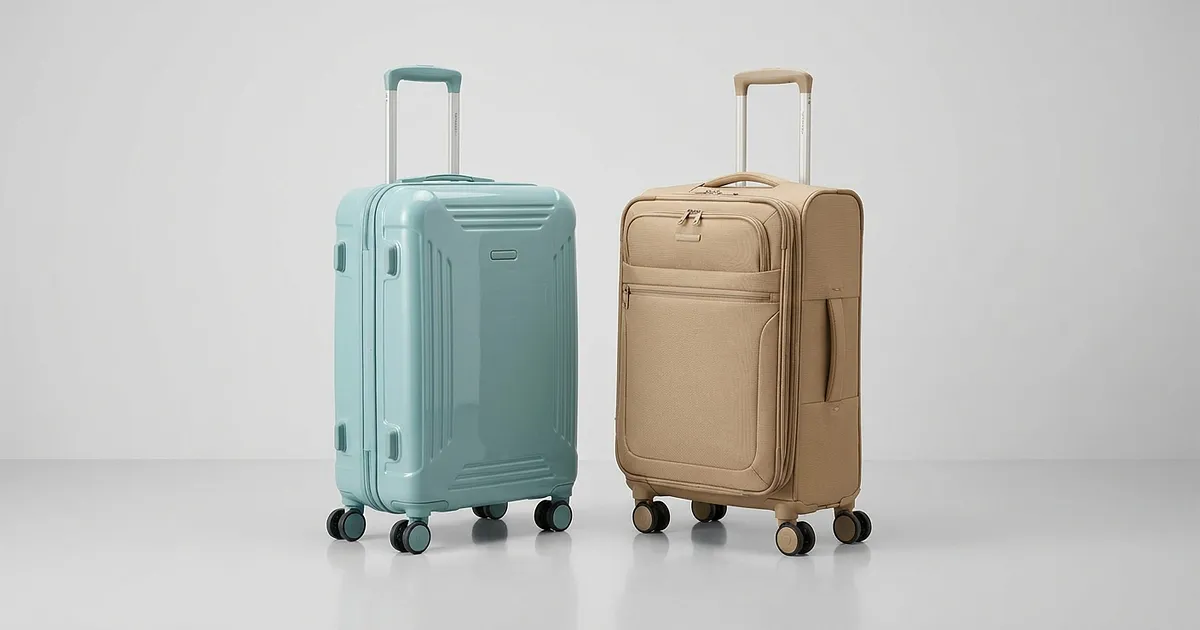
There's barely a luggage question that splits people as reliably as this one. Hard shell vs soft shell suitcase, that's the debate running through your head before every bigger trip. One person swears by the rigid plastic shell, another won't give up their fabric case for anything. And honestly? They're both right. Just for different trips.
We'll walk through the difference between a hard shell and a soft shell case here, factor by factor. No "test winner" fluff, no pretending we dragged each case around the world ourselves. Just the facts, the sources behind them, and a clear read on which type suits which traveler.
Weight and baggage allowance: where the real math starts
Almost every comparison online treats weight as a convenience thing. Lighter case, less to lug, done. For us, though, the real math starts right here, at the airport check-in desk.
Because every kilo the empty shell weighs comes straight off your baggage allowance. According to Traveler's Choice (March 2026), empty hard shell carry-ons average roughly 3.2 to 4.1 kg, while soft shell ones sit closer to 2.3 to 3.2 kg. Sounds like nothing. It isn't.
Do the math with me. On Lufthansa, most Economy fares include 23 kg per checked bag, with a hard single-piece ceiling of 32 kg (as of July 2026). If your shell weighs a kilo more, that's a kilo less for shoes and the second sweater, never mind the souvenirs. A kilo of plastic instead of a kilo of holiday, if you like.
Before you settle on a shell, it's worth checking the carry-on luggage dimensions for 2026 too, so your case doesn't cause trouble at the check-in desk.
For frequent flyers and anyone juggling tight budget-airline limits, the soft shell often wins here. But careful, this isn't a law of nature. Modern hard shells made from polypropylene or composite materials have closed the gap a lot. Some ultralight hard shells now sit closer to a cheap fabric case than you'd think.
What material is behind a hard shell and a soft shell?
"Hard shell" doesn't mean one thing, and neither does "fabric." If you really want to understand the hard shell soft shell difference, you have to glance at the material for a second. Don't worry, this won't turn into a chemistry lecture.
Hard shell: polycarbonate, ABS, and polypropylene
Three plastics share the market. According to Travelpro, polycarbonate makes up over 40 percent of hard shell cases and counts as the most impact- and crack-resistant of the common materials. It flexes on impact and springs back instead of shattering.
ABS is the cheap entry material. Light, affordable, but more brittle, and more prone to cracking at the corners. Polypropylene sits between the two and is the lightest of the three. So when you're holding a polycarbonate suitcase, you're usually holding the most durable option.
A classic in this category is the Samsonite S'Cure, a pure polypropylene shell with built-in combination locks instead of a zipper. Samsonite S'Cure Spinner L Hartschalenkoffer, 75 cm, 102 L, Schwarz
Why the lock design is a genuine advantage, we'll get to in a moment.
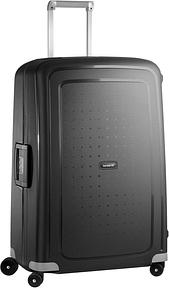
Samsonite S'Cure Spinner L Hartschalenkoffer, 75 cm, 102 L, Schwarz
View at Amazon (as of Aug 11)Affiliate link. Buying through it earns us a commission; the price stays the same for you.
Soft shell: polyester and nylon
The soft shell case, often just called a fabric case, is usually polyester or the tougher nylon over an internal frame. The fabric gives, compresses, and absorbs small knocks without keeping a dent. In exchange, it's more vulnerable to cuts and abrasion, and sustained wet weather eventually gets to it too.
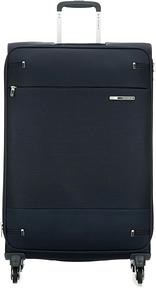
A solid pick with an expansion zip and the usual outside pocket is the Travelite VIIA. Travelite 4-Rad Koffer Größe L Weichschale aus recyceltem Material, Gepäck Serie VIIA: Trolley mit Dehnfalte + Kantenschutz, 77 cm, 91-103 Liter
Those outside pockets, by the way, are one big reason plenty of soft shell fans refuse to switch.
Not available in your region — closest match
Samsonite Base Boost Weichgepäck-Koffer (66 cm)
View at Amazon (as of Aug 11)Affiliate link. Buying through it earns us a commission; the price stays the same for you.
Durability and security in the cargo hold
Now it gets interesting, because a myth persists here. People assume hard shell means automatically safe and soft shell means fragile. Reality is more nuanced.
Stiftung Warentest, the German consumer testing body, checked 17 cabin cases, 11 hard shell and 6 soft shell (bought November 2025, prices as of March 2026). Five failed. And here's the part almost no comparison online mentions: they didn't fail on durability. They failed on chemicals. In the handles and outer materials of several soft shell cases, testers found PAH and PFAS compounds, some of them suspected carcinogens.
That flips the old story. Not "soft shell breaks faster," but "with some soft shells, it's worth a look at material safety." Durability itself was fine on most tested cases of both builds.
Still, one solid advantage stays on the hard side. In the cargo hold, your case spends the flight stacked between other bags, on wet tarmac, over rough belts. Exactly the conditions where fabric picks up the most cosmetic wear. If you regularly check fragile things, a hard shell lets you breathe easier. A model with an all-round frame and plenty of volume for the big trip is the American Tourister Ellipso. American Tourister Ellipso Hartschalenkoffer Groß (79 cm)
Both brands keep coming up here, and if you're torn between them, our Samsonite vs American Tourister comparison breaks down where they actually differ.
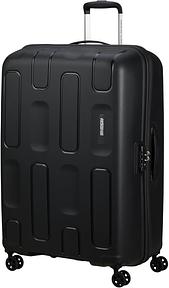
American Tourister Ellipso Hartschalenkoffer Groß (79 cm)
View at Amazon (as of Aug 11)Affiliate link. Buying through it earns us a commission; the price stays the same for you.
Theft protection: why a TSA lock isn't everything
This one caught me off guard the first time I read it. A TSA lock doesn't actually make your case theft-proof.
According to Traveler's Choice, an ordinary zipper coil can be forced open with a plain ballpoint pen. You stab through the zipper fabric, the pull springs open, and afterward you just zip it back shut. No visible trace. Meanwhile the TSA lock hangs on the pulls untouched, suggesting a security that isn't really there.
And here's the key part: this affects any zippered case, hard shell or soft. Real protection only comes from latch or drawbolt closures instead of zippers, and by design you only find those on hard shells. For business travelers carrying a laptop and documents, that argument outweighs any color or brand.
Packing flexibility and expandability
Here the soft shell strikes back, and clearly. There are two things a fabric case does that a rigid shell simply can't.
First, the outside pockets. Laptop, passport, the jacket for the chilly plane, all within reach without having to open the whole case. Second, the expansion zip. One zipper all the way around, pulled open, and suddenly there's room on the way home for the extras nobody planned for on the way out.
With the right suitcase packing tips, you'll use that expansion zip even smarter.
AFAR editor Laura Dannen Redman long described soft shell cases as a byword for travel flexibility, from a weekend to a full week. One catch, though: she's since switched to a hard shell herself. A small hint of how much the rigid models have caught up on comfort.
A hard shell packs differently. Two halves, both the same depth, both with straps. Tidy, easy to see, pleasant to unpack at the hotel. Just not expandable. Full is full.
If you want that flexibility without giving up a familiar name, you often land on the Samsonite Base Boost, a light soft shell with an expansion zip. Samsonite Base Boost Weichgepäck-Koffer (66 cm)
Samsonite Base Boost Weichgepäck-Koffer (66 cm)
View at Amazon (as of Aug 11)Affiliate link. Buying through it earns us a commission; the price stays the same for you.
Water resistance
Short and honest, because this topic gets overrated. A hard shell keeps tarmac rain off better, sure. The seams and zipper of a soft shell will eventually soak up water in sustained wet weather.
The reason comes down to construction. A hard shell is usually two continuously molded half-shells joined together, so the only real weak point is the zipper running around the perimeter. A soft shell, by contrast, is basically one big seam construction end to end, fabric panels stitched together and attached to the internal frame. Every seam is a potential water path, even though modern soft shells often use coated fabric that makes splashes bead off at first. Almost no suitcase, hard or soft, actually carries a genuine IPX water rating the way a phone or an action camera does. Properly waterproof, in the technical sense, describes almost nothing on the market. "Water resistant" is the more honest label either way.
Concrete scenario: you're standing at the gate, it's pouring, and your case waits ten minutes on the open tarmac before it gets loaded. With a hard shell, you just wipe the surface dry afterward and you're done. With a soft shell, moisture can work its way through the seams into the interior, especially if the case is lying flat on its back instead of standing upright. One rain shower rarely soaks anything through completely, but string together a few connections in the rain and the risk adds up.
For most trips, that's not a dealbreaker. Your case rarely stands in a downpour for hours. But if you regularly fly into wet regions or haul your case on open trailers and roof racks, the hard shell is the more carefree choice. A cheap rain cover solves it pretty well for soft shells too, and it barely adds any weight of its own.
Price: what does each build really cost?
On money, there's no blanket "cheaper." Both builds cover the full price range, from a discount set to a premium model.
Roughly: ABS hard shells and simple polyester soft shells are the cheapest ways in. Polycarbonate sits in the middle. Composite materials like Samsonite's CURV or aluminum play at the top end. If you're buying for the first time and don't fly constantly, you don't need to spend a fortune.
A solid, affordable hard shell model is the Hauptstadtkoffer Mitte, which strikes a fair balance on volume and price. Hauptstadtkoffer Mitte Hartschalenkoffer (68 cm)
And if you only travel now and then and just want a light cabin set, the Amazon Basics soft shell set is a budget-friendly way in. Amazon Basics Weichschalen-Koffer-Set Handgepäck (58 cm)
A tip from experience: the cheapest case is rarely the best value. A zipper that quits after three trips, or a wheel that gives up, costs you more in the end than the twenty euros you saved at the till.
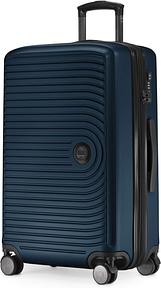
Hauptstadtkoffer Mitte Hartschalenkoffer (68 cm)
View at Amazon (as of Aug 10)Affiliate link. Buying through it earns us a commission; the price stays the same for you.
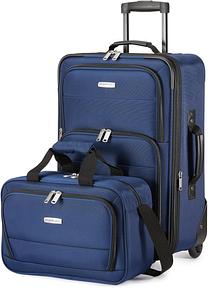
Amazon Basics Weichschalen-Koffer-Set Handgepäck (58 cm)
Affiliate link. Buying through it earns us a commission; the price stays the same for you.
Which suitcase for which type of traveler?
Enough theory. Here's the honest breakdown by traveler type, because "better" doesn't exist, only "better for you."
The weekend and city-break traveler. Soft shell, no question. You're rarely gone more than three or four days, you throw in an extra layer at the last minute, and the outside pockets plus expansion zip are built for exactly this kind of trip. Our picks for lightweight carry-on luggage show models that shave off even more weight.
The long-haul, checked-bag traveler. Two weeks, big case, everything goes in the hold? Hard shell. The protection against stacking and rough handling pays off here, wet tarmac included. And you can wipe it clean afterward too, as AFAR travel editor Lyndsey Matthews points out.
The business traveler. Laptop, documents, often on the train or at the hotel? Hard shell with a latch lock, for the security. You lose quick pocket access, but the theft protection matters more.
The family traveler with kids. Juice, sand, a cookie that somehow ends up smeared across the lid, something always finds its way onto the case. Hard shell, because you can wipe it clean in two minutes and it shrugs off life with kids far more calmly.
The budget-minded occasional traveler. One or two trips a year, budget matters? Both builds have cheap entries. Take whichever feels sturdier, and check the wheels.
At a glance:
Weekend trip → soft shell
Long-haul with checked luggage → hard shell
Business travel → hard shell with a latch lock
Family trip with kids → hard shell
Occasional trip on a budget → either works, check robustness and wheels
Decided on the hard side and want to know which specific models actually hold up? Then check our hard shell suitcase test 2026, where we go model by model.
The verdict
Hard shell vs soft shell suitcase: there's no winner in this duel, and anyone telling you otherwise is probably selling you something right now. Soft shell means light and flexible, with outside pockets you'll actually use. Hard shell means protection and easy cleaning, plus, with the right lock, genuine security.
My pragmatic advice: start with your typical trip, not the case. If you fly a lot, weigh empty and watch your allowance. If you check fragile things, go rigid. If you want to pack flexibly, stay soft. That simple, that honest.
And if you're unsure which case fits your next airline, we've untangled the baggage rules of the major carriers for you, so you don't pay extra at the desk.
All products from this post
The ones we named above are marked; the rest are alternatives in the same category.
Not available in your region — closest match
Samsonite Base Boost Weichgepäck-Koffer (66 cm)
View at Amazon (as of Aug 11)
Amazon Basics Weichschalen-Koffer-Set Handgepäck (58 cm)
Affiliate notice: As an Amazon Associate, we earn from qualifying purchases. Product prices and availability are subject to change.
Frequently Asked Questions
Is a hard shell or soft shell suitcase better?
Neither is better across the board. Soft shell cases are usually lighter and more flexible, with outside pockets and an expansion zip, great for short trips. Hard shell cases protect fragile contents better, wipe clean easily, and are the calmer choice in the cargo hold. Decide by your travel type, not by some supposed overall winner.
Which suitcase is best for flying?
It depends on your baggage allowance. Every kilo of empty shell comes off your weight limit, so light soft shells shine under tight budget-airline caps. But if you check fragile items into the hold, a hard shell is the safer pick. When in doubt, weigh the case empty before you buy.
What are the downsides of a hard shell suitcase?
It's often heavier than a comparable fabric case, which eats into your allowance. There are no outside pockets for quick access, and it can't expand via a zip. Cheap ABS models can crack at the corners. In return, it protects better and cleans up easily.
Are soft shell suitcases really lighter?
Usually yes, but not always. On average, empty soft shells weigh less than hard shells of the same size. Modern hard shells in polypropylene or composite have narrowed that gap a lot, though. Some ultralight hard shells now sit close to a cheap fabric case, so a direct weight comparison is worth it.
Is a TSA lock actually secure?
Only up to a point. An ordinary zipper coil can be forced open with a ballpoint pen, leaving no visible trace, while the TSA lock hangs on untouched. This affects hard and soft shells with zippers alike. Real protection only comes from hard shells with a latch or drawbolt closure instead of a zipper.