Sports Equipment on a Plane 2026: Golf Clubs, Surfboards and Dive Gear
 13 min read
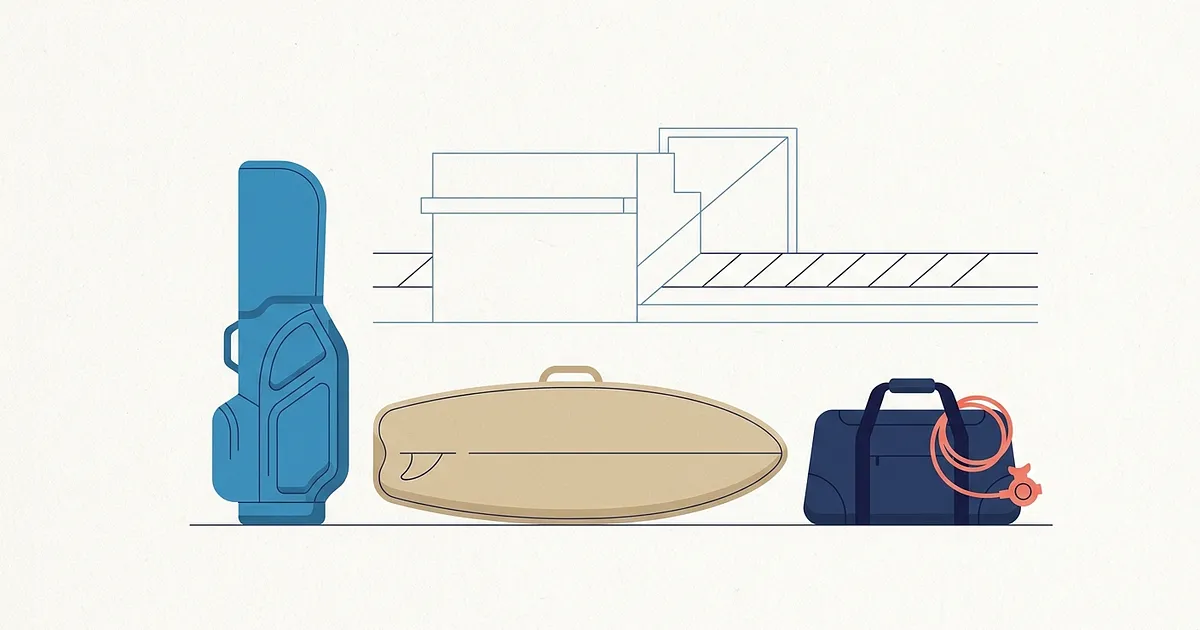
My friend Thomas did the maths back in March, two weeks before his flight to Fuerteventura. Ticket: 79 euros. Golf bag: 54 euros. Per leg, obviously. He took the clubs anyway and then sent me a very long voice message about it.
Taking sports equipment on a plane is almost never free. That's the exact point where most guides go vague on you. They write "usually for a fee" and then no number ever shows up. So, concretely, as of September 2026: most airlines charge somewhere between 30 and 115 euros per leg, and budget carriers sit at the top of that range. Add registration deadlines of eight to 72 hours before departure, and missing one leaves you at the desk with a problem instead of a board.
I've split this into golf, surfing and diving, each with its own trap. Then the airline table, ten carriers. And the diving section gets slightly legal, because there it isn't the airline making the call.
Short answer: Sports gear counts as chargeable special baggage at almost every airline. Expect 30 to 115 euros per leg, a 20 to 32 kg limit, and mandatory registration eight to 72 hours before departure. Dive cylinders only fly completely empty.
Sports equipment on a plane: special baggage vs oversized baggage, what's what?
Four terms that get mixed up constantly. Sorted quickly:
Special baggage is the umbrella term for anything outside the normal frame, so above roughly 158 cm total dimensions or 23 kg.
Sports baggage is the sub-category holding golf bags, boards, dive kit, skis and bikes. Some airlines price it separately, some don't bother.
Oversized or bulky baggage means the same thing as special baggage in everyday use, and searching for it turns up identical rules.
Excess baggage is something else entirely: pure extra weight on your normal suitcase, billed per kilo, unrelated to sports fees.
According to flug-gepaeck.de, the difference mostly comes down to size, weight and which sport you're doing. Sounds trivial. It's also why the same board gets two wildly different prices at two airlines.
One more thing before we get into it. At several airlines the fee doesn't buy you extra capacity. easyJet's sports equipment charge is a handling fee, and the item's weight still comes out of your normal allowance. I only understood that properly when a reader forwarded me their invoice.
Golf clubs on a plane: the most expensive of the three
Golf is where comparing carriers pays off fastest. A packed golf bag hits 15 to 18 kg without trying, and the airlines are well aware.
Lufthansa handles a golf set as special baggage, clubs plus balls, tees and one pair of shoes. Up to 32 kg and 220 cm total, from around 50 euros, registered up to 72 hours ahead. Ryanair and easyJet just file the same bag under "large sports equipment" with a 20 kg cap and a flat per-leg price. easyJet asks 43 euros online for golf clubs and 54 if you only remember at check-in.
And that's where the maths tips over. On a short budget route your bag costs nearly as much as your own seat. Thomas paid 108 euros for the return trip. A rental set at the resort would have run him about 90, trolley included, at least by his own research.
There is one genuine exception. Turkish Airlines carries one set of golf clubs free of charge on international flights through 31 December 2026. That's a dated promotion, not a permanent policy, so if you're reading this after New Year, I'd check it again.
Picking a travel cover
Handing a golf bag to the baggage system without a cover is brave. I've never watched a shaft snap myself, but I've met plenty of golfers it happened to.
Two basic types: the padded soft travel cover with wheels, and the hard case. The hard case protects better and weighs more, which stings under a 20 kg cap. The soft one is the compromise most people land on.
Skip the sizing guesswork. golfsportmagazin.de points out that internal dimensions vary a lot between models, so measuring your own club bag before buying a cover is worth the five minutes. Sounds like a detail. It's also why people end up returning covers.
What I'd look at:
- Reinforced corners top and bottom, since that's where the clubs knock
- Heavy zips with a double slider so a TSA lock can go through
- An internal address pocket as well as the luggage tag, because tags tear off
- Wheels that survive cobblestones
- Enough room left over to stuff towels in as padding
That last one is the cheapest trick going. Towels, rain jacket, socks. Anything already coming with you goes into the bag and cushions the clubs. Plus you free up suitcase space.
Surfboards on a plane: the part nobody explains
Search for board packing technique and you'll find a surprising amount of nothing, at least in any depth. Fee tables are everywhere. Actual technique isn't. And technique is what decides whether your board lands intact.
Costs first. Ryanair has classified surfboards as large sporting goods since 2026 and charges £60/€60 online, £70/€70 at the airport, with a 20 kg allowance and £13/€13 per extra kilo. easyJet sits in the same region at 52 euros online and 64 at the desk, though with a 32 kg limit.
What annoys me about this: length limits often aren't printed next to the fee, and they vary enormously. Some carriers take anything up to 300 cm, others stop at 200. A 9'2" longboard is simply untransportable on certain routes, whatever you're willing to pay. So for surfers, choosing an airline is part of the packing decision, not just a price question.
How to pack a board for a flight
Before wrapping anything, freshsurf.de says the fins have to come off and the rails need bubble wrap or foam pipe insulation. Fins are the classic failure point. They stick out, they take the full load, and in the worst case they rip the box out with them.
The routine I hear from surfers again and again:
- Fins off, screws into a ziplock bag, ziplock into your carry-on. Otherwise you're hunting for them in Portugal.
- Nose and tail get wrapped thickly. Probably 80 percent of damage happens there.
- Rails wrapped in foam pipe insulation from a hardware shop. Under five euros a metre and better than most specialist sleeves at the same price.
- Wetsuit, towels and clothes layered into the board bag. Used twice, padding twice.
- A "fragile" sticker. Honestly, I don't know whether it helps. It doesn't hurt.
And a day bag isn't a travel board bag. The thin thing you walk to the beach with has no business in a cargo hold. A proper travel bag has at least 8 to 10 mm of padding, reinforced nose and tail, and ideally wheels.
Flying with dive gear: here a regulator authority has a say
Diving works differently. With golf and surfing, the argument is about money. With diving it's dangerous goods law, and that isn't negotiable.
According to the German Luftfahrt-Bundesamt, a dive cylinder counts as dangerous goods once its pressure exceeds 2 bar at 20°C. Only fully depressurised cylinders may travel at all, and security staff can require the valve to be left open for visual inspection. That's a federal aviation authority rule, not an airline preference, so it holds whoever you fly with.
The airlines write it into their own terms. At TUIfly, the official conditions require dive cylinders to be completely emptied before they can be checked in. At Condor, sports baggage has to be registered at least eight hours before departure, the maximum weight is 30 kg, and tanks travel empty with valves open.
So "pretty much empty" doesn't cut it. It's a hard number.
One detail almost nobody mentions: dive lights. TUIfly wants those registered separately by phone, with batteries travelling apart from the lamp housing because of short-circuit risk. If you're carrying a powerful light, I'd make the call. Five minutes on the phone beats the argument at the desk.
What belongs in your carry-on
Most experienced divers work like this: the cylinder and the weights stay home and get rented locally. Both are heavy, bulky and available everywhere. What travels is whatever is personally fitted or hard to replace.
Carry-on: regulator, dive computer, prescription mask. The regulator is the single most expensive piece you own and the most exposed in the hold. Checked: wetsuit, fins, BCD, boots.
And the most useful sentence on the whole topic comes from divers themselves. Never rely on a blanket "allowed," says tauchliebe.de, because every airline, every fare class and even the departure airport can apply different rules. On codeshare flights the operating carrier's policy often applies rather than the one printed on your ticket. Every segment needs checking separately. Yes, it's tedious. Still cheaper than a confiscated cylinder.
Sports baggage fees compared: 10 airlines in 2026
Ten carriers and their sports equipment fees for a plane, relevant for golf, surf and dive trips out of Europe. All figures per leg, as of September 2026.
| Airline | Golf | Surfboard | Dive gear | Max weight | Registration |
|---|---|---|---|---|---|
| Lufthansa | from approx. €50 | from approx. €50 | from approx. €50 | 32 kg, 220 cm | up to 72 h ahead |
| SWISS | from approx. €50 | from approx. €50 | often within allowance if declared | 32 kg | up to 72 h ahead |
| Austrian Airlines | from approx. €50 | from approx. €50 | from approx. €50 | 32 kg | up to 72 h ahead |
| Eurowings | from approx. €60, route-dependent | from approx. €60 | from approx. €60 | 30 kg | at booking |
| Condor | $70 to $115 pre-booked, $145 to $160 at airport¹ | same | same, tank empty, valve open | 30 kg, 200x40x100 cm | min. 8 h ahead |
| TUIfly | special baggage rate | special baggage rate | empty cylinders only, lights registered separately | 30 kg | in advance, else penalty around €100 |
| Turkish Airlines | 1 set free through 31 Dec 2026 | chargeable | chargeable | 32 kg | at booking |
| Ryanair | €60 online, €70 airport | €60 online, €70 airport | €60 online, €70 airport | 20 kg, then €13/kg | online only, in advance |
| easyJet | €43 online, €54 airport | €52 online, €64 airport | €52 online, €64 airport | 20 kg golf, 32 kg large | at booking |
| Wizz Air | approx. €50 to €70 | approx. €50 to €70 | approx. €50 to €70 | 32 kg | at booking |
An honest note on that table. The Condor, Ryanair, easyJet and Turkish Airlines figures come straight from those airlines' own pages. The Lufthansa, SWISS, Austrian, Eurowings and Wizz Air numbers are guide values from airline statements and comparison sources, because those fees swing with route and fare class. ¹ Condor quotes its amounts in dollars on the US site, and the euro figures on the German site can differ slightly.
Also worth saying plainly: baggage fees change at least annually. If your airline raises them between today and your flight, nobody emails you about it. Two minutes on the carrier's own page before booking covers you.
Three assumptions about sports equipment on a plane that get expensive
"Sports gear is just normal luggage." It isn't. It's special baggage with its own price. The genuinely free cases are promotions like the Turkish Airlines one, or situations where your existing allowance already covers it.
"I'll register at the airport." Condor wants eight hours' notice, the Lufthansa Group carriers up to 72. Without registration there's no transport guarantee, and TUIfly adds a penalty of roughly 100 euros on top. The desk is not where this gets negotiated.
"It worked on the way out, so it'll work coming back." Not necessarily. Different airline, different airport, different fare class, different rule. Codeshare itineraries especially.
What I do before any sports flight
Four things I check before flying with sports equipment on a plane, in this order. First, I read the fee on the airline's page, outbound and return separately. Second, I compare it against local rental, especially for clubs and tanks. Third, I register as soon as the ticket is confirmed rather than the night before. Fourth, I pack with what's coming anyway, so towels and clothes as padding.
Honestly, I skipped the first two for years and once paid 70 euros for a board I could have rented for 40 a week on arrival. One time is enough tuition.
If you do bring your own gear, I'd rather see the money go into protection than into a faster booking. A cover with reinforced corners costs once. A snapped shaft costs every time.
Frequently Asked Questions
How much does sports equipment cost on a plane?
Between 30 and 115 euros per leg, depending on airline and route. Budget carriers use flat rates: Ryanair charges €60 online, easyJet €43 for golf clubs and €52 for large sports equipment. Condor prices by destination zone and charges considerably more at the airport than pre-booked. Lufthansa Group carriers start at around 50 euros.
Do I have to register sports baggage in advance?
Yes, at practically every airline. Condor requires registration at least eight hours before departure, while Lufthansa, SWISS and Austrian allow up to 72 hours ahead. Without it there's no transport guarantee, and some carriers such as TUIfly add a penalty fee. Registering right after you book the ticket is the safest habit.
Can you take a scuba tank on a plane?
Only completely empty. Above 2 bar at 20°C a dive cylinder counts as dangerous goods and cannot be transported. Security staff may require the valve to be left open for visual inspection, and flights to the US sometimes ask for the valve to be removed entirely. Most divers rent the cylinder at the destination instead.
Does dive gear count as special baggage?
Yes. Dive equipment falls under sports baggage, which sits within the special baggage category. A 30 kg limit and a separate fee are typical. Regulator, dive computer and prescription mask belong in carry-on because they're expensive and fragile. Wetsuit, fins and BCD travel in the hold.
Can I check golf clubs as normal luggage?
Usually not. A golf bag exceeds the standard 158 cm total dimension at most airlines and gets billed as special baggage. Lufthansa allows up to 32 kg and 220 cm, easyJet only 20 kg. The exception is Turkish Airlines, which carries one set free on international flights until the end of 2026.
How do I pack a surfboard for a flight?
Unscrew the fins and put the screws in your carry-on. Wrap nose and tail thickly in bubble wrap, since most damage happens there. Protect the rails with foam pipe insulation from a hardware shop. Layer your wetsuit and clothes into the board bag as extra padding. A thin day bag won't survive the hold, so you need a real travel board bag.