Aluminium Suitcase Test 2026: Real Full-Aluminium or Just the Look?
 12 min read
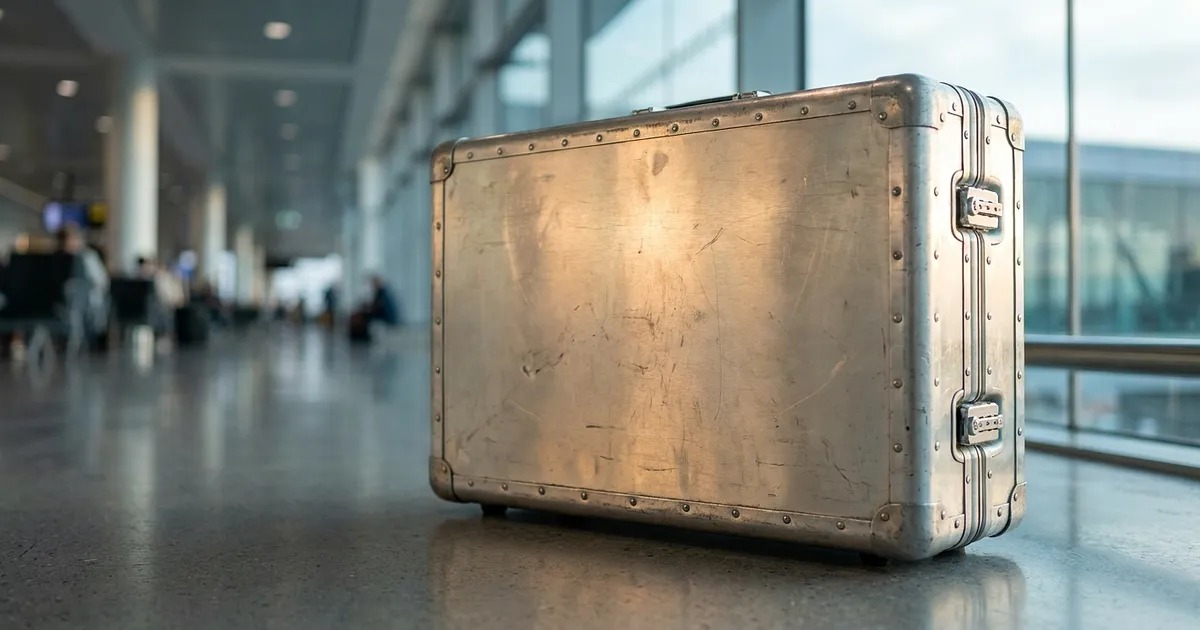
You go looking for an aluminium suitcase and trip over shiny silver models for 89 euros. Real metal? Not a chance. That's exactly where the trouble starts, and it's the whole point of this aluminium suitcase test 2026: what counts as real full-aluminium, what's just alu-look painted plastic, and when the premium is even worth paying.
We didn't throw 20 suitcases through a drop-test rig. Honestly, almost nobody has done that properly for aluminium, more on that later. What we did do: sort through the available data, weigh manufacturer specs and material figures against real owner reports, and turn it into a buying decision that keeps you out of the next alu-look trap.
Real full-aluminium vs. aluminium look: the difference nobody explains
Let's be blunt, because this is where most buyers get taken for a ride. "Aluminium suitcase" isn't a protected term in a product title. It sits on three completely different things:
Full-aluminium (solid alu shell): the entire shell is aluminium sheet, riveted at the edges. The real deal. A hard-shell suitcase made of aluminium ends up sturdier but heavier than any polycarbonate equivalent.
Alu frame: a plastic shell (polycarbonate or ABS) with an aluminium frame instead of a zip. Metal is there, but only along the edges.
Alu look: painted or metallic-coated ABS with no aluminium content at all. Purely cosmetic.
So how do you tell them apart before you click buy? Four things give it away every time.
The price. According to reisetrolley.org, genuine full-aluminium trolleys start at around 700 euros, while shiny models under roughly 200 euros are almost always painted ABS in an aluminium look. Sounds harsh, but it's the best first filter you've got.
Does the case really weigh what it claims? A real cabin-sized alu case comes in at about 4 to 5 kilos. If the listing says 2.5 kilos next to the word "aluminium," it isn't aluminium.
Look closely at the seams: real alu shells are visibly riveted, not seamlessly moulded. One glance at the product photos along the edges usually gives it away.
The closure. Full-aluminium and alu-frame cases almost never use a zip. They use clamp latches instead. A silver case with a zip? Alu look, most likely.
Above all, remember the price filter. If an "aluminium suitcase" costs 79 euros, the colour is the only aluminium on it.
Aluminium Suitcase Test 2026: The Best Models by Price Tier
Now for actual models. Aluminium suitcases are ultimately a special case of the hard-shell suitcase, for a broader look at materials and models, see our hard-shell suitcase test. We picked one per price tier that's honest about what it really is. And yes, in the budget tier that's deliberately not full-aluminium but a solid alu frame. Anything else at that price would be a lie. All prices as of August 2026, and Amazon prices shift constantly.
Budget: an alu frame instead of an alu fairy tale
Want a silver suitcase under 100 euros? You won't get full-aluminium. Full stop. What you can get is a sturdy polycarbonate shell with a genuine aluminium frame, and that's more honest than any painted ABS box.
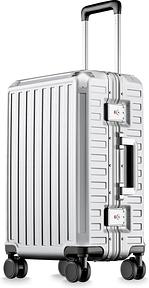
The LUGGEX Koffer Trolleys, Koffer Klein ohne Reißverschluss, 100% PC Hartschalenkoffer Reisekoffer mit Aluminium Rahmen, 8 Spinner Rollen, TSA Schloss, Silber, 55,8 x 37 x 24 cm, 36L is exactly that kind of model: 36 litres, small format without a zip, PC hard shell with a surrounding alu frame, TSA lock, at 99.99 €. With over 1,000 reviews and 4.4 stars, it's proof that an alu frame is plenty for weekend trips, without paying the full-alu premium. For beginners who want the look and are watching the budget, that's our honest pick. If you want more choice in the budget segment, our budget cabin luggage test has you covered.
Affiliate link. Buying through it earns us a commission; the price stays the same for you.
Mid-range: more volume, alu frame for the big trip
One step up, still built on the tough frame principle rather than a solid shell, sits the Travelhouse® London Aluminium-Rahmen Koffer Trolley 102L Schwarz. 102 litres, aluminium frame, zipless, at 199 €. Over 800 reviews at 4.2 stars say plenty: this is the case for people who pack a lot, value the frame's protection and still don't want to pay full-aluminium money. For a two-week family holiday with checked luggage, a sensible choice.
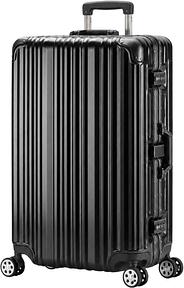
Travelhouse® London Aluminium-Rahmen Koffer Trolley 102L Schwarz
View at AmazonAffiliate link. Buying through it earns us a commission; the price stays the same for you.
Premium: real full-aluminium for the big shell
If you want actual metal in checked-suitcase size, there's barely a way past the Travelhouse® Oslo M Koffer Trolleys ohne Reißverschluss Silber 70L. The Oslo M is 100% full-aluminium, 70 litres, zipless, at 289 €, and with over 400 reviews at 4.3 stars it's one of the most-reviewed genuine alu cases in this bracket. Not a 700-euro Rimowa, sure, but honest solid aluminium at a price that doesn't sting. If you want that rigid alu look for your checked shell and can live with a few extra kilos, this is your case.
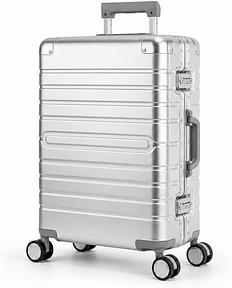
Travelhouse® Oslo M Koffer Trolleys ohne Reißverschluss Silber 70L
View at AmazonAffiliate link. Buying through it earns us a commission; the price stays the same for you.
An aluminium suitcase as cabin luggage: does it even fit?
This is where it gets interesting, and where the right answer sits for most travellers. Because an alu case in the hold gets thrown, stacked and crushed by baggage handling. An alu case as your carry-on? You carry it, you stow it, you treat it like your own child. That's exactly where aluminium plays to its strengths without fully eating the downside.
The standard cabin dimensions at most airlines sit around 55 x 40 x 20 cm, though IATA's "Cabin OK" recommendation nudges towards 55 x 35 x 20 cm. How tight it really gets airline by airline, we break down in our cabin baggage sizes by airline. The key thing for alu: the rigid shell won't give a millimetre. A polycarbonate case can be squeezed into the sizer at a push. An aluminium one can't. So measure carefully first.
For a full roundup of models, see our carry-on luggage test 2026; here are two genuine full-aluminium cabin cases we think make sense from it:
The LUGGEX Aluminium Koffer Handgepäck, 100% Alu Koffer Trolleys ohne Reißverschluss, Hartschalekoffer Reisekoffer mit 8 Spinner Rollen, TSA Schloss, 55 cm, 40L is 100% alu, 55 cm, 40 litres, zipless, with a TSA lock and 8 wheels, at 169.98 €. It's the cheapest real full-aluminium entry on this list, and at 4.5 stars buyers rate it well. If you want real metal in cabin size without dropping 350-plus euros, start here.
If you're willing to pay more for business looks and finish, you land on the LEVEL8 Koffer Aluminium Handgepäck Koffer Trolley mit Doppelte TSA, Alu Reisekoffer Business Cabin Trolley Hartschalenkoffer Reißverschlussloses Gepäck (55cm,35L,Silber). 100% aluminium, 55 cm, 35 litres, double TSA lock, zipless, at 373.96 €. At 4.6 stars it's the highest-rated case in this whole comparison. Pricey, yes. But if it rolls along on every work trip and is meant to last years, that's not a throwaway price, it's an investment.
Honestly? For 80 percent of the people even thinking about aluminium, a cabin case is the better compromise than a big checked alu shell. Less throwing, fewer dents, more joy.
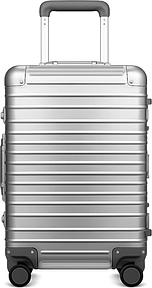
Affiliate link. Buying through it earns us a commission; the price stays the same for you.
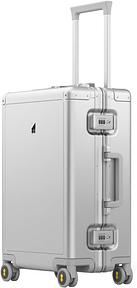
Affiliate link. Buying through it earns us a commission; the price stays the same for you.
Why aluminium suitcases dent (and why that's not a flaw)
Now the big misunderstanding. An alu case with dents isn't a broken case. It's a normally used alu case. That's baked into the physics, not into poor quality.
Plastic flexes. Polycarbonate dents under an impact and springs back into shape afterwards. Aluminium is dimensionally stable up to a point, and then the dent just stays. According to Aluvox, a maker of aluminium cases, aluminium's modulus of elasticity is around 69 GPa versus 2 to 2.4 GPa for polycarbonate. In plain terms: alu is far stiffer, barely gives, and when the load gets too high it deforms permanently instead of bouncing back. Small caveat, Aluvox sells aluminium cases, so their "alu is better" verdict is their side of the story. The material constants themselves still hold.
How much that matters day to day depends entirely on handling. And handling is rougher than you'd think: worldwide in 2025, roughly 24 million bags were mishandled, as SITA reports in its 2026 Baggage IT Insights report. Your checked alu case is not being handled gently.
What does that look like in practice? Owners on the R-L-X forum report their aluminium cases picked up visible dents right where baggage handlers gripped them, after years of near-daily use, in one case badly enough that the frame warped and the two shells no longer closed flush. In the enthusiast community that's called "patina," and plenty of owners wear the dents like a passport full of stamps. Whether you find that cool or annoying is down to taste. But surprised you shouldn't be.
My friend Jonas bought himself a 900-euro alu carry-on back in 2019, convinced the thing would last forever. Three years of frequent-flying later, the corner looked like a battered tin bowl. He still wheels it around proudly.
Honest pros and cons: weight, noise, dents, price
Aluminium isn't a better material than polycarbonate. It's a different one, with different trade-offs. Here's the maths without the marketing. This table sums up what any honest aluminium suitcase test finds: aluminium wins on build quality, loses on weight.
| Criterion | Full-aluminium | Polycarbonate |
|---|---|---|
| Weight (cabin, ~34 L) | approx. 4 kg | 2.7 to 3 kg |
| Impact behaviour | dents permanently | springs back |
| Rolling noise | often louder, rattly | quieter |
| Look over the years | patina, scratches, dents | scratches, looks "cheap" sooner |
| Price (genuine) | from approx. 700 € (brand) | from approx. 60 € |
| Feel / build quality | very high | medium |
Weight is the most honest downside. As Sioux.de explains, an aluminium cabin trolley weighs around 4 kilos versus 2.7 to 3 kilos for a comparable ABS model. On an airline with an 8-kilo cabin limit, that's nearly a kilo and a half less for your own stuff, purely because of the shell. Not nothing. Sioux, mind you, sells polycarbonate, so their "go plastic" conclusion isn't a neutral verdict either. The truth sits somewhere between Aluvox and Sioux.
And what about the famous "Stiftung Warentest aluminium winner"? It doesn't exist. The current cabin-case test from konsument.at, run jointly with Stiftung Warentest, tested 15 models with, among other things, 18 drops from a metre and 50 kilometres of rolling, but there was no dedicated aluminium test field. If a site sells you a "Stiftung Warentest alu winner," they're inventing it. We won't.
When is full-aluminium worth it, and when isn't it?
Now the decision, sorted honestly. Not "alu is great, buy alu," but who actually needs it.
Full-aluminium is worth it if you:
are a frequent flyer looking for a cabin case you handle yourself and want to last for years,
put feel and build quality above everything and can live with patina,
need business looks anyway and the case is a working tool,
see dents as character, not damage.
Steer clear if you:
fly once or twice a year and need every kilo of packing allowance,
want a big checked case that gets thrown around (that's where alu takes the most dents),
have a small budget (then an honest alu frame beats painted ABS),
can't stand rolling noise.
One point almost no buying guide mentions: the after-sales service. On the Vielfliegertreff forum, frequent flyers report multiple repairs on premium hard-shell cases, a sign that warranty and repair service matter at least as much as the material itself. An alu case is a long-term relationship. Ask before you buy what a dent repair or a wheel swap costs, not after.
My personal takeaway after this research? Aluminium is a cabin material, not a hold material. Take it for the case you carry yourself. For the big shell that vanishes into the belly of the plane, good polycarbonate is often the smarter, lighter and cheaper call. And if someone tries to sell you an 89-euro "aluminium suitcase," you now know exactly what's really shining there. That's the whole point of this aluminium suitcase test: check the price, the weight and the rivets before you trust the label.
All products from this post
The ones we named above are marked; the rest are alternatives in the same category.
Affiliate notice: As an Amazon Associate, we earn from qualifying purchases. Product prices and availability are subject to change.
Frequently Asked Questions
How do I spot a genuine aluminium suitcase?
By four things: price, weight, rivets and closure. Real full-aluminium starts at around 700 euros, weighs about 4 to 5 kilos in cabin size, is visibly riveted at the edges and almost always skips the zip in favour of clamp latches. A silver case for 79 euros with a zip is alu look, meaning painted plastic.
Are aluminium suitcases heavier than polycarbonate ones?
Yes, noticeably. An aluminium cabin trolley weighs around 4 kilos, while a comparable ABS model is only 2.7 to 3 kilos. On an 8-kilo cabin limit, that costs you nearly a kilo and a half of your own packing allowance. If you need every gram for your gear, plastic serves you better.
Do aluminium suitcases dent more easily?
Aluminium dents permanently, while polycarbonate springs back after an impact. That's not a quality defect, it's physics: alu is stiffer and deforms for good once the load gets too high. In checked luggage especially, dents are practically unavoidable with regular use. Many owners call it "patina."
Is there an independent aluminium suitcase test from Stiftung Warentest?
No. The current cabin-case test from konsument.at and Stiftung Warentest put 15 models through drop tests and a rolling course, but included no dedicated aluminium field. Sites naming a "Stiftung Warentest alu winner" are making it up. Reliable answers come instead from material data and real owner reports.
Is an aluminium suitcase worth it for occasional travellers?
For most occasional travellers, not really. The premium, the extra weight and the dent risk in the hold only add up if you fly often and value build quality. If you travel once or twice a year, a good polycarbonate case or an honest alu-frame model is cheaper and lighter.