Carry-On Luggage 2026: Spec Sheets Checked Against Airline Limits
 12 min read
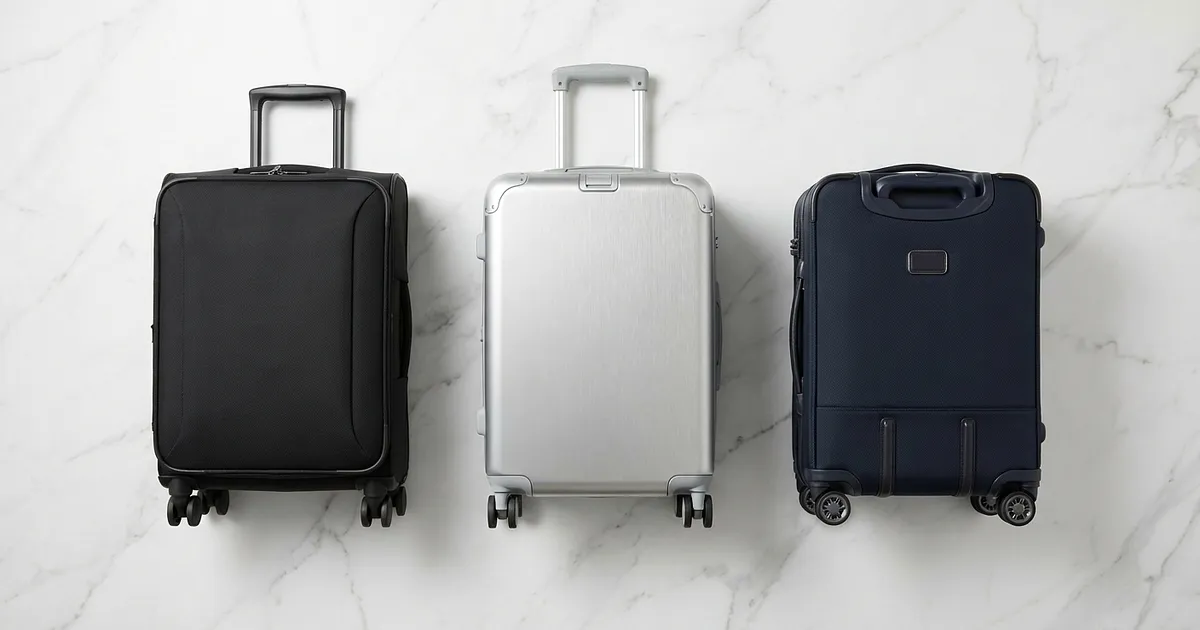
There is no single carry-on size. There are at least six, and they contradict each other.
Ryanair allows 55x40x20 cm with Priority. Lufthansa allows 55x40x23 cm. easyJet allows 56x45x25 cm for its large cabin bag. Air France allows 55x35x25 cm. A case that uses the full easyJet allowance is 5 cm too deep for Ryanair and 10 cm too wide for Air France. At the same time.
And in 2026 that costs more than it used to. Since November 2025, Ryanair pays ground staff €2.50 for every oversized bag they catch, with no monthly cap. easyJet does the same.
So what follows is not a travel diary. It is arithmetic. I took the manufacturers' published figures for the five cases in this article and ran them against the airlines' published limits. Every number in the tables is a stated figure from a spec sheet or listing, not something I measured. Where a manufacturer states nothing, or two listings disagree, that is what the cell says.
Stated specs side by side
Prices are Amazon.de snapshots, As of 2026-07. All dimensions are height x width x depth, exactly as the manufacturer publishes them.
| Model | Outer dimensions incl. wheels and handles | Empty weight | Capacity | Shell | Wheels | Warranty | Price (As of 2026-07) |
|---|---|---|---|---|---|---|---|
| Cabin Max Anode 24 L | 40 x 30 x 20 cm | 2.0 kg | 24 L | ABS | 4 spinners | 3 years | €47.00 |
| Cabin Max Anode 40 L | 55 x 40 x 20 cm | 2.8 kg | 40 L | ABS | 8 spinners | 3 years | £54.95 (cabinmax.com) |
| Samsonite S'Cure Spinner 55/20 | 55 x 40 x 20 cm | 2.9 kg | 34 L | Polypropylene (Flowlite) | 4 double wheels | 10 years | €121.00 |
| BEIBYE hard shell size M, blue | 55 x 36 x 21 cm or 55 x 39 x 24 cm | 2.5 kg or 2.8 kg | 38 L or 45 L | ABS | 4 twin wheels | not stated | €33.00 |
| BEIBYE hard shell size M, chillired | as above, contradictory | 2.5 kg or 2.8 kg | 38 L or 45 L | ABS | 4 twin wheels | not stated | €39.00 |
| BEIBYE M/L/XL set (M piece) | as above, contradictory | 2.5 kg or 2.8 kg | 38 L or 45 L | ABS | 4 twin wheels | not stated | €34.90 |
Two things stand out before any airline gets involved.
First, the most expensive case here is also the heaviest. 2.9 kg for the Samsonite against 2.0 kg for the small Cabin Max. Under Lufthansa's 8 kg cap that is 900 grams of clothing you do not take with you.
Second, BEIBYE's size M appears in two retailer spec sheets with two different sets of dimensions. More on that below, because it genuinely changes the buying decision.
Which case clears which airline limit
Here is the actual calculation. Every limit applies including wheels and handles, which is how the airlines define it. "Fits" means every single edge stays under the stated maximum.
| Case | Ryanair free bag 40x30x20 | Ryanair Priority 55x40x20, 10 kg | easyJet small, free 45x36x20, 15 kg | easyJet large 56x45x25, 15 kg | Lufthansa and Turkish 55x40x23, 8 kg | Air France 55x35x25, 12 kg |
|---|---|---|---|---|---|---|
| Cabin Max Anode 24 L (40x30x20) | exact fit | fits | fits | fits | fits | fits |
| Cabin Max Anode 40 L (55x40x20) | too big | exact fit | too big | fits | fits | 5 cm too wide |
| Samsonite S'Cure 55/20 (55x40x20) | too big | exact fit | too big | fits | fits | 5 cm too wide |
| BEIBYE M at 55x36x21 | too big | 1 cm too deep | too big | fits | fits | 1 cm too wide |
| BEIBYE M at 55x39x24 | too big | 4 cm too deep | too big | fits | 1 cm too deep | 4 cm too wide |
The result is less comfortable than product pages suggest. Only one case in the field satisfies all six limits, and it is the smallest one. The 55x40x20 models fail at Air France, because Air France allows 5 cm less width than Ryanair does. And the BEIBYE models reliably satisfy exactly one limit: easyJet large.
Worth remembering that the weight caps are packed weights, not empty weights. 2.0 kg empty against an 8 kg cap leaves 6 kg for everything else. 2.9 kg empty leaves 5.1 kg. The gap is roughly a pair of shoes plus a pair of jeans.
Why BEIBYE's dimensions do not agree with each other
This was the most interesting thing I found, and it appears on no product page.
BEIBYE sells size M under practically the same title in a long list of colours and sets. Vergleich.org lists size M at 55 x 36 x 21 cm, 2.5 kg and 38 litres. Gepäckheld lists size M from the same set at 55 x 39 x 24 cm, 2.8 kg and around 45 litres. That is a 3 cm gap in width and a 3 cm gap in depth for the same label.
For Ryanair Priority, that gap decides everything. At 21 cm deep you are 1 cm over. At 24 cm you are 4 cm over and you also stop clearing Lufthansa.
Where that leaves me: the BEIBYE Hartschalen-Koffer Trolley Rollkoffer Reisekoffer Handgepäck 4 Rollen (M-L-XL-Set), the BEIBYE Hartschalen-Koffer Trolley Rollkoffer Reisekoffer Handgepäck 4 Rollen - Blau and the BEIBYE Hartschalen-Koffer Trolley Rollkoffer Reisekoffer Handgepäck 4 Rollen - Chillired are usable holiday cases for easyJet and for train travel. I would not buy one as a Ryanair Priority case without reading the depth figure in the specific listing first and measuring the case myself once it arrives. At €33 to €39 that is a fair deal. It is just not a guarantee about size.
One note on the review numbers, because they mislead easily here. All three BEIBYE listings share the same Amazon.de review base of 13,797 ratings, since Amazon pools colour variants. That is one body of evidence, not three independent ones.
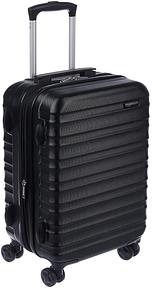
Not available in your region — closest match
Amazon Basics Hard Shell Suitcase, black
View at Amazon (as of Aug 14)Affiliate link. Buying through it earns us a commission; the price stays the same for you.
Not available in your region — closest match
Amazon Basics Hard Shell Suitcase, black
View at Amazon (as of Aug 14)Affiliate link. Buying through it earns us a commission; the price stays the same for you.
Not available in your region — closest match
Amazon Basics Hard Shell Suitcase, black
View at Amazon (as of Aug 14)Affiliate link. Buying through it earns us a commission; the price stays the same for you.
Cabin Max Anode: a 40x30x20 case, not a 55x40x20 case
I need to correct a figure that earlier versions of this article got wrong.
The Cabin Max Anode Handgepäck Koffer Leicht Hartschalen Koffer mit 4 Rollen und Zahlenschloss is not the 55x40x20 model. It is the underseat version. Cabin Max states the Anode 24 L as exactly 40 x 30 x 20 cm with wheels included, 2.0 kg empty, ABS shell, four 360-degree spinner wheels, a three-stage telescopic handle up to 89 cm, and a 3-year warranty against manufacturing faults.
40 x 30 x 20 is not an arbitrary size. It is precisely what Ryanair permits as the free bag under the seat in front of you, a limit Ryanair raised from 40x25x20 on 4 September 2025. So if you fly Ryanair without Priority, this case gives a gate agent nothing to measure against you, and you still get a hard shell rather than a soft holdall.
Paying €47.00 for 24 litres next to €33.00 for 38 or 45 litres looks odd at first. What the extra buys is a dimension you can rely on, plus the 3 years. Whether that is worth €14 depends on how often you fly Ryanair without Priority.
If you want the full 55x40x20 instead, Cabin Max sells the Anode 40 L at 55 x 40 x 20 cm, 2.8 kg, eight spinner wheels and the same 3-year warranty for £54.95 on its own site. It is in the table because it makes the gap between the two limits visible. What Ryanair actually applies to Priority bags is covered in more depth in our piece on Ryanair's stricter hand luggage rules.
Not available in your region — closest match
Amazon Basics Hard Shell Suitcase, black
View at Amazon (as of Aug 14)Affiliate link. Buying through it earns us a commission; the price stays the same for you.
Samsonite S'Cure: 34 litres for 2.9 kilos, and what the warranty excludes
The Samsonite S'Cure - Spinner S Handgepäck, 55 cm, 34 L, Schwarz is the only case here that is not ABS. Spec sheets give 55 x 40 x 20 cm, 34 litres, 2.9 kg and 100 percent Flowlite polypropylene with four double wheels.
Run that against the field. 34 litres at 2.9 kg. The Cabin Max 40 L gives you 40 litres at 2.8 kg. So the Samsonite is heavier and smaller in volume, at roughly double the price. What you get instead is polypropylene rather than ABS, a clip closure rather than a zip, and Samsonite's 10-year warranty.
Which brings up the thing worth knowing before you buy. Samsonite explicitly excludes transport damage, airline damage included, along with normal wear and tear, abrasion and water exposure. The 10 years cover manufacturing defects. The most common real-world suitcase damage happens during loading. Reading that warranty as airline insurance reads it wrong.
Amazon.de rating at the snapshot date: 4.4 stars across 19,614 reviews. That is the lowest star rating in this field and simultaneously the largest sample.
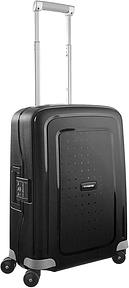
Samsonite S'Cure - Spinner S Handgepäck, 55 cm, 34 L, Schwarz
View at Amazon (as of Aug 11)Affiliate link. Buying through it earns us a commission; the price stays the same for you.
What no spec sheet tells you
Three figures are almost always missing on budget cases, and the absence is itself information.
Empty weight. For BEIBYE it differs by retailer or is simply absent. If you fly against an 8 kg cap, empty weight is the single most useful number on a spec sheet, and it is the worst documented one.
Whether the dimensions include the wheels. Cabin Max says so outright ("wheels included"). easyJet and Air France require it outright. For BEIBYE, nothing states it bindingly. A case whose 55 cm was measured without wheels is over the limit at the gate by whatever the wheels add, and the wheels count.
Who makes the zips and wheels. YKK is treated as the industry standard, and it appears in none of the spec sheets here. A manufacturer that does not name the component usually is not fitting YKK.
On the material difference itself there is lab work: drop tests from 1.2 metres show polycarbonate absorbs impact by deforming, while ABS cracks along the edges. Four of the five cases here are ABS. That explains both the price and the expectation. ABS cases are consumables, not ten-year purchases.
The three-minute check before your first flight
Not a test. Just measuring. But it is the only number you can actually rely on, because it comes from your case rather than from a listing.
- Case on the floor, telescopic handle fully retracted.
- Measure height at the tallest point, so over the wheels and over the handle housing.
- Measure width and depth at the widest points, including exterior pockets and feet.
- Put the empty case on your bathroom scale, note the figure, write it inside the case.
- Hold those four numbers against the table above, for your airline.
If any edge is over the limit, return it while the returns window is open. Do not bet on nobody measuring. Lufthansa's figures in detail, personal item rule included, are in our piece on Lufthansa's hand luggage rules. Eurowings runs its own numbers again, and those are in the Eurowings guide.
Once the case is sorted, the long-haul half still needs a neck pillow.
In short
Fly Ryanair without Priority and the Anode 24 L is the only case here whose dimensions are not up for debate. Fly Lufthansa or Turkish and want volume, and the Samsonite S'Cure works, though it costs double and weighs more than the cheaper Cabin Max 40 L. And if €33 is the budget, take a BEIBYE for easyJet, but read the depth figure in that specific listing first.
The habit I dropped for 2026: trusting a dimension on a product page without checking whether it includes the wheels. That one detail is the difference between fitting and paying a fee the airline sets rather than you.
As of 2026-07
All products from this post
The ones we named above are marked; the rest are alternatives in the same category.
Not available in your region — closest match
Amazon Basics Hard Shell Suitcase, black
View at Amazon (as of Aug 14)
Not available in your region — closest match
Amazon Basics Hard Shell Suitcase, black
View at Amazon (as of Aug 14)
Not available in your region — closest match
Amazon Basics Hard Shell Suitcase, black
View at Amazon (as of Aug 14)
Not available in your region — closest match
Amazon Basics Hard Shell Suitcase, black
View at Amazon (as of Aug 14)Affiliate notice: As an Amazon Associate, we earn from qualifying purchases. Product prices and availability are subject to change.
Frequently Asked Questions
Which carry-on suitcase is the Stiftung Warentest winner?
Stiftung Warentest last examined hand luggage in 2016, and large suitcases in 2021. So there is no current winner from them for 2026, however many sites use the word. Since airline dimensions have changed several times since 2016, a ranking from back then would not map onto today's limits anyway.
Which carry-on size fits the most airlines?
Going by the tariff pages linked above, 40 x 30 x 20 cm is the only size in this comparison that satisfies all six limits checked, because it sits under the smallest of them. If you need more volume and fly an international mix, you end up at 55 x 35 x 20 cm, since Air France caps width at 35 cm.
Is it a problem if my carry-on is 2 cm too big?
With Ryanair and easyJet, yes, now. Ryanair has paid ground staff €2.50 per oversized bag found since November 2025, with no monthly cap. Lufthansa, per the same source, pays no such bonuses.
How do I measure my carry-on correctly?
Including wheels, handles, feet and exterior pockets, with the telescopic handle retracted. That is exactly how easyJet and Air France define their limits. Manufacturer figures do not always use the same method, which is why measuring is worth the three minutes.
How much may a carry-on case weigh when empty?
No airline sets an empty-weight rule, only a packed-weight one: 10 kg for Ryanair Priority, 8 kg for Lufthansa and Turkish Airlines, 15 kg for easyJet, 12 kg for Air France across bag and personal item combined. The cases here run from 2.0 to 2.9 kg empty. Every kilo of case is a kilo less of contents.
Why does one suitcase have two different sets of dimensions?
Because a manufacturer without its own spec sheet spreads figures through retailers, and those figures drift apart. For BEIBYE size M, one retailer says 55 x 36 x 21 cm and another says 55 x 39 x 24 cm. In that situation the more conservative figure is the safe assumption, and measuring replaces both.
Hard shell or soft shell for cabin luggage?
Hard shell protects electronics better and shrugs off rain, but gives you no exterior pockets and will not squash into a full overhead bin. Soft shell is more flexible and often lighter, though it wears through at the corners sooner. For a gate size check the hard shell is at a disadvantage, because it cannot be made narrower.
Sources
- Ryanair allows 55x40x20 cm with Priority ryanair.com
- Lufthansa allows 55x40x23 cm lufthansa.com
- easyJet allows 56x45x25 cm for its large cabin bag easyjet.com
- Air France allows 55x35x25 cm wwws.airfrance.fr
- Ryanair pays ground staff €2.50 for every oversized bag they catch infranken.de
- Cabin Max Anode 24 L cabinmax.com
- Cabin Max Anode 40 L cabinmax.com
- Samsonite S'Cure Spinner 55/20 tradeinn.com
- 10 years shop.samsonite.com
- 55 x 36 x 21 cm vergleich.org
- 55 x 39 x 24 cm gepaeckheld.de
- Turkish turkishairlines.com
- drop tests from 1.2 metres show polycarbonate absorbs impact by deforming, while ABS cracks along the edges eumeworld.com