Carry-On Luggage 2026: Which Suitcase Actually Fits?
 12 min read
59% of carry-on suitcases on the market don't meet their advertised dimensions. That's what TÜV Rheinland found in a 2022 study. Budget models miss the mark by an average of 2.8 cm.
Two or three centimeters. Doesn't sound like much.
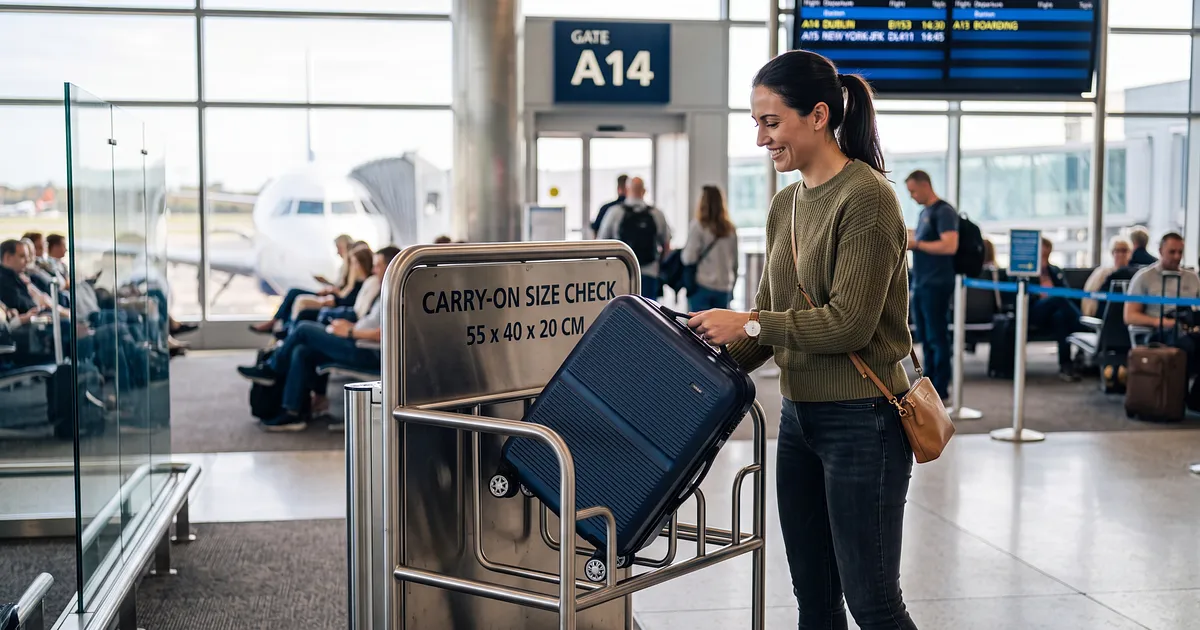
But fly Ryanair with a bag that's 2 cm too wide, and you'll pay up to 70 euros at the gate. Per leg. For a couple on a return trip, that's 280 euros. More than many round-trip tickets cost.
The pattern behind it is always the same. The label says 55x40x20 cm, but the gate template measures wheels and handle too - and that is exactly where the 2.8 cm the TÜV found on budget models comes from. Rely on the manufacturer's figure alone and you end up at the gate with a suitcase the product page calls "Ryanair compatible" that still will not go through the sizer.
This article digs into that: which suitcases comply with which airlines according to manufacturer specs and published airline dimensions, why those specs are so often wrong, and why 2026 is the year you really can't afford to get it wrong.
Why 2026 Changed Everything
Airlines have been tightening enforcement. But what happened in late 2025 made things worse.
According to ADAC research, Ryanair started paying gate staff 2.50 euros per oversized bag they catch. No monthly cap. easyJet introduced the same system.
Think about that for a second. If a gate agent flags 20 bags in a single day, that's 50 euros in bonus pay. Five working days a week? The math adds up fast. Staff have a real financial reason to scrutinize every bag now.
On top of that, Eurowings changed its Basic fare rules. No more cabin trolley in the cheapest fare. If you used to fly Eurowings Basic and just bring your suitcase? That costs extra now.
And then there's the German Consumer Protection Association, which filed lawsuits in 2025 against easyJet, Wizz Air, and Vueling. They want a minimum free allowance of 10 kg and 115 cm total dimensions. That works out to roughly 55x40x20 cm. No final ruling yet.
Honestly? I think enforcement will keep getting stricter throughout 2026. Maybe I'm wrong. But the trend is clear: stricter controls, higher fees, less tolerance.
Carry-On Size Limits: All Major Airlines 2026
Before we talk suitcases, you need to know what your airline actually allows. Every carrier sets its own rules, and the differences are bigger than most people expect.
| Airline | Trolley Size | Personal Item | Weight Limit | Gate Fee Risk |
|---|---|---|---|---|
| Lufthansa | 55x40x23 cm | 40x30x10 cm | 8 kg | 40-55 € |
| Eurowings Smart | 55x40x23 cm | 40x30x25 cm | 8 kg | Included |
| Eurowings Basic | None | 40x30x25 cm | 8 kg | From 18 € |
| Ryanair Standard | None | 40x30x20 cm (in force since 4 September 2025, Ryanair Bag Policy) | N/A | 50-70 € |
| Ryanair Priority | 55x40x20 cm | 40x30x20 cm | 10 kg | 6-20 € |
| easyJet Standard | None | 45x36x20 cm | 15 kg | 40-60 € |
| Wizz Air Standard | None | 40x30x20 cm | 10 kg | 25 € |
| TUI fly | 55x40x20 cm (add-on) | 40x30x20 cm | 10 kg | Varies |
| Condor Classic | 55x40x23 cm (since 1 May 2026, Condor carry-on baggage) | 40x30x15 cm | 8 kg | Varies |
| Turkish Airlines | 55x40x23 cm | 40x30x15 cm | 8 kg | Varies |
Sources: Sorglosfliegen.de, Flug-verspaetet.de
The pattern is obvious. If you want a trolley suitcase that works across the most airlines, 55x40x20 cm is the sweet spot. Anything deeper (like the 23 cm that Lufthansa allows) becomes a risk the moment you book a budget carrier.
But "55x40x20 cm" on the label doesn't always mean 55x40x20 cm in real life. And that's the whole point.
How to Measure Your Suitcase Properly
Most people get this wrong. You look at the product listing, it says 55x40x20, you trust it, you go to the airport.
Then you find out the manufacturer measured the interior. Or left out the wheels. Or the telescopic handle.
The TÜV study proved exactly that. 59% of suitcases are bigger than claimed.
How to actually measure:
- Stand the suitcase upright, as if it were standing next to you
- Measure height from wheels to collapsed handle (the handle matters)
- Measure width at the widest point, including any side pockets or protruding locks
- Measure depth including external zippers, TSA locks, and expansion seams
- Compare against your airline's limits from the table above
If your bag comes in at 57 cm instead of 55, that's enough to fail the sizer. And at the gate, you've got two options: pay or unpack.
Quick tip that sounds obvious but saves money: grab a tape measure and check at home before you leave. Takes 30 seconds.
Carry-On Suitcase Comparison: Our Picks
Based on the airline dimensions above and the TÜV findings, we compared four suitcases across different price ranges using manufacturer specs, published spec sheets and buyer reports. The main question: do they hold their advertised dimensions once wheels and handle are included?
Budget Pick: Cabin Max Anode (approx. 40-55 €)
The Cabin Max Anode is probably the best-known budget carry-on in Europe. 55x40x20 cm, 2.2 kg empty, ABS hardshell.
What convinced me: over 15,000 Amazon reviews at 4.6 stars. The manufacturer explicitly markets it as compatible with Ryanair Priority, easyJet, Wizz Air, and Lufthansa. And based on user reports, the dimensions actually check out.
At 40-55 euros, it's cheaper than most gate fees. That alone is a decent argument.
What you should know: ABS hardshell isn't as tough as polycarbonate. For a few holiday flights a year, totally fine. Frequent flyers who take 30 trips annually will want something more durable.
Mid-Range: American Tourister Soundbox (approx. 80-100 €)
The Soundbox Spinner 55 from American Tourister (a Samsonite subsidiary) is a solid suitcase. 2.6 kg, polypropylene, 35.5 liters. And here's the special feature: it's expandable. From 20 cm to 23 cm depth.
Sounds great. But this is where the trap is.
Unexpanded it measures 55x40x20 cm and works at most airlines. Expanded it is 55x40x23 cm. That is fine for Lufthansa, Turkish Airlines and Wizz Air Priority, but too deep for Ryanair.
WIZZ Priority allows 55 x 40 x 23 cm and 10 kg (as of 2026-07, Wizz Air cabin baggage). easyJet even allows 56 x 45 x 25 cm with an upgrade (as of 2026-07, easyJet cabin bags).
I think a lot of people buy the Soundbox, expand it on the way home (because you always have more stuff coming back), and then get caught at the gate with a bag that's 3 cm too deep. It's the expandability trap, and barely any review site mentions it.
My take: if you only fly full-service airlines, great suitcase. If you also use budget carriers, keep the expansion closed.
Premium: Samsonite Restackd 55 cm (approx. 150-180 €)
The Restackd looks good, weighs about 2.3 kg, and is made from polycarbonate. With Samsonite, you know what you're getting.
But: it measures 55x40x23 cm. Not 20.
So Lufthansa, Eurowings Smart, Turkish Airlines? No problem. Ryanair Priority, easyJet, Wizz Air? Too deep. And when expanded, it gets even bigger.
For 150-180 euros, you get a suitcase that'll last years on full-service airlines. If you mostly fly Lufthansa or book business fares, you can't go wrong.
But if you also book Ryanair or Wizz Air occasionally, think twice. Or keep a second, smaller bag handy.
Business Alternative: LEVEL8 Road Runner (approx. 100-150 €)
The LEVEL8 Road Runner has a laptop compartment (15.6 inch) and a separate tablet slot. 38 liters, 100% polycarbonate.
For business travelers carrying tech, the design makes sense. The laptop section opens separately, so you don't need to unpack everything at security.
What I'd watch out for: it weighs 4.3 kg empty. That's noticeably heavier than competitors. With an 8 kg weight limit, you've only got 3.7 kg left for clothes and everything else. And the laptop compartment can push the depth beyond the stated 20 cm.
Honestly, for dedicated business trips on Lufthansa or Condor, it works well. For a Ryanair weekend trip, probably not my first choice.
The Expandability Trap: What No Review Tells You
This is the point I found missing in almost every other carry-on luggage test. And in my opinion, it's the most important one.
Many popular suitcases are expandable. The Soundbox. The Samsonite Stackd. Various Hauptstadtkoffer models. A zipper that unlocks 3-5 cm of extra depth. Sounds like a bonus.
And it is. As long as you know when you're allowed to use it.
The rule is simple:
Expanded: Only for return flights on Lufthansa, Eurowings Smart, Wizz Air Priority or Condor (55x40x23 cm allowed)
Keep it closed: For Ryanair, easyJet Standard and TUI fly (55x40x20 cm max)
If you buy an expandable suitcase and regularly fly budget airlines, you're buying yourself a problem.
My advice? Figure out which airlines you fly most often. If Ryanair or easyJet is on the list, get a non-expandable suitcase that measures exactly 55x40x20 cm. The Cabin Max Anode, for instance. No wiggle room, no trouble.
Caught at the Gate: What to Do
It happens. It's happened to me. And it's stressful.
Here's what you can do:
Before you reach the gate: Try checking the trolley at the counter. It's almost always cheaper than the gate fee. Ryanair might charge 25-40 euros at check-in. At the gate, that jumps to 50-70 euros.
At the gate itself: Stay calm. Arguing rarely helps, especially with budget airlines. Staff have clear instructions, and since the incentive system launched, a financial reason to be strict. If needed, stuff items into your coat pockets or a duty-free bag. Sounds silly. But it sometimes avoids the fee.
For next time: According to a Check24 analysis, travelers on budget airlines pay an average of 31 euros extra per leg for carry-on fees. A properly sized suitcase for 40-50 euros pays for itself after one flight.
42% of German travelers have paid unexpected airport fees because they didn't fully understand baggage rules, per Statista data. So if it's happened to you, you're in good company.
Consumer Rights: The Lawsuits Against Airlines
Worth mentioning briefly: the German Consumer Protection Association is currently suing to establish that carry-on luggage isn't a luxury add-on but part of air travel.
Their position: every passenger should be allowed at least 10 kg and 115 cm total dimensions (roughly 55x40x20 cm) for free. Vueling lost a preliminary ruling.
No final verdict yet. It shows things are moving, though. Will it change fees in the short term? I'm honestly skeptical. But long-term, it could improve things for travelers. Maybe.
Our Verdict
The best carry-on suitcase is the one that actually fits. Not the one with the best marketing, the prettiest colors, or the most recognizable brand.
If you mostly fly budget airlines: get a suitcase that measures exactly 55x40x20 cm and isn't expandable. The Cabin Max Anode does that for 40-55 euros.
If you mostly fly Lufthansa or other full-service carriers: you can afford 3 cm more depth. The Samsonite Restackd is a good choice there.
And whatever you buy, measure it yourself. With wheels. With handle. With everything. 59% of suitcases don't match their specs. Yours shouldn't be one of them.
Frequently Asked Questions
What size carry-on is allowed on planes?
It depends on the airline. The most common trolley allowance is 55x40x20 cm. Lufthansa and Turkish Airlines allow 55x40x23 cm. Ryanair Standard doesn't include a trolley at all, only a small personal item (40x30x20 cm). You need the Priority add-on for a trolley on Ryanair.
Does 2 cm over the limit matter?
Yes, it can be expensive. Budget airlines like Ryanair and easyJet use sizers (metal frames) at the gate. Since late 2025, gate staff earn a bonus for every oversized bag they flag. 2 cm can mean the difference between "fits" and a 50-70 euro gate fee.
Which carry-on fits all airlines?
A suitcase measuring exactly 55x40x20 cm (including wheels and handle) fits most airline requirements for trolley luggage. However, for the free personal item on Ryanair or Wizz Air, you need something much smaller (40x30x20 cm on both). There's no truly universal bag for every fare type.
How heavy can carry-on luggage be?
Most airlines allow 8-10 kg. Lufthansa, Eurowings, and Condor set 8 kg. Ryanair allows 10 kg for Priority trolleys. easyJet applies 15 kg to the small under-seat bag; for the large cabin bag there is no published weight limit. The suitcase's own weight always counts toward the limit, so lightweight bags (under 2.5 kg) give you more packing room.
Is an expensive carry-on worth it?
Depends on how often you fly. For two or three holiday trips a year, a budget suitcase like the Cabin Max Anode (40-55 euros) does the job. Weekly flyers benefit from polycarbonate cases like the Samsonite Restackd, which handle rough treatment better. But here's what matters most: the bag needs to be the right size. An expensive suitcase that gets rejected at the gate is worthless.
What should I look for in a carry-on luggage test?
Focus on actual exterior dimensions including wheels and handle, not what the manufacturer prints on the box. Then check the empty weight, because with an 8 kg limit, every gram of suitcase reduces your packing space. And verify airline compatibility. A bag that fits Lufthansa requirements can be too large for Ryanair.
Sources
- TÜV Rheinland reise-preise.de
- ADAC research adac.de
- Eurowings changed its Basic fare rules newscloud.eurowings.com
- German Consumer Protection Association verbraucherzentrale.de
- Ryanair Bag Policy help.ryanair.com
- Condor carry-on baggage condor.com
- Sorglosfliegen.de sorglosfliegen.de
- Flug-verspaetet.de flug-verspaetet.de
- Lufthansa lufthansa.com
- Turkish Airlines turkishairlines.com
- Wizz Air cabin baggage wizzair.com
- easyJet cabin bags easyjet.com
- Check24 analysis flug.check24.de