Universal Travel Adapter Test 2026: Which One Actually Works Everywhere?
 13 min read
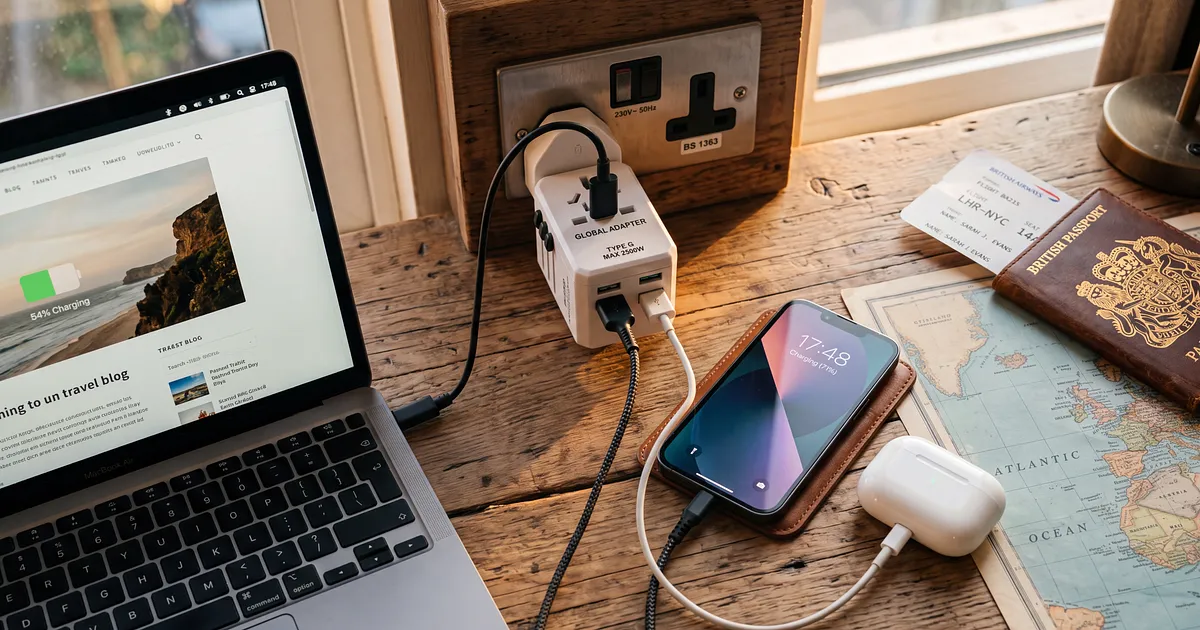
A laptop charger plugged into a wall socket in a Colombo hostel: there's a crack, the adapter breaks apart, and the plug gets stuck inside the outlet. An 8-euro "universal" adapter grabbed at the airport can do exactly one thing in that situation: nothing. Only a pair of pliers gets the broken piece back out. Sri Lanka's Type D sockets have three fat round pins arranged in a triangle, and no standard universal adapter covers it.
That's the thing about "universal" travel adapters. The word universal is doing a lot of heavy lifting. There are 15 different socket types worldwide, classified from Type A through Type O. Most universal travel adapters cover four of those fifteen. Good enough for 80% of tourist destinations. Not good enough if you're heading to India, South Africa, or Israel.
I've spent the last few months doing a proper best travel adapter 2026 comparison, checking six current models against real-world specs, prices, and compatibility. Here's what I found.
What a Travel Adapter Does (and Doesn't Do)
Before we get into products: a travel adapter only changes the plug shape. It doesn't convert voltage. Your smartphone, laptop, and camera almost certainly support "dual voltage," meaning 100-240V. Check the label on your charger. If it says "INPUT: 100-240V, 50/60 Hz," you're fine with just an adapter.
Your hair dryer? Maybe not.
A friend plugged his 120V travel hair dryer into a Thai socket without a voltage converter. The thing died instantly. Smoke, melting plastic smell, hair dryer toast. It's probably the most common mistake travelers make: confusing adapters with voltage converters.
Quick rule: Anything with a motor or heating element (hair dryers, curling irons, some electric razors) needs voltage checking. Anything with electronics (laptops, phones, cameras, power banks) works with just a universal travel adapter.
The 6 Best Travel Adapters in Our 2026 Test
This travel adapter test covers six models across different price points, compared on build quality, charging speed specs, port variety, and real-world compatibility data. Honest assessment only.
TESSAN GaN 65W: Best Value Pick
The TESSAN 65W GaN Reiseadapter Weltweit mit 2 USB A und 2 USB C, Schwarz is the biggest surprise in this travel adapter test. For around 40 euros you get a GaN adapter with genuine 65W USB-C Power Delivery that charges a laptop and a phone at the same time.
What it does: 2 USB-C ports (up to 65W on one port), 2 USB-A ports, and an AC outlet. GaN technology means less heat and a smaller body compared to conventional adapters. You can charge a MacBook Air while your phone and earbuds are plugged in simultaneously.
What bugged me: the plug slider is stiff. You really have to push, and the first time I used it, I thought I'd snap something off. And under full load, it gets noticeably warm.
If you want to charge a laptop via USB-C without paying 45 euros or more for the 120W model, this is one of the best travel adapters available right now.
Not available in your region — closest match
View at Amazon (as of Aug 15)Affiliate link. Buying through it earns us a commission; the price stays the same for you.
TESSAN Standard (45W): The Bestseller
The TESSAN Universal Reiseadapter mit USB-C und USB-A, Weltweiter Steckdosenadapter has been the bestseller on Amazon.de for months. Over 6,100 reviews, 4.6 stars. The classic: 150+ countries, USB-C at 45W, plus USB-A ports and an AC outlet.
Is it enough? For smartphones, tablets, and most ultrabooks, yes. For a 16-inch MacBook Pro, it's cutting it close since you'd want 65W or more. But for 90% of travelers, the standard TESSAN gets the job done.
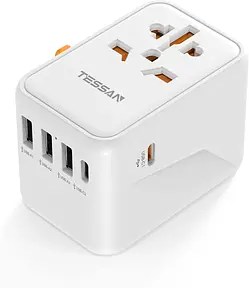
TESSAN Universal Reiseadapter mit USB-C und USB-A, Weltweiter Steckdosenadapter
View at Amazon (as of Aug 11)Affiliate link. Buying through it earns us a commission; the price stays the same for you.
LENCENT 120W GaN3: The Powerhouse
If you've got a power-hungry laptop or want to charge four devices at once, the LENCENT 120W GaN3 Universal Reiseadapter mit 3x USB-C PD und USB-A is the one to look at. 120W total output, up to 100W on a single USB-C port. That's enough for a 14-inch MacBook Pro.
The manufacturer claims it charges an iPhone 15 Pro to 88% in 30 minutes. I think real-world numbers vary, but it's fast, no question about it.
Downside: at roughly 250g, it's the heaviest in this best travel adapter 2026 comparison. And at 35 to 45 euros, it's also priced at the upper end. But if you want a single device to charge everything you own (laptop, phone, headphones, smartwatch), you'll save weight by not carrying individual chargers.
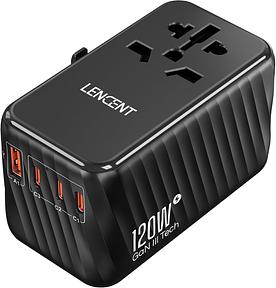
LENCENT 120W GaN3 Universal Reiseadapter mit 3x USB-C PD und USB-A
View at Amazon (as of Aug 11)Affiliate link. Buying through it earns us a commission; the price stays the same for you.
LENCENT 65W: The Sweet Spot
The LENCENT 65W Universal Reiseadapter mit USB-C Power Delivery sits price-wise between the TESSAN models and its 120W sibling. 65W USB-C is enough for most laptops. Fewer ports than the 120W model, but also lighter and more compact.
Honestly? For most travelers, this hits the sweet spot. Laptop charging works, phone charging is a given, and you don't spend 40 euros.
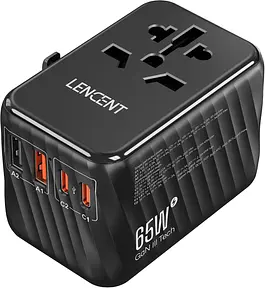
LENCENT 65W Universal Reiseadapter mit USB-C Power Delivery
View at Amazon (as of Aug 11)Affiliate link. Buying through it earns us a commission; the price stays the same for you.
EPICKA TA-105: Most Recommended Internationally
EPICKA dominates the international market. Over 10,000 five-star reviews globally. In the EPICKA review by GearUpTravel, it scores well for reliability. CE, FCC, and RoHS certified, with a built-in fuse, child safety shutters, and a travel pouch included.
But the USB-C port only delivers 30W. That's fine for phones, not for laptop charging. If you're buying a travel adapter in 2026 and want USB-C laptop charging, you need at least 45W. The EPICKA can't do that.
For travelers who only charge phones and tablets and care about safety certifications, it remains a solid option.
Skross PRO Light USB: Swiss Premium
Skross is the Mercedes of travel adapters. "Designed in Switzerland," 190+ countries, solid build quality. The thing feels premium. Plugs click into place firmly, nothing wobbles.
The problem: standard models don't have USB-C at all. Just USB-A ports (2,400 mA total). In 2026, that's outdated. Skross has announced newer models with USB-C, but pricing and availability on Amazon.de are still unclear.
Who should buy Skross? If you mainly need the AC outlet (bringing your own charger) and want a universal travel adapter that'll last five years without breaking.
Comparison Table: All Adapters at a Glance
| Adapter | USB-C Watts | USB-A Ports | AC Outlet | Weight | Price (approx.) | Laptop Charging? |
|---|---|---|---|---|---|---|
| TESSAN GaN 65W | 65W | 2 | Yes | 197g | around 40 EUR | Yes |
| TESSAN Standard | 45W | 2 | Yes | 170g | 17-22 EUR | Limited |
| LENCENT 120W GaN3 | 100W | 1 (QC) | Yes | 250g | 35-45 EUR | Yes (incl. Pro) |
| LENCENT 65W | 65W | 1 | Yes | 200g | 27-32 EUR | Yes |
| EPICKA TA-105 | 30W | 4 | Yes | 156g | 25-35 EUR | No |
| Skross PRO Light | 0W | 4 | Yes | ~170g | 35-50 EUR | AC only |
USB-C and GaN: Why It Matters in 2026
Since late 2024, the EU mandates USB-C as the standard charging port for smartphones, tablets, and cameras. Laptops follow in 2026. Your devices have USB-C now. Your travel adapter should too.
GaN (gallium nitride) is the semiconductor material that, according to Anker, enables chargers up to 40% smaller and more efficient than traditional silicon-based ones. Less heat, less wasted energy, smaller form factor. GaN used to be expensive. In 2026, you can get a GaN adapter for 20 euros. I honestly can't think of a reason to buy one without it.
But how many watts do you actually need?
| Device | Minimum Watts | Recommended |
|---|---|---|
| Smartphone | 20W | 20-30W |
| Tablet (iPad Air) | 30W | 30-45W |
| Ultrabook (MacBook Air) | 30W | 45-65W |
| Large laptop (MacBook Pro 16") | 65W | 96-140W |
| Headphones, smartwatch | 5W | 5-10W |
I could be wrong, but I think adapters without USB-C will disappear from shelves within two years.
Charging Multiple Devices at Once
Something most travel adapter test roundups skip over: how does a multi-port adapter actually behave when everything is plugged in simultaneously?
With GaN adapters that have multiple USB-C ports, the power gets distributed. A TESSAN GaN 65W that delivers 65W to a single port will probably split it to something like 45W and 20W when two USB-C devices are connected at the same time. That's still enough to charge a laptop and a phone together without throttling either one.
In practice, that means charging a MacBook Air, AirPods, and an Android phone at the same time without anything throttling. The adapter gets noticeably warm, but not hot.
The EPICKA is a different story. Four USB-A ports sound generous, but USB-A maxes out at 2.4A per port, and with four devices running, that gets divided further. Four phones charging overnight? Fine. A laptop alongside three phones? The EPICKA can't manage that.
For families or long-term travelers who need to charge many devices at once, I'd point you toward the LENCENT 120W GaN3: 100W on one port for the laptop, a second USB-C for a tablet, USB-A for extra phones. One adapter, four devices, no cable chaos.
Which Adapter for Which Destination?
Not everyone needs the same travel adapter. If you're flying to Mallorca or Crete, you don't need one at all. Spain and Greece use Type C/F, same as Germany and most of continental Europe.
Europe (Including the UK)
Within the EU, you usually don't need an adapter if you're coming from another EU country. The exception: the UK, Ireland, Malta, and Cyprus use Type G (three rectangular pins). Any adapter in this travel adapter test covers that.
Switzerland has Type J. A standard Europlug (Type C) fits most Swiss outlets. Going the other way doesn't work though.
USA, Canada, Mexico, Japan
Type A/B (flat parallel pins). 110-120V. Every adapter in this test covers it. Laptops and phones are dual voltage. No issues.
Australia, New Zealand, China
Type I (angled flat pins in a V shape). All tested adapters work.
UK, Singapore, Malaysia, Hong Kong
Type G. No problem with any universal travel adapter.
Where "Universal" Fails: India, South Africa, Israel
This is where it gets complicated. According to Reisestecker-Adapter.de, India uses Types C, D, and M. Type D has three thick round pins in a triangle. No standard universal adapter includes this.
For India specifically: bring your regular universal travel adapter, but also buy a separate Type D adapter for about 5 euros. Most upscale hotels in India have Type C outlets too, but older guesthouses and hostels outside the main cities often only have Type D. Better to have both.
South Africa uses Types C, D, M, and N. Type N is the newer South African standard, but older buildings still have Type D or M outlets. My recommendation: a combined Type D/M adapter for South Africa costs under 8 euros and saves a lot of frustration. Israel officially uses Type H, but Type C works in most Israeli outlets in practice because the sockets are built to accept multiple plug types.
Thailand? Officially Type O, but in practice, Types A and C fit most outlets.
If you're a long-term traveler or backpacker, bring your universal adapter plus a small India/South Africa adapter. It barely takes up space and saves you from exactly the situation described in Colombo.
For more tips on what to pack for international travel, check our carry-on packing guide for international trips.
Safety: What to Watch For
Cheap adapters under 10 euros without safety certifications? Don't bother. In the ExpertenTesten.de travel adapter test for 2026, surge protection, child safety locks, and built-in fuses were key testing criteria.
What a good travel adapter needs:
CE marking (European standard)
Surge protection
Built-in fuse (replaceable is best)
Child safety shutters on contacts
Flame-retardant materials
Something I noticed during research: the price difference between a safe adapter and an unsafe one is maybe 8 to 12 euros. Your smartphone costs 800 euros. Your laptop 1,500. A short circuit from a cheap adapter, and you're paying many times that.
One more thing: don't chain adapters into power strips. Don't combine them with extension cords. And unplug them when you're not using them.
Verdict After This Travel Adapter Test
For most travelers: the TESSAN GaN 65W. Around 40 euros, charges laptops and phones at the same time, GaN tech, enough ports for a whole family. It's the right middle ground for anyone who wants USB-C laptop charging without paying for the 120W model, and it came out on top in my best travel adapter 2026 testing.
Need more power for a large notebook? LENCENT 120W GaN3. More expensive, heavier, but 100W USB-C means few adapters charge laptops faster.
Only charging a smartphone and tablet? The TESSAN Standard for under 20 euros does the job.
And whatever you buy: check whether your destination has special socket types. India, South Africa, Israel. Better to pack a small extra adapter for 5 euros than pay 30 at the airport.
All products from this post
The ones we named above are marked; the rest are alternatives in the same category.
Not available in your region — closest match
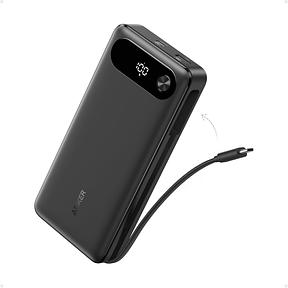
Anker Powerbank, 20.000mAh tragbares Ladegerät mit integriertem USB-C-Kabel, 87W Max Schnellladung, kompatibel mit MacBook, iPhone, Samsung und mehr
View at Amazon (as of Aug 15)
Affiliate notice: As an Amazon Associate, we earn from qualifying purchases. Product prices and availability are subject to change.
Frequently Asked Questions
What is the best universal travel adapter in 2026?
In our travel adapter test 2026, the TESSAN GaN 65W offers a good balance of price, performance, and compatibility. It costs around 40 euros, has USB-C with 65W Power Delivery, and covers 150+ countries, charging a laptop and phone simultaneously without the 120W model's higher price. For maximum charging power, the LENCENT 120W GaN3 is the strongest option.
Do I need a voltage converter for my trip?
Almost certainly not. Modern smartphones, laptops, cameras, and tablets are dual voltage (100-240V). Check your device charger's label. If it says "INPUT: 100-240V, 50/60 Hz," a simple universal travel adapter is all you need. Voltage converters are only necessary for devices with motors or heating elements, like some hair dryers.
How many watts does my travel adapter need?
Smartphones need 20W. Tablets require 30-45W. Ultrabooks like the MacBook Air charge at 45-65W. Large laptops like a 16-inch MacBook Pro need 96W or more. If you're only charging phones and tablets, a 30W adapter is plenty. For laptops, you want at least 45W USB-C Power Delivery.
Does a universal travel adapter really work everywhere?
No. Standard universal travel adapters cover Types A, B, C, F, G, and I. That works in the US, Europe, the UK, Australia, and many Asian countries. For India (Type D/M), South Africa (Type M), and Israel (Type H), you often need separate adapters because these socket types aren't included in standard models.
What is the difference between GaN and regular adapters?
GaN (gallium nitride) is a newer semiconductor material that works more efficiently than traditional silicon. GaN adapters are up to 40% smaller at the same power output, generate less heat, and waste less energy. In 2026, the price difference is only 5-10 euros. For travelers who want to save space and weight, GaN is worth it.
Which travel adapter do I need for India?
India is one of those cases where standard universal adapters fall short. You need a separate Type D adapter (three thick round pins in a triangle). These cost about 5 euros online. Many Indian hotels now have Type C outlets too, but don't count on it. Bring both just to be safe.
*Last updated: April 2026*
Sources
- 15 different socket types worldwide worldstandards.eu
- without a voltage converter doace.com
- EPICKA review by GearUpTravel gearuptravel.com
- EU mandates USB-C as the standard charging port europarl.europa.eu
- Anker anker.com
- Reisestecker-Adapter.de reisestecker-adapter.de
- ExpertenTesten.de travel adapter test for 2026 expertentesten.de