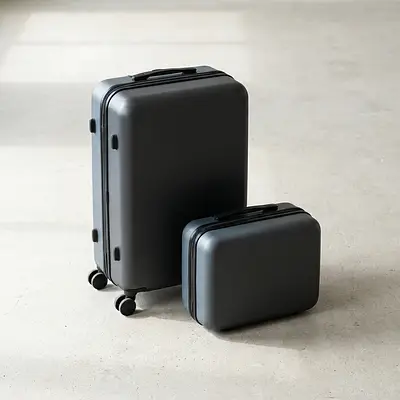
Smart Luggage Test: What Buyers Really Say After 6 Months
 9 min read
A smart suitcase easily runs 300 to 400 euros. GPS tracking, USB charging port, its own app, the whole package. Sounds like it solves every luggage problem. Whether that still holds up after a few months of ordinary use is a different question.
This smart luggage test isn't glossy ad copy. It's a synthesis of what buyers actually describe in reviews and experience reports after six real months of ownership, not just what the brochure claims.
Why buy such a suitcase at all? Lost luggage remains a real risk, especially on connecting flights.
The current SITA baggage report says the mishandling rate fell to a record low in 2025. And yet it still cost the industry 6.3 billion dollars, mostly on connecting flights. We looked at why transfer connections through Europe's hub airports are hit so often in a separate piece. So the odds are small. But not zero. And transfers are the danger point.
Smart Suitcase GPS Tracking in Daily Life: Does It Actually Help?
Smart suitcase GPS tracking is the main reason most people buy one. And here comes the first uncomfortable truth.
Something a lot of people don't know: a built-in "GPS tracker" in a suitcase is often really a Bluetooth tracker with a range of just 30 to 45 meters. Live tracking like a phone isn't possible with that. For that you'd need a real GPS tracker with its own mobile data plan, which costs money every month and whose battery dies after days, not months.
Many models marketed as "smart luggage with GPS" actually run on Bluetooth. Buyers commonly report only noticing this after purchase, and it shows up in reviews as a recurring complaint.
In practice this means: as long as some stranger's phone is nearby, the app shows roughly where the bag was. At baggage claim, great. In the hotel, great. But when the bag is stuck in the cargo hold of some other plane with no phones around, the app only shows the last known spot, and that can be hours old.
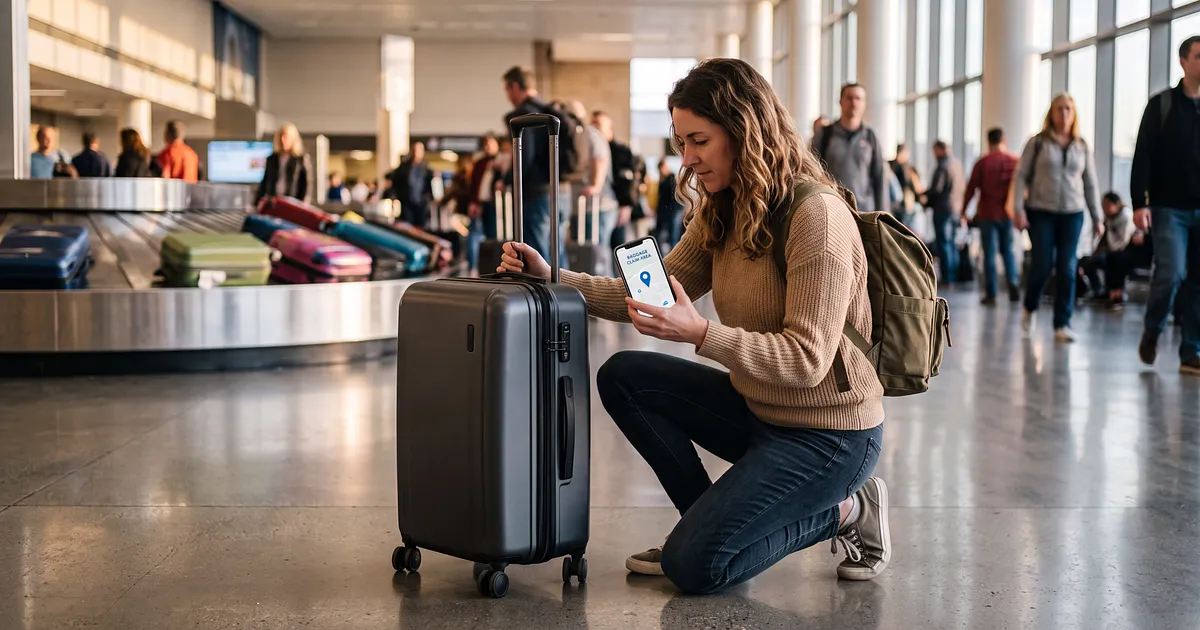
Even so, one scenario keeps coming up in owner reports where the tracking genuinely paid off: the bag gets sorted onto the wrong belt, the app shows the approximate last location, and that's enough for staff at the desk to find it in minutes instead of a long wait.
An AirTag, by the way, would do exactly the same thing in that moment. For around 35 euros instead of 340. You have to say that honestly. How AirTag, Samsung SmartTag and other Bluetooth trackers compare head to head is something we cover in our AirTag luggage tracker test.
Suitcase With USB Charging Port on the Go: Useful or Gimmick?
A suitcase with a USB charging port is new territory for most first-time buyers. Reviews are largely positive here.
The removable battery doubles as a power bank. You pull it out, plug in your phone, done. That exact scenario — every socket at the gate taken while everyone circles the last free charging cable — is the benefit that comes up most often in owner reports, frequently good for two full phone charges from the suitcase battery.
But. And it's a big but.
That USB port on the outside of the case, the one that lets you charge your phone without opening the bag? Many reports describe barely using it after the initial novelty wears off. Sounds cool in the brochure. In practice, most owners seem to prefer pulling the power bank out and slipping it into a pocket rather than staying tethered to the suitcase by a cable.
On battery life over several months, buyers overwhelmingly report no noticeable drop in capacity — one of the more common pre-purchase worries that mostly doesn't hold up in practice.
The App in This Intelligent Suitcase Test: First Impression Versus Reality
In this intelligent suitcase test, a recurring pattern shows up across owner reports: day one is pure excitement. Bag location, battery level, luggage weight straight to the phone. It feels like a lot of tech at first.
Within a few weeks, many reports describe opening the app almost only for the built-in luggage scale. After six months, usually just occasionally, often by accident.
That's probably the most honest thing that can be said about the software. The luggage scale in the handle genuinely gets used, because it removes the guesswork about being over 23 kilos before departure. The rest of the app? Nice, but for most owners it's barely relevant after the novelty phase.
Two things come up especially often as annoyances in reviews: the pairing, which frequently needs to be redone after bigger phone updates, and battery drain from constant Bluetooth scanning, on both the case and the phone. Small stuff individually, but it adds up to mild irritation over months.
The Battery at Check-In: What Buyers Report
Quick bit of background: the battery has to be removable, or the bag gets rejected at the gate. That's been industry standard under IATA rules since the Bluesmart shutdown in 2018. The full rules on batteries in aircraft for 2026 are in our own guide on the topic.
According to owner reports, this usually plays out unspectacularly: battery out, into the backpack, done, no questions asked in most cases. Some reports mention gate staff actively wanting to see the battery removed — a quick show-and-tell, nothing more. The "ritual" itself is still commonly described as annoying when you're in a rush: hunting for the battery, wiggling it out, stowing it, every single time.
Downsides: What Buyers Complain About Most
For this smart luggage test to be worth anything, here are the ugly bits without sugarcoating, as they keep showing up in reviews.
The weight. The built-in tech noticeably adds weight, and that extra load gets carried on every lift, even when the GPS isn't needed at all. For a suitcase in this price range, many buyers expect more usable payload.
The battery-out ritual at every check-in, see above.
The app pairing that occasionally throws a fit after updates.
And the price. A 200 to 400 euro premium over a solid hardshell case is steep. For that money you can buy a good regular suitcase plus an AirTag plus a separate power bank, and get roughly the same feature set without the extra weight and without the app tantrums. If you also want to guard against pickpockets, pairing that setup with an anti-theft backpack for your carry-on rounds things out nicely.
Pros and cons at a glance:
Pros: power bank function is widely described as genuinely useful day to day, battery reportedly holds up reliably for several months, luggage scale gets real use according to reviews, tracking has saved real time in individual cases
Cons: Bluetooth instead of true GPS, app pairing throws a fit after updates, battery-out ritual at every check-in, noticeable extra weight, 200 to 400 euros pricier than a solid regular case plus AirTag plus separate power bank
Everyday Use Without Flying: Train, Commute, Weekends
Interesting: according to several reports, the suitcase brings the most joy when not flying at all.
On the train, power bank out of the case, laptop and phone charged, without fighting a seatmate over the single socket at the seat — this exact scenario comes up repeatedly in owner reports as the real everyday advantage, since no battery rules apply and the battery can just stay in the case.
Travelers who mostly go by rail or car rather than by plane apparently get more out of the smart features, since none of the flight bureaucracy around lithium batteries applies to them.
Smart Luggage Test Verdict: Is It Worth It?
Would buyers purchase it again? Based on the available reports, mostly: probably not.
Not because it's bad. The case is generally described as solid, the battery holds up, and the tracking genuinely helps in individual cases. But almost everything that actually gets used day to day is available cheaper and lighter with a normal good suitcase, an AirTag in the inner pocket and a power bank in the side one. Staying organized inside the case is really more about good packing cubes than any app anyway.
If you love tech, like having it all from one source and the premium doesn't bother you, buyers who go this route mostly report no disappointment. But if you think practically and watch your money, the cheap DIY setup is almost as good. Sometimes better.
The 340-euro lesson that emerges from these reports: "smart" in the brochure and "smart" in real travel life can be two different things.
Frequently Asked Questions
Is a smart suitcase really worth it in this test?
Depends. Based on buyer experiences over six months, for tech fans yes, for practical savers not really. A good standard case plus AirTag plus power bank costs less, weighs less and can do almost the same. The 200 to 400 euro premium is mostly justified by the comfort of having everything in one device.
Does GPS tracking hold up in a smart luggage test?
Partly. Many models use Bluetooth with just 30 to 45 meters of range, not real satellite GPS. Great at baggage claim or in a hotel, but not much help for a bag lost worldwide, since strangers' phones have to be nearby. Check before buying whether it's true GPS or only Bluetooth.
How long does the battery on a smart suitcase last?
According to buyer reports, the battery typically holds up for several months with no noticeable capacity loss and still fully charges a phone multiple times. The constant Bluetooth scanning does draw power, though, on both the case and the phone. As a plain power bank on the go, it's widely described as the most useful part of the whole suitcase.
Can I take a smart suitcase on a plane?
Yes, as long as the battery is removable. You take it out at check-in and carry it in your hand luggage, like a normal power bank. Built-in batteries over 2.7 Wh can be rejected. We explained the full rules in our smart luggage guide.
What's better: a smart suitcase or a normal case with an AirTag?
For most people the AirTag setup is enough. It often tracks better than the suitcase's built-in Bluetooth via the huge Apple network, costs only around 35 euros, and leaves the case itself freely chosen. The smart suitcase only wins if you want an integrated power bank and luggage scale bundled into one device.
*Last updated: July 2026*