Ski Baggage on Planes: Costs, Airline Comparison & Packing Tips 2026
 13 min read
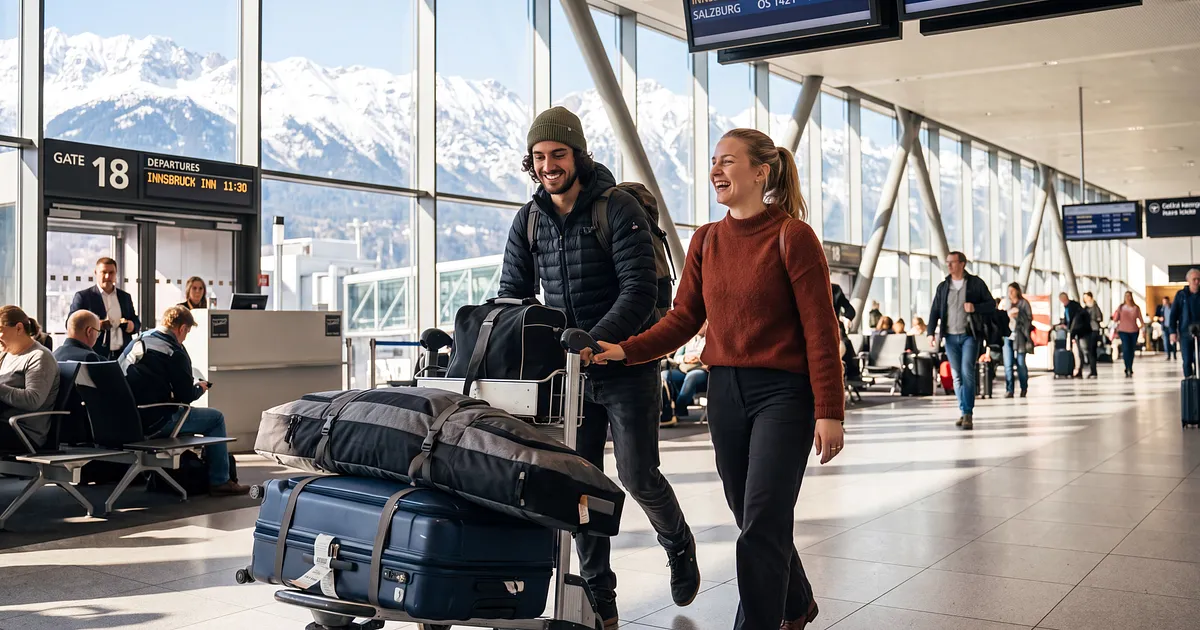
"Skis fly for free, right?" I've heard that line at Munich airport more times than I can count. Usually from someone who just got a nasty surprise at the check-in desk. Whether your ski baggage on a plane is free or suddenly costs 105 euros extra comes down to two things: your airline and your fare class. And almost nobody checks that combination before booking.
Germany alone has around 27.7 million winter sports enthusiasts, according to Statista, which makes it one of Europe's biggest ski-travel markets. Yet there's barely a single place that lays out the sports-baggage fees of every major airline side by side. So let's do that here, in time for the 2026/27 winter season.
Quick answer: free or expensive?
On the big network carriers (Lufthansa, Austrian, SWISS) a ski or snowboard set often flies free, but only on the standard fares. Book the Economy Basic or Light fare and you pay extra. On budget and holiday airlines (Eurowings, easyJet, Condor, TUI fly), ski baggage on a plane almost always costs money. Prices run from a flat 30 euros up to over 100 euros if you only register at the airport.
Sounds messy? It is. Let's take it step by step.
The fare trap: why "skis fly free" often isn't true
This is where most people get caught. You book the cheapest flight, feel clever about saving 40 euros, and then your ski bag costs 80 euros at the desk. Net loss.
According to Lufthansa's official policy, a ski or snowboard set is indeed allowed on top of your normal baggage allowance. Just not on Economy Basic (short and medium haul) and not on the Light fare. Austrian and SWISS work the same way: free on the standard fare, chargeable on the cheapest one.
As Snowplaza puts it, big carriers like Lufthansa, SWISS, and Austrian usually treat ski gear as part of the standard baggage allowance on regular fares, while budget airlines such as easyJet require advance reservation plus a fee as a rule. So the catch sits in the fine print of the fare, not in the airline itself.
My advice: before you book the cheapest fare, add the sports-baggage fee to it. Sometimes the fare that costs 40 euros more, with free ski transport included, ends up being the cheaper option. I learned this the hard way after getting caught twice myself.
The big airline comparison for ski baggage on a plane
Here's the table you'd otherwise have to build yourself by clicking through seven different airline pages. Prices are guideline "from" figures for the 2026/27 season and can depend on route and fare. SWISS and Austrian only give you the exact price in their baggage calculator. Use this for orientation and always double-check on the airline's own page for your specific route, since prices can shift between seasons.
| Airline | Fee (online/advance) | Fee (airport) | Max weight | Max size | Fare exclusion |
|---|---|---|---|---|---|
| Lufthansa | free* | €80 (or €130 over 32 kg) | 32 kg | approx. 200 cm | Economy Basic, Light |
| Austrian | free* | approx. €10 to €20 service fee | 32 kg | up to 3.15 m | Economy Basic, Light |
| SWISS | free* | approx. €80 (Europe) | fare limit | approx. 200 cm | Economy Basic, Light |
| Eurowings | €30 per item | online registration required | 32 kg | L+W+H ≤ 158 cm | none (always a fee) |
| Condor | from €44.99 | up to €120 | 30 kg | 200x40x100 cm | free only in Business |
| TUI fly | from approx. €65 per leg | from approx. €105 per leg | 30 kg | check in calculator | packages often include it |
| easyJet | from approx. €49 (£42) | approx. €55 (£52) | 20 kg (standard) | max 6 items/booking | none (always a fee) |
| Norwegian | approx. €40 to €45 | approx. €50 | 23 kg | not specified | none (always a fee) |
*free on top of your allowance on the standard fare, not on Economy Basic/Light.
A few things jump out right away.
Eurowings at a flat 30 euros is almost the cheapest carrier that charges a fee at all. And at least that fee stays the same across every fare. According to Eurowings, carrying skis or a snowboard costs a flat 30 euros per item, no matter which fare you booked. No hidden surprise there.
Registering at the airport is expensive everywhere, and that pattern holds across the whole table. Condor charges from €44.99 online but up to €120 at the airport, more than two and a half times as much. TUI fly jumps from around €65 (advance) to €105 (airport). Whatever airline you fly, I'd register sports baggage online right after booking, before you forget. With Lufthansa you can do it up to 72 hours before departure, because hold space for oversized items is limited.
Snowboard instead of skis? Nearly the same, but watch the weight
For snowboard baggage with most airlines, almost everything works the same as for skiers. A snowboard counts as one piece of sports baggage, just like a ski set. The difference is in the detail: on easyJet and Norwegian the standard weight limit for sports baggage is lower (20 and 23 kg) than the 32 kg on the network carriers. A board plus boots plus bindings hits that 20 kg line fast. Weigh it at home, or Norwegian charges you 15 euros per excess kilo, per leg. That adds up quicker than you'd think.
Rent or bring your own? The honest cost math
Now for the question everyone actually cares about. Is it even worth flying with your own gear, or are you better off renting on site?
A January 2026 analysis by the University of Europe for Applied Sciences finally gives us real numbers. A full ski set (skis, boots, helmet) for 3 days costs, on average:
Austria: €56.97
Switzerland: €68.77 (the priciest region in the comparison)
Germany: €60.40
France: €32.53
Bulgaria: €28.44 (the cheapest)
And booking online in advance instead of renting on the spot saves up to 50 percent, according to Alpy.com. On-site prices often run two to three times the advance online rate, roughly 120 to 250 euros per person per week on-site versus 60 to 130 euros pre-booked online. For a family of four, Alpy.com puts that at a realistic 300 to 600 euros saved on rental alone, per week.
Let's run that through two real examples.
Example 1: family of four to Innsbruck (Eurowings)
The family owns their own gear. They register two pieces of sports baggage (parents share one bag, kids the other, two pairs of skis each within the 32 kg limit). Eurowings charges 30 euros per item per direction. That's 60 euros out, 60 euros back. 120 euros in flight costs for the whole week.
If the same family rented four sets on site, that would be roughly 520 to 600 euros for the week. Clear case: if your ski bag already exists in the closet, flying it out beats renting by a wide margin. Those 120 euros are a fraction of the rental cost.
Example 2: solo snowboarder on easyJet
A single snowboarder pre-books sports equipment online with easyJet for around 49 euros per direction, so roughly 98 euros round trip, plus a separate checked bag for clothes. On TUI fly it would be from 65 euros per leg, so around 130 euros. But watch out: many TUI fly ski packages already bundle baggage into the package price. The pure fee comparison misleads you here unless you check what's actually included in the package. I missed that once myself and ended up paying twice.
And if the solo boarder doesn't own a board and would have to buy one first? Then renting wins. No question.
The rule of thumb that both examples point to: your own, properly fitted gear is nearly always cheaper to fly with, especially as a family. Without your own gear, or for a single short trip, renting is often the more relaxed choice. Your ski boots are the deciding factor here. More on that in a second.
If you're still unsure which gear and gadgets are actually worth it, we wrote a separate ski gadget guide for the 2026 season that runs through goggles, safety equipment and accessories. If you're still working out your broader packing list for a winter trip, that's worth a look too. Here we're sticking with the transport side.
Winter trip packing list for flying: boots, helmet & clothing done right
Now for the practical part. You know the airline rules for your ski baggage on a plane. But how do you actually pack without slipping over the weight limit at the desk?
Here's one thing nearly every experienced ski traveler does, but hardly any guide explains: carry your ski boots in your hand luggage or wear them. Sounds odd, but there are two reasons. First, you save real weight in the ski bag. Second, and this is the bigger one: ski boots are the one thing you can barely re-rent in your exact fit on site. If your ski bag arrives late, you're without skis. Annoying, but fixable. Without your boots, though, the whole ski day is a write-off.
Is that delay risk just theory? Not entirely. According to SITA, global baggage mishandling is trending down (SITA reports mishandling down 20% year over year), but bulky sports baggage still runs through separate, more manual processes at check-in and on the belt. In my experience, a ski bag goes missing or arrives late more often than a standard suitcase, even as the industry-wide rate improves.
A few more packing tricks for your winter trip packing list that genuinely help:
Ski poles go inside the ski bag, not separately. That way they count toward your one piece of sports baggage instead of as an extra item. On Eurowings that can save you a second 30-euro fee.
Helmet inside the jacket hood or tucked into a ski boot, the boot shell protects it from pressure too.
Wear your winter jacket through security. A thick ski jacket quickly weighs a kilo, and that's a kilo you don't want on the baggage scale.
Pack a luggage scale. A little handheld scale costs almost nothing and saves you from the expensive excess-weight surprise at the desk... on easyJet (20 kg) and Norwegian (23 kg) especially, the limit comes fast. I've cut it close myself more than once.
Base layers and thermal underwear go rolled up into your carry-on. If the ski bag is delayed, at least you've got warm clothes with you.
What if your gear gets lost or damaged?
Quick reality check, because a lot of people are too optimistic here. The airline won't simply replace your broken board at full retail value.
Under the Montreal Convention, airlines have been liable since December 2024 only up to 1,519 SDR, roughly 1,868 euros per passenger, for lost or damaged baggage, ski gear included. That's for all your baggage combined, not per item. For a family of four with premium equipment, that ceiling gets tight. If you want the full breakdown of your rights and deadlines when this actually happens, we cover that in our lost baggage rights and compensation guide.
On top of that: the airline is only liable for damage from check-in to the baggage belt. ARAG makes clear that airline liability covers incidents happening during check-in, transit, or baggage handling, in other words while your gear is in their custody. A break during actual skiing, say a binding releasing in a fall or a board catching an edge on the lift, falls outside that entirely, neither the airline nor your standard travel insurance picks it up. Only genuine transport damage counts. A padded ski bag isn't a luxury recommendation, then. It's the best protection you personally control.
The bottom line
Check your fare before booking, not just the airline. The cheapest flight turns expensive when ski gear costs extra. Always register your sports baggage online in advance, or you'll pay double or triple at the airport. And weigh what you're bringing at home, so the kilo limit doesn't catch you out.
If you own your gear, flying with it is nearly always cheaper than renting. If you don't, renting on site is usually the more relaxed call. Carry your ski boots in the cabin. Wrap everything in a padded bag, and your kit arrives in one piece.
Frequently Asked Questions
What does it cost to bring skis on a plane?
It depends on the airline and fare. On Lufthansa, Austrian and SWISS a ski set is free on the standard fare but costs extra on Economy Basic or Light. Eurowings charges a flat 30 euros per item, easyJet from around 49 euros, and Condor from €44.99 online up to €120 at the airport.
Does ski baggage count as normal checked luggage or extra?
Usually extra. Ski equipment runs as sports baggage in its own category and almost always has to be registered online in advance, often up to 72 hours before departure. On network carriers it flies on top of your normal suitcase on the standard fare, while budget airlines always treat it as a chargeable add-on.
Can I take ski boots as hand luggage?
Yes, if they fit your airline's carry-on dimensions. It's actually smart: you save weight in the ski bag, and if your checked bag arrives late, you've kept your most important and hardest-to-rent items with you. Ski boots in your exact fit are almost impossible to source last minute on site.
Which airline is cheapest for ski baggage?
For families with their own gear, Eurowings at a flat 30 euros per item is often the fairest, since the fee is the same across all fares. Network carriers like Lufthansa are free, but only on the standard fare. On the cheapest fare you can pay up to 80 euros there. Always add fare price plus baggage fee together.
How heavy can a ski bag be on a plane?
On Lufthansa, Eurowings and Austrian it's 32 kg per piece of sports baggage, on Condor and TUI fly 30 kg. Budget airlines are stricter: easyJet allows only 20 kg for standard sports baggage, Norwegian 23 kg. Over the limit gets pricey, around 15 euros per kilo per leg on Norwegian. Weighing beforehand pays off.