TSA Luggage Locks: Which Ones Actually Hold Up in 2026
 12 min read
TSA luggage locks solve exactly one problem, and there's another one they don't touch. The first: your bag doesn't get cut open during a US inspection. The second, which they don't solve: they won't stop a thief who has pulled a master key file off the internet and printed it. Both things are true at once. And you'll find that honest double answer in almost no "best luggage locks 2026" roundup, because most of them either hide one half or oversell the other.
For this guide I went through the current German comparison sites, Travel Sentry's own documentation, and the security research around these locks. No lab test of my own, just an honest read of what other people measured and documented, from the angle we know best at Kofferly: what actually happens to your bag at the airport.
What a TSA lock is and how it works
TSA stands for the Transportation Security Administration, the US security agency. But "TSA lock" doesn't mean the agency sells or certifies the lock. The accurate term is a TSA-recognized lock, licensed through the Travel Sentry program.
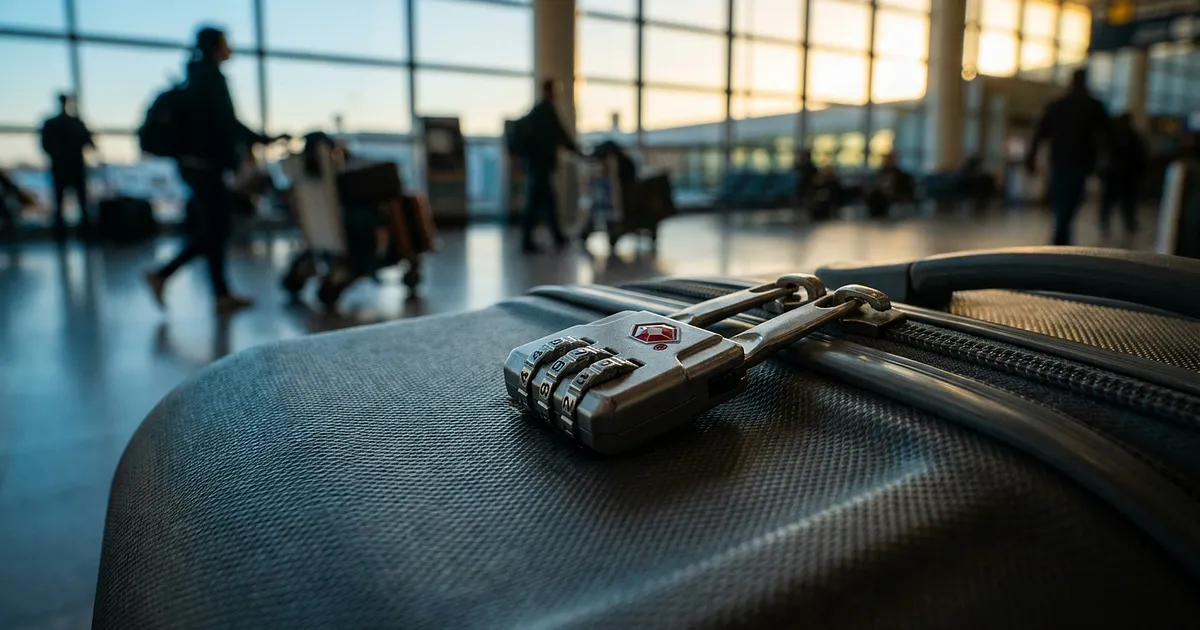
The trick sits in a second cylinder. Day to day, you use your own number combination. Next to it there's a small keyway for one of seven master keys, often labelled TSA001 through TSA007. According to Travel Sentry, the company behind the system, an inspection goes like this: you lock the bag, officers screen it, and if they need to open it they use the master key, then re-lock it afterwards. No cut lock, no torn-open zipper.
How do you spot a genuine one? By the Red Diamond, the Travel Sentry logo stamped on the lock body. Without that mark, it's just an ordinary combination lock calling itself "TSA" with no master-key cylinder inside. At an inspection, that does nothing for you.
There are two builds. Integrated locks are set into the shell of the case, common on hardshell suitcases. Then there are the add-on kind: small padlocks or cable locks you hang on a zipper pull or a loop. That second type is the right one for backpacks, duffel bags, and older suitcases with no built-in lock.
What happens to a locked bag at the airport
Here's the part the pure product lists skip, even though it's the whole reason a TSA lock exists. The moment you check your bag, it disappears into a system you never see: conveyors, sorting machines, x-ray scanners, loading carts. On US flights, or when you connect through the US, your bag can be pulled for a manual inspection at random, with you nowhere near it.
And now the difference that matters. If your bag has a recognized TSA lock, officers open it with their master key, look inside, and lock it again. Often the only thing you notice is a small notice slip tucked into the bag. If it has a regular lock the master key can't open, they're allowed to cut it off. And they do. There's usually no replacement for it.
Outside the US none of this applies, since nobody routinely opens your locked bag there. So a TSA lock isn't a global standard, it's a very specific precaution for a very specific route. That's exactly why the honest recommendation isn't "everyone needs one," it's "if you're flying to the US, it saves you a cut lock."
Are TSA locks actually secure?
Now the part the sales pages tend to leave out. No, a TSA lock is not theft protection. And that's not a rumour, there's a concrete reason for it.
Back in 2014/2015, high-resolution photos of all seven TSA master keys were published. Ever since, 3D-printable reproductions have circulated online, documented among others by 3D Printing Industry. Anyone who wants to can print the key on a home printer out of plastic. Done.
It even works without the leaked photo. As TrustedSec explains on the technical side, you can recreate a master key just by taking apart a commercial TSA lock and filing a blank to match. The principle is out in the open. Security researcher Matt Blaze summed it up pretty drily: nobody ever seriously relied on these locks as real security.
On top of that: a three-digit combination lock only has 1,000 combinations anyway. Working through them systematically takes roughly 20 to 30 minutes according to absicherungstechnik.com, no master key needed. That's also why you can't really lock yourself out, more on that below.
So is the lock pointless? No, and this is where it gets nuanced. Against a casual thief at the baggage belt who isn't carrying a printed key, a closed lock is still a real, if modest, barrier. An open zipper is quicker to rummage through than a locked one. Against someone specifically targeting locked bags with a printed key in their pocket, it protects almost nothing.
So the honest way to handle your valuables stays the same as it would be without a lock: laptop, jewellery, medication, cash belong in your carry-on, not in the checked bag. How big is the problem in the first place? In 2022, roughly 7.6 out of 1,000 bags worldwide were reported mishandled, a 74.7 percent jump over the previous year (source: DOT/SITA data compiled by Smart Locks Guide). Those figures are from 2022, so not a current-year number, but they show the scale.
What to look for when you buy one
If theft protection isn't the point, what separates a good lock from a bad one? The answer is unglamorous: durability. A TSA lock has to survive the trip through the baggage system, thrown, crushed, sitting at minus 20 degrees in the hold. The TSA lock comparison at vergleich.org (as of August 2026) screened 101 products and directly tested 14 of them. According to ExpertenTesten.de (updated February 2026), it's mainly the sustained-load durability of the number-wheel mechanism that decides how long a lock lasts.
So here's what you check for:
A metal housing, zinc die-cast or steel, not thin plastic around the number wheel
Number wheels that click in firmly and don't drift on their own, or you'll stand at the belt facing a code you never set
A flexible steel cable for awkward bags instead of a rigid shackle, since that also reaches two zipper pulls sitting far apart
The Red Diamond has to be on it, otherwise it isn't a TSA lock
Beyondcamping.de draws a clear line between integrated suitcase locks and add-on padlocks or cable locks. Short version: a backpack and a duffel need a cable lock, a hardshell suitcase often already has one built in.
The cheap starting point
If you just need one solid combination lock for the next flight and don't want to spend much, a single lock from an established maker does the job. The Burg-Wächter TSA 74 30 SB sits in that category: a German lock manufacturer, a decent housing, under ten euros. For the job a TSA lock actually does, that's plenty, and its customer ratings stay consistently high.
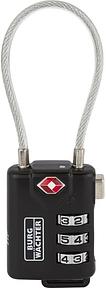
Burg-Wächter TSA 74 30 SB Kombinationsschloss
View at Amazon (as of Aug 21)Affiliate link. Buying through it earns us a commission; the price stays the same for you.
The bestseller for a small budget
Most travellers end up reaching for a twin pack, because a suitcase tends to have two zipper pulls and nobody wants to stand there on the way home with just one lock. The Diyife 2-pack is exactly that case: two locks for under nine euros, with one of the highest review counts in the whole segment. No premium claims, but honest enough for a holiday case.
![Diyife [2 Stück] TSA Gepäckschlösser, 3-Stelliges Sicherheitsschloss, Kombinationsschlösser, Codeschloss für Reisekoffer](https://kofferly.com/rails/active_storage/representations/proxy/eyJfcmFpbHMiOnsiZGF0YSI6MTIwNCwicHVyIjoiYmxvYl9pZCJ9fQ==--e519b5c6dbc462375cebcdaec060e0843f86b9fa/eyJfcmFpbHMiOnsiZGF0YSI6eyJmb3JtYXQiOiJqcGciLCJyZXNpemVfdG9fbGltaXQiOlsyODgsMjg4XX0sInB1ciI6InZhcmlhdGlvbiJ9fQ==--b7a7af1d9490199d0a8048d8ed5b80d3fb201a3c/tsa-schloss-B0773BGZJJ.jpg)
Affiliate link. Buying through it earns us a commission; the price stays the same for you.
When you want to see if someone opened it
One detail I'd underestimated: the tamper indicator. A lock like this shows a coloured window if it's been opened with the master key. It changes nothing for theft protection, but at least you know after the trip whether your bag was inspected or whether someone else got in. The NovLock 2-pack with a tamper indicator does exactly that and still sits in the budget range.
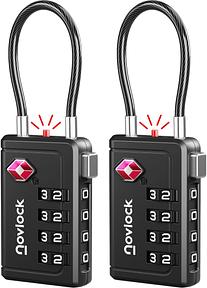
TSA Zahlenschloss mit Öffnungsanzeige, 2er Pack
View at Amazon (as of Aug 21)Affiliate link. Buying through it earns us a commission; the price stays the same for you.
The premium option
Some people want a travel accessory that also feels nice in the hand. The ABUS 146TSA/30 in a leather look comes from one of Germany's best-known lock makers and, at around 30 euros for the twin set, costs several times the budget models. Honestly? The actual function is the same. You're paying for the brand, the looks, and a slightly nicer housing. Anyone who wants that gets it. Anyone who doesn't misses nothing on security.
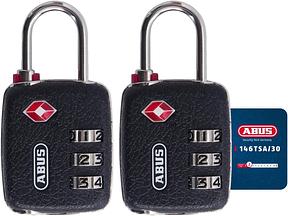
ABUS TSA Schloss 146TSA/30 im Lederlook, 2er Set
View at Amazon (as of Aug 21)Affiliate link. Buying through it earns us a commission; the price stays the same for you.
For the whole family, or if you hate number codes
Travelling as a family of four, you quickly need four locks, and a set is cheaper than four separate buys. The TravelMore 4-pack covers that. The clever bit for anyone who just can't remember number codes: this version also comes with a real key. Handy, because there's nothing to forget. It changes nothing about theft, since the master-key cylinder for inspections is still in there either way.
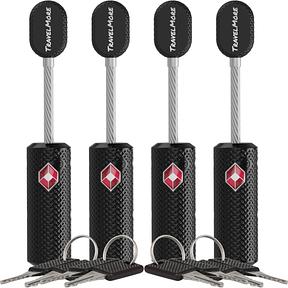
TravelMore TSA Kofferschloss mit Schlüssel, 4er Pack
View at Amazon (as of Aug 21)Affiliate link. Buying through it earns us a commission; the price stays the same for you.
The five locks at a glance
| Lock | Type | Price (approx.) | Rating | Standout |
|---|---|---|---|---|
| Burg-Wächter TSA 74 30 SB | Single padlock | €8.47 | 4.6 ★ | Solid entry, German maker |
| Diyife 2-pack | Padlock, twin pack | €8.99 | 4.5 ★ | Bestseller on a budget |
| NovLock 2-pack | Padlock with tamper indicator | €9.99 | 4.7 ★ | Shows if it was inspected |
| ABUS 146TSA/30 | Padlock, twin pack | €29.95 | 4.0 ★ | Premium look, brand quality |
| TravelMore 4-pack | Padlock with key | €17.99 | 4.6 ★ | Four-set plus a real key |
Suitcases that already have a TSA lock built in
You might not need a separate lock at all. On plenty of good hardshell suitcases it's been standard kit for a while. In Stiftung Warentest issue 06/2026, suitcases with a TSA lock were among the test winners, such as the TITAN UPGRADE S20 scoring 1.8 (see the summary at Markenkoffer.de). That wasn't a test of the locks themselves, it was a test of whole cabin suitcases where the TSA lock simply came as standard equipment on the winners.
The takeaway is still clear: an integrated TSA lock is expected hardware on a decent suitcase today. If your case already has one, don't buy a second. An add-on lock mainly pays off for duffels, backpacks, and older suitcases with no built-in system. If you happen to be shopping for a new case anyway, take a look at our big suitcase comparison first, and for carry-on questions our hand luggage size overview.
My verdict in one sentence
Buy a TSA lock if you're flying to the US, so your bag stays intact through an inspection, and still treat your valuables as if the lock weren't there. That isn't a weakness of the lock. It's simply what it was built for. Two questions come up afterwards almost every time: which lock to buy, and what to do when the code is gone. We've handled the buying part, so here are the support questions.
All products from this post
The ones we named above are marked; the rest are alternatives in the same category.
Affiliate notice: As an Amazon Associate, we earn from qualifying purchases. Product prices and availability are subject to change.
Frequently Asked Questions
I forgot the code to my TSA lock. Now what?
Don't panic, you can barely lock yourself out. A three-digit lock only has 1,000 combinations. Try the factory code 000 first, plus lazy favourites like 123. If that fails, work through them systematically from 000 upward, which takes about 20 to 30 minutes. A light pull on the loop while you turn helps you feel the moment the shackle pops open.
How do I set a new code on a TSA lock?
Almost every model follows the same routine. Set the current or factory code first, usually 000. Then press the reset button, often with a pen tip or a paperclip, until it clicks. Now dial in your new combination and release the button or work the slider. The new code is set. Note it somewhere so you don't have to rely on your whole number memory.
What happens to a regular non-TSA lock at a US inspection?
If your checked bag gets pulled for a manual inspection and it has a non-recognized lock on it, officers are allowed to cut it off to reach the contents. There's usually no replacement for it. A TSA lock is exactly what prevents this, because officers open it with the master key and lock it again instead of destroying it.
Is a TSA lock required for US flights?
No. No country legally mandates a TSA lock, it's a recommendation. The practical consequence of flying without one is the case above: a regular lock can simply be cut off during an inspection. For flights with no US leg a TSA lock isn't necessary, though it does no harm either.
Can a TSA lock be broken open?
Yes, and honestly, pretty easily. The seven master keys have been public since 2014/2015 and can even be printed. A three-digit code is brute-forced in half an hour. That's why a TSA lock is an inspection lock and a deterrent against casual thieves, but not real theft protection. Valuables belong in your carry-on.
Sources
- Travel Sentry travelsentry.org
- 3D Printing Industry 3dprintingindustry.com
- TrustedSec trustedsec.com
- Matt Blaze techradar.com
- absicherungstechnik.com absicherungstechnik.com
- DOT/SITA data compiled by Smart Locks Guide smartlocksguide.com
- TSA lock comparison at vergleich.org vergleich.org
- ExpertenTesten.de expertentesten.de
- Beyondcamping.de beyondcamping.de
- summary at Markenkoffer.de markenkoffer.de