Interrail With Just a Backpack: 2 Weeks, 5 Countries, Zero Luggage Stress
 8 min read
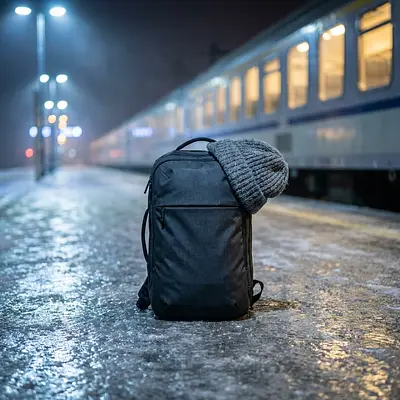
Budapest Keleti station, 10:17 PM. The Nightjet to Vienna is boarding. Backpack over one shoulder, walk on. No check-in counter. No baggage scale. No argument with a gate agent about two extra centimeters.
That's what day 9 of a typical Interrail trip looks like. An Interrail backpack with 40 liters on it. Nothing else.
Sounds extreme? Most people think so before they leave. But after 14 days through five countries, the case holds up: it works exactly this way. Probably with even less stuff.
Why a Backpack and Nothing Else?
Honest answer: an Interrail backpack beats a suitcase on a route like this without much of a contest. Old train stations in Central Europe have stairs. Lots of them. And a 23-kilo suitcase on wheels turns into a nightmare the moment there's a platform sprint to catch a connection in Prague. Anyone who's tried the same route with a rolling suitcase usually reaches the same conclusion within a few days.
Here's the thing most people don't realize: trains in Europe don't have luggage rules like airlines. No 55x40x20 cm limits. No 8-kilo scale at the gate. Deutsche Bahn, Austrian Railways (OBB), RegioJet, and most other operators follow one simple principle. If it can be carried and stowed safely, that's good enough.
That's a massive difference from Ryanair or easyJet, where every centimeter counts. A carry-on backpack that works on planes will work on trains with room to spare.
The Route: 5 Countries in 14 Days
Nothing groundbreaking here. Munich, Vienna, Budapest, Prague, Berlin. One of the most popular Interrail routes through Central Europe, and for good reason.
| Leg | Travel time | What you should know |
|---|---|---|
| Munich to Vienna | about 4 hours | OBB Railjet, no reservation needed |
| Vienna to Budapest | about 2.5 hours | Hourly direct connections |
| Budapest to Prague | about 7 hours | Longest stretch. RegioJet runs direct |
| Prague to Berlin | about 4 hours | EuroCity, every 2 hours |
The big advantage of this route? Eastern Europe. On the Vienna to Budapest and Budapest to Prague legs, no expensive mandatory reservations are needed, unlike on France's TGV. Just hop on. Spontaneously. That's what makes Interrail with a backpack so relaxed.
The Vienna to Budapest stretch is often considered a highlight of the route. Two and a half hours, views of the Danube, cold beer in the dining car. Doesn't get much better.
The Interrail Backpack and What Goes In It
An Osprey Farpoint 40 is a reliable Interrail backpack: 40 liters of volume, 1.3 kilograms empty, available from around 108 euros. It opens from the front, like a suitcase. That sounds minor, but on a train trip it's genuinely useful — no need to unpack everything just to find the socks at the bottom.
For spending less: the CabinZero Classic 44L weighs only 760 grams and costs between 60 and 75 euros. No hip belt, so it's not great for long walks. But perfectly fine for train travel.
For those willing to invest more, there's the Deuter AViANT Access 38. German brand, solid materials, rated 7.6 out of 10 by Pack Hacker. Costs 150 to 170 euros though.
An Interrail Packing List for 2 Weeks
Clothing (yes, this is really enough):
3 t-shirts, two of them merino wool
2 pairs of pants, one short, one long
5 pairs of socks and underwear
1 lightweight rain jacket
Running shoes worn, flip-flops in the backpack
Merino wool is the best thing to pack for this. Those shirts can go three or four days straight and still not smell. One merino shirt costs between 40 and 70 euros. Sounds steep. But it cuts the clothing load in half — an effect that sounds unlikely on paper and holds up in practice.
Laundry every four to five days is enough. Hostel machines cost 3 to 6 euros per load. Washing everything in the sink one evening, say in Budapest, works too — dry by morning.
Beyond that: microfiber towel, travel-size toiletries, power bank, noise-cancelling headphones, universal adapter. And two packing cubes. They keep things organized. Sounds boring, but by day 6 it's a relief that the dirty clothes aren't mixed in with the clean shirts.
What Worked (and What Didn't)
Day 1 usually brings some nerves. Forty liters for fourteen days? Has everything really been thought through?
Mostly, yes. Honestly, it's more common to pack too much. The book often stays unopened (Kindle app covers it). The second pair of long pants gets worn maybe twice total. And a travel alarm clock? Not needed with a smartphone around.
What works brilliantly: spontaneity. Deciding two hours before departure to catch an earlier train to Budapest? Interrail backpack on, go. Trying that with a 23-kilo roller bag across Viennese cobblestones is an entirely different story. Travel blogger Daniela Leitner from planBvoyage puts it best: "Backpack! You're more flexible, faster, and travel more comfortably."
What doesn't work as well: a rain jacket that's too thin for a rainy day in Prague. A proper softshell is the better call there — probably the one real mistake worth avoiding on a route like this.
Why Interrail Instead of Flying?
Sure, flying is faster. Munich to Budapest in 90 minutes instead of seven hours. But the math isn't as simple as "faster equals better."
First: carbon emissions. According to co2online.de, a train journey produces up to 96.5 percent fewer emissions than a comparable flight. Specifically: Munich to Budapest by air generates about 227 kg of CO2 return. By train? 7.4 kilograms. That's not a rounding error. That's a different category entirely.
And then there's the experience itself. On a train, the view out the window, reading, sleeping. At the airport, standing in line, getting scanned, waiting for boarding. Factoring in getting to and from the airport, the time difference is often smaller than expected.
Interrail is booming, by the way. According to official Interrail statistics, over 1.2 million passes were sold in 2023. That's 25 percent more than the previous year. Germany is the single biggest market with 142,000 passes sold. Something's shifting.
Curious about night trains: there's a detailed piece on packing for the night train from Berlin to Paris.
The Best Tips for 14 Days of Interrail
Pack everything worth bringing. Then put a third of it back. Seriously. As Interrail themselves recommend: pack small and light.
Merino wool over cotton. Yes, it costs more. But it means half the shirts.
Packing cubes. Sounds boring. Saves the sanity from day 4 onwards.
Noise-cancelling headphones for night trains. Non-negotiable.
And the most important tip: no suitcase. An Interrail backpack. 35 to 44 liters is enough for two weeks. For a detailed look at carry-on backpacks, the comparison test is worth a look. And for anyone drawn to the idea of traveling with carry-on only, there's a full experience report on that too.
Is It Worth It?
Yes.
Without hesitation. Maybe even with 30 liters instead of 40. The feeling of standing on a platform, backpack on the shoulders, knowing any train can be boarded without being weighed down like a pack mule. That's freedom. Not the kind from a marketing campaign. The real kind.
14 days, 5 countries, 1 Interrail backpack. It works — and it's an easy recommendation for anyone weighing up a suitcase against a backpack.
Frequently Asked Questions
How big should a backpack be for Interrail?
For two weeks in summer, 35 to 44 liters is plenty. 40 liters usually leaves space to spare. Packing carefully and washing clothes along the way can make even 30 liters work. Look for front-loading backpacks that open like a suitcase. They make finding things on trains much easier.
Are there luggage restrictions on European trains?
No. European rail operators like Deutsche Bahn, OBB, and RegioJet don't enforce fixed size or weight limits. The only rule: luggage has to be carried and stowed safely without help. That's a huge advantage over budget airlines.
How much does an Interrail pass cost for this route?
The 7-day flex pass (2nd class) costs roughly 335 euros for adults, around 251 euros for under-28s. That covers all five countries. Reservations on Eastern European routes like Vienna to Budapest or Budapest to Prague are usually not required.
Can I fly with a 40-liter backpack as carry-on?
Yes, with most full-service airlines a 40-liter backpack fits in the overhead bin. With Ryanair or easyJet it gets tight because the depth (usually limited to 20 cm) is exceeded. For Interrail by train, this doesn't matter at all.
Which Interrail backpack is best?
The Osprey Farpoint 40 (from about 108 euros) is the classic choice: 40 liters, 1.3 kg, front-loading. Budget option: CabinZero Classic 44L (60 to 75 euros, only 760 grams). For premium quality: Deuter AViANT Access 38 (150 to 170 euros). All three open like a suitcase.
*Last updated: March 2026*