Long-Haul Carry-On Only: A 3-Week Southeast Asia Trip with 7 kg
 9 min read
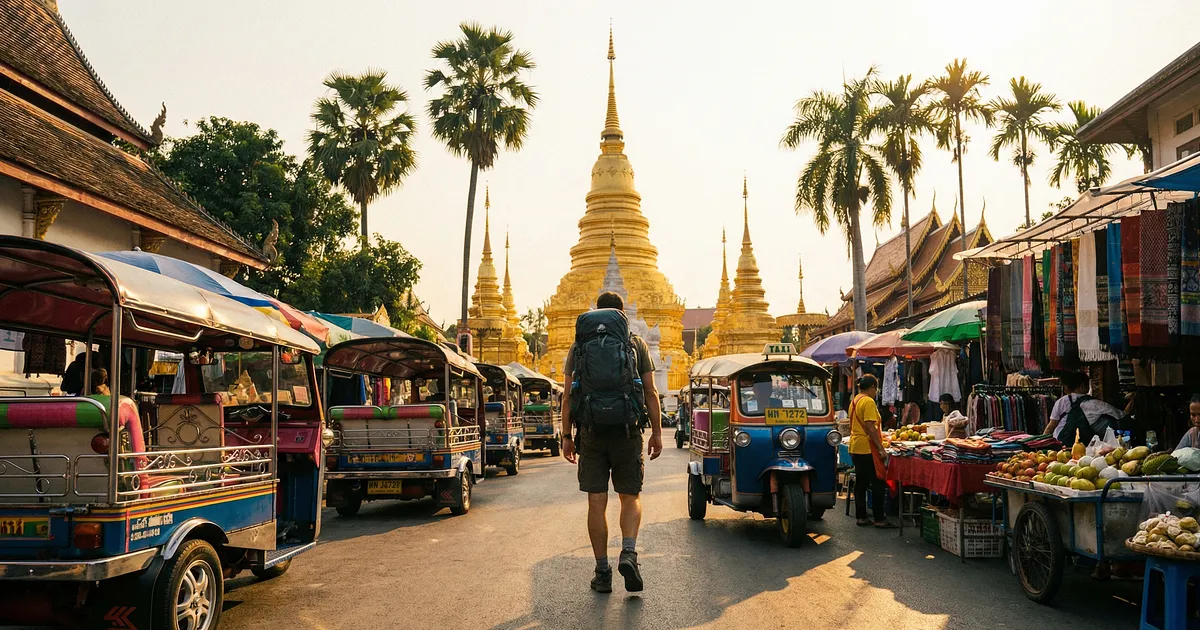
Bangkok, Hanoi, Siem Reap. Five airlines, three countries, zero checked bags. A route that can turn into simultaneously one of the best and riskiest travel decisions around, especially the first time.
Quick answer: Yes, carry on only travel works on long-haul flights and in the tropics. But it takes the right backpack, an honest packing list, and the willingness to do laundry on the road. A solid 40-liter backpack can last a full three weeks without leaving much genuinely missed.
Why the Suitcase Can Stay Home
Anyone who's done a carry-on only trip across Europe already knows the effect: everything gets easier once the baggage carousel is simply skipped. No waiting, no stress, no lost luggage horror stories.
But Europe and Southeast Asia are two very different beasts. Tropical heat, monsoon downpours, overnight buses with no proper luggage compartment. Skepticism is almost guaranteed: "Three weeks? Just a backpack? In the tropics?" Half deserved.
The real trigger is usually simpler than philosophy: saving money on internal flights. AirAsia charges around 20-30 euros for checked baggage on routes like Bangkok to Hanoi. VietJet is similar. Across five internal flights, that adds up to 150 euros or more pretty fast — reason enough to check whether carry on only travel can work here too, and skip the checked bag entirely.
Carry On Only Long-Haul: Is It Actually Possible?
That's usually the main question going in. Carry on only long haul is one thing on a short trip; three weeks feels different. More countries, more climates, more unknowns.
It's more possible than most people think. The key is accepting that laundry happens on the road, cheap things get bought locally, and the "just in case" outfit for every scenario stays home. Traveling Southeast Asia with backpacking carry on luggage means packing light and then packing lighter again.
The IATA guidelines for hand luggage don't change much region to region, but enforcement by individual airlines varies a lot. More on that below.
The Southeast Asia Packing List Carry On Version
Packing usually starts about a week before departure. Then unpacking. Then repacking. Several false starts before the scale finally shows 7.2 kg are entirely normal.
A southeast asia packing list carry on approach comes down to one rule: if it's not certain to get used, it stays home. Here's what typically ends up in the backpack:
Clothes (about 2.5 kg):
4 merino wool t-shirts (dry fast, resist smell)
2 pairs of shorts
1 pair of long pants (temples require covered legs)
7 underwear, 4 pairs of socks
1 thin rain jacket
Flip-flops clipped to the outside
Tech (about 1.8 kg):
Leave the laptop at home on purpose. Just phone and power bank
Noise-cancelling headphones (non-negotiable for an 11-hour flight)
Charging cables, travel adapter
Toiletries and the rest (about 1.5 kg):
Toiletry bag with liquids in hand luggage-compliant sizes
Sunscreen (50 ml tube, buy more locally)
Bug spray (small bottle, same strategy)
Microfiber towel
Basic first-aid kit
What usually gets left out: the printed book (Kindle app is fine), the second sweater (not needed at 35 degrees), and the hiking boots. The hiking boots are typically the hardest call — rarely a regret in hindsight.
Airline Roulette: 5 Airlines, 5 Different Rules
This is where things get interesting. And a little annoying.
Understanding hand luggage long haul flight rules versus low-cost carrier rules is actually two different problems. On the long-haul leg from Europe, airlines tend to be relatively relaxed. On the short hops inside Southeast Asia, things get strict fast.
Lufthansa (Frankfurt to Bangkok): 8 kg carry-on, max 55x40x23 cm. A 40-liter backpack fits easily here, and on the long-haul flight nobody tends to glance twice at it.
Thai Airways (codeshare leg): Officially 7 kg. Rarely checked on long-haul routes. Sticking to 7 kg anyway is still the safer bet.
AirAsia (Bangkok to Chiang Mai, later to Hanoi): This is where it gets real. AirAsia allows 7 kg carry-on, and they actually weigh bags. At the gate in Don Mueang, a scale is a regular sight, and being just a few hundred grams over can cost 400 Baht (roughly 10 euros) on the spot. A common workaround: wear the heaviest jacket in the morning instead of packing it, even at 32 degrees. Looks ridiculous, works anyway.
VietJet (Hanoi to Ho Chi Minh City): Also 7 kg, also strict on paper. In practice often more relaxed than AirAsia: no scale at the gate, just a quick look.
Cambodia Angkor Air (Saigon to Siem Reap): 7 kg officially, enforcement close to nonexistent in practice. 10 kg would probably slide through too, though that's not something to count on.
The lesson: Asian low-cost carriers are stricter than most European comparisons. Ryanair might occasionally weigh a bag. AirAsia does it almost every time. Anyone browsing the carry-on backpack comparison on Kofferly should pay attention to lightweight models. Every gram genuinely counts for carry on only travel in this region.
Thailand: Baptism by Monsoon
The first few days in Bangkok tend to be easy. Hostel, street food, temples. Backpack sits in the corner. Everything fine.
Then comes Chiang Mai. And the rain.
A monsoon shower at a night market can flood everything in about 20 seconds. Without a rain cover for the backpack — a detail that's easy to forget — the clothes inside come out soaked, and a microfiber towel is no help either once it's soaked through too. A phone survives best when it's already in a pocket, not in the bag.
Lesson number one: pack everything into zip-lock bags. Four large ones from a market cost about 80 cents and save the rest of the trip.
Vietnam: Overnight Buses and Backpacking Carry On Reality
Vietnam is often the part of the trip where the carry on only concept gets truly tested. The overnight bus from Hanoi to Hue doesn't have a real luggage compartment. Sleep happens in a sort of pod-capsule, with the backpack beside or underneath it. A full-size suitcase? Not a chance. Backpacking carry on style is the only sensible option on these routes.
And then there are the markets. A tailored suit in Hoi An often costs around 40 euros — and suddenly there's a suit in a plastic bag and no room left in the backpack. Throwing away a dirty t-shirt and a pair of broken flip-flops to make space is a fairly obvious call at that point. Minimalist travel sometimes means making tough decisions on the spot.
The travel gadget tip worth passing along here: packing cubes. A set from Hanoi runs about 5 euros and makes a total difference — suddenly everything has a place, and the backpack feels twice as big.
Cambodia: Three Weeks Later
Siem Reap is often the last stop. Angkor Wat at sunrise with a 40-liter backpack on the shoulders sounds a little impractical — it is, a little. But the hostel is usually only a few minutes away, so the bag can wait there after breakfast.
After three weeks of carry on only travel, the backpack tends to smell interesting, despite regular washing at hostels (costs between 1 and 2 euros per load in Southeast Asia). The merino wool shirts consistently hold up better than expected. A cotton replacement bought spontaneously at a market, on the other hand, often lasts exactly one day in the humidity before it starts to stink.
What's Worth Changing Next Time
Most of it tends to go right. A few things are still worth adjusting.
A rain cover belongs in the bag from day one. Weighs 80 grams. Saves a miserable evening exactly like the one in Chiang Mai.
Packing cubes from the start, not bought halfway through the trip. And maybe compression bags for dirty laundry.
Three t-shirts instead of four is probably enough. In Southeast Asia, laundry is cheap and available everywhere. One to wear, one drying, one in reserve. Enough.
And honestly, the long pants are almost skippable. They tend to come out exactly twice, for temples. There's probably a lighter solution for that.
Frequently Asked Questions
Can you really travel for three weeks with carry-on only?
Yes, if there's a willingness to do laundry on the road and stick to the essentials. In Southeast Asia, laundry services are cheap (1-2 euros per load) and rarely take longer than a day. Merino wool shirts go a long way between washes.
How strict are Asian airlines about carry-on weight limits?
It varies. AirAsia weighs bags at the gate almost every time. VietJet is more relaxed. With low-cost carriers in Asia, assume the 7 kg limit is enforced. Wearing heavy items and keeping the power bank in a jacket pocket both help.
What backpack works best for long-haul carry-on only travel?
A 40-liter backpack with a front-opening design (opens flat like a suitcase) is ideal. Look for max dimensions of 55x40x20 cm and an empty weight under 1.5 kg. That leaves 5.5 kg for actual stuff on a 7 kg limit.
What items are not allowed in carry-on luggage on long-haul flights?
The rules are pretty much the same worldwide. Liquids over 100 ml, sharp objects, and lighters go in checked baggage. Sunscreen and bug spray are best bought locally in bigger bottles, with just a small tube for the flight.
Do you actually save money travelling carry-on only?
Skipping checked baggage fees on five internal flights adds up to around 150 euros in savings. Plus no lost luggage risk, no waiting at the belt, and faster transfers. The actual savings depend on how many flights are involved.
*Last updated: March 2026*