Pet on a Plane: The 2026 Transport Box Guide for Dogs and Cats
 13 min read
You bought a nice soft carrier, perfect for flying Lufthansa. Then you booked a spontaneous Condor flight to Palma. And now you're stuck at the gate. Because Condor sets its own pet-carrier rules.
That's what this guide is about. A pet flight transport box is usually a one-time purchase, but you fly with different airlines. And they each do their own thing when it comes to size, weight, and price. I lined up the rules of the four carriers most of us actually book: Lufthansa, Eurowings, Condor, and TUI fly. Plus the part most guides leave out, which is the vet's point of view.
Quick context on why this matters to so many people. German households counted roughly 15.7 million cats and 10 million dogs in 2025, according to Statista/ZZF. A chunk of them fly. And nearly every owner makes the same mistake the first time. They only check their one airline.
The one number at Lufthansa, Eurowings and TUI fly: 8 kilos
Let's start with the good news. There's a common thread.
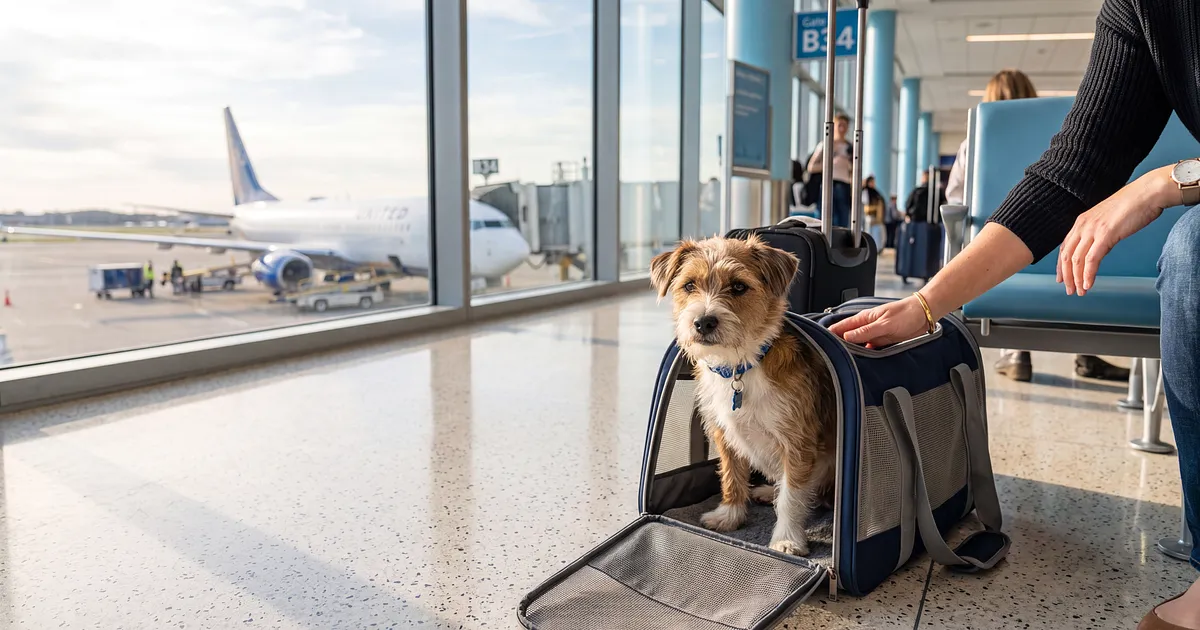
For the cabin, Lufthansa, Eurowings and TUI fly agree on this: your pet, including the carrier, can weigh up to about 8 kg, and the box has to fit under the seat in front of you. That means a footprint of roughly 55 x 40 cm. Small dogs, cats, very young or very light animals get to travel in the cabin with you.
Anything heavier? Into the cargo hold. An 18-kilo Labrador isn't sitting next to you by the window, that dog goes as excess baggage into the climate-controlled hold. And no, that's not some arbitrary rule. More on that below.
The catch is in the details. And the detail is height.
Lufthansa and Eurowings allow a box up to 23 cm tall. TUI fly caps it at 20 cm. Sounds like nitpicking? Those are exactly the three centimeters that keep your cat off the rebooking queue at the counter. One more thing with Eurowings: they only accept a soft, non-rigid bag. A hard plastic box won't make it into the cabin. If you're already traveling with regular carry-on, it's probably worth checking what Lufthansa allows for your own suitcase, so your bag and the pet carrier both fit the baggage limit together.
Condor publishes its own pet-carrier requirements — see Condor carry-on baggage.
How those differences play out for your own suitcase is covered in our Eurowings hand luggage compared to Lufthansa, handy if you switch between the two airlines.
If you're not sure which airline you'll fly: buy to the strictest common standard among the three airlines whose box size is documented here. So a soft box of no more than 55 x 40 x 20 cm. That covers Lufthansa, Eurowings and TUI fly. Better to take the smaller height and survive an airline switch than to buy three times.
Airline comparison: 2026 airline pet rules at a glance
Here are the four main carriers side by side. Heads up first: the fees are the figure that changes fastest. Some airline sites blocked our research access, so treat the prices as ballpark figures per segment, not gospel. Double-check on the airline's own page before you book.
| Airline | Max. weight (incl. box) | Max. cabin box size | Cabin allowed? | Approx. fee (per segment) | Notes |
|---|---|---|---|---|---|
| Lufthansa | ~8 kg | 55 x 40 x 23 cm | Yes | around 50 to 70 € (Europe), more long-haul | Cargo transfers only via Frankfurt, not Munich |
| Eurowings | ~8 kg | 55 x 40 x 23 cm | Yes | around 60 to 80 € | Soft bag only, no hard-shell box |
| Condor | own policy | own policy | Yes | around 50 € up to nearly 100 € by zone | Pit bull terriers and Rottweilers excluded entirely |
| TUI fly | ~8 kg | 55 x 40 x 20 cm | Yes | from around 40 € (higher international) | Low height, limited pets per flight |
A few things jump out of that table.
Condor is the strictest on breeds. Pit bull terriers and Rottweilers aren't allowed at all, cabin or cargo. What Condor requires for a pet carrier is published on Condor's own baggage page. Other airlines are more relaxed about it, or the ban only covers the hold.
Then there's that Lufthansa transfer thing. If your bigger dog travels in the cargo hold and you've got a connecting flight, it only works through Frankfurt. Munich doesn't handle checked animals in transit. Book through MUC and you'll have to replan. You won't find that detail in a generic "flying with your dog" article, but it can honestly cost you the whole trip.
IATA sizing: what the cargo hold demands from your pet flight transport box
For the cabin, a decent soft bag does the job. For the hold it gets more technical. That's where IATA rules kick in, and they're not a nice-to-have. They're the condition for your pet flying at all.
The IATA Live Animals Regulations, 52nd edition, in force since 1 January 2026, tightened container requirements again. Here's what that means for you when buying a box.
Under the IATA container requirements, at least 16% of the wall area has to be ventilated, with openings on all four sides in the upper two-thirds of the box. The gaps can measure at most 25 x 25 mm for dogs and 19 x 19 mm for cats. A paw or nose shouldn't fit through.
And a new point that catches people off guard: boxes for snub-nosed breeds have to be 10% bigger in every dimension than the standard for that weight. Why those breeds specifically? More on that in the breed section.
For the size of a cargo box there's a simple rule of thumb. Your pet has to stand up straight, lie down, and turn around once without bumping into anything. Too small gets rejected. Too big isn't great either, because the animal gets thrown around more during turbulence.
Paperwork: the EU pet passport, and the destination decides
No documents, no flight. The core is the EU pet passport with a microchip and a valid rabies vaccination. The order matters: chip first, then vaccinate. Do it the other way around and the vaccination doesn't count. And after the rabies shot there's a 21-day wait before you can travel.
Quick freshness note, because nearly everyone gets this wrong. Since 21 April 2026, Part VI of Regulation (EU) 2016/429 forms the legal basis for pet travel. It replaced the old Regulation 576/2013. Nothing changes on the passport itself for you, but plenty of guides still cite the old number.
Now the part where most people trip up. "Non-EU" doesn't mean the same thing everywhere.
Here's an example. For entry into countries like Turkey, German customs requires an additional rabies antibody titer test done in an EU-approved lab. For the USA, Canada, or the UK that test isn't needed. Both are non-EU destinations, yet the requirements couldn't be more different. Anyone who thinks "outside the EU is equally complicated everywhere" is planning wrong. And you can't squeeze in a blood test three days before departure.
So: pick the destination, then check the specific entry rules. Weeks ahead, not the night before.
Dog in plane cabin or cargo: which is less stressful?
The gut answer for a dog in plane cabin situations is that it's obviously better, your pet is with you, you can calm it down. Sounds logical.
It's not that clear-cut, though. In cat forums like Katzen-Forum.net, owners debate exactly this, and one point keeps coming up: the animal cargo hold on major airlines is soundproofed and climate-controlled. No food smells, no perfume, no crying kids, no feet walking past the crate. For some animals that's calmer than the cabin.
The honest answer, as far as I can tell, is that it depends on the animal. Some cats arrive completely relaxed, others are wrecked no matter where they sat. I think the real variable probably isn't cabin versus cargo. It's how well the animal knows its box. Which brings us to this.
How to get your pet used to the box
This is the part you don't handle the night before, at least not if you want it to go smoothly. The vet-reviewed guide from zooplus suggests starting weeks or even months ahead, and honestly, that makes sense once you think about it from the animal's side.
What worked for us was putting the box out, open, somewhere our cat already liked hanging out. No forcing involved. We dropped in a familiar blanket that smelled like home, plus a few treats, since the goal is for your pet to see the box as a safe spot rather than a cage that only means a trip to the vet.
From there you ramp up slowly. We started feeding right in front of the box, then moved the bowl inside it. Close the door for a few seconds at first, while you're right there watching. Extend the time bit by bit, and once that feels normal, carry the closed box around the house, into the car, maybe a short drive. That way the box becomes a normal part of daily life instead of a sudden shock at the airport.
A tomcat named Mauzi, belonging to a friend of mine, took three weeks before he went in willingly. On the fourth try he actually fell asleep inside. That's the state you're after.
Sedatives: please don't, and here's why
The most understandable wish in the world. Your pet's nervous, so you give it something to take the edge off. Sounds caring. It's dangerous.
From what I've seen, vets generally advise against sedatives for flying, as the Pet Cargo Blog lays out too. The reason is altitude. The changed air pressure affects how the drug hits the cardiovascular system. Even a dose your vet calls moderate on the ground can cause circulation problems in the air. And in an unsupervised cargo hold, nobody can step in if something goes wrong.
What helps instead? A long walk or a proper play session before the flight, to burn off excess energy. Royal Canin and others recommend exactly that. Plus pheromone products like Adaptil, a familiar blanket, the right feeding timing. No magic bullet, but probably without the risk a sedative brings along.
Why pugs, bulldogs, and Persians often stay grounded
"Why can't my pug fly when my neighbor flies with her beagle?" Fair question. And it's not about size.
It's the anatomy. Snub-nosed, or brachycephalic, breeds like pugs, French and English bulldogs, plus Persian cats and British Shorthairs, have naturally narrowed airways. Under stress and heat, breathing quickly becomes a problem for them. As the veterinarian Ralph Rückert explains, French bulldogs need treatment for respiratory conditions about five times more often than normal-nosed breeds.
That's exactly why most airlines ban these breeds from the cargo hold. And even in the cabin it gets dicey: Lufthansa refuses carriage when the departure or arrival airport is above 27 °C. Germany's Federal Chamber of Veterinarians has also weighed in with a publication on the flight ban for brachycephalic dogs and cats. As far as I can tell, the veterinary consensus is pretty clear. For these animals, flying is a genuine health risk, not a formality.
A bigger box won't fix it, by the way. The problem sits in the airways, not the floor space.
Cat flight carrier extras
A lot applies equally to dogs and cats. A few things are different with cats, though, especially when it comes to the cat flight carrier itself.
Cats are escape artists. It's worth securing the carrier's zipper with an extra little carabiner or a velcro strap. A cat that slips out mid-flight isn't just chaos, it can lead to charges for disrupting a flight. Not a joke.
On timing, it helps to stop feeding a big meal a few hours before departure so the stomach stays settled. Water yes, big meal no. And if you're flying round-trip, it's generally smart to leave enough of a gap between flights so your cat can recover from the travel stress before the next leg. Two short trips back to back are, in my experience, about the worst thing for an animal's nerves.
What to actually take away about your pet flight transport box
If you only remember two things: buy the box to 55 x 40 x 20 cm so it fits Lufthansa, Eurowings and TUI fly. And start the box training weeks ahead, not the night before.
The rest is detail you can work through calmly. Documents deserve an early check, especially for non-EU destinations. Sedatives are best avoided entirely. And if you have a snub-nosed breed, it's worth sorting out carriage honestly with your vet and the airline before you even book.
You'll probably find the right pet flight transport box in our carry-on luggage test 2026, where we've already checked dimensions and airline compatibility for you. Measure what your airline allows first, and you'll skip the trouble at the gate. Safe travels, both of you.
Frequently Asked Questions
What pet flight transport box do I need for the cabin?
For the cabin, Lufthansa and Eurowings allow up to 55 x 40 x 23 cm, while TUI fly caps it at 55 x 40 x 20 cm. Weight including pet and box sits around 8 kg. A 55 x 40 x 20 cm box therefore fits Lufthansa, Eurowings and TUI fly.
How heavy can a dog cabin flying weight be?
Including the transport box, about 8 kg at Lufthansa, Eurowings and TUI fly. Anything heavier goes into the climate-controlled cargo hold as excess baggage. Small dogs, cats, and light animals may travel in the cabin under the seat in front.
What does it cost to bring a pet on a plane?
As a ballpark per segment: roughly 40 to 100 € depending on airline, destination, and zone. Within Europe it's cheaper, long-haul is more. Exact fees change often, so check directly on the airline's page before booking.
Should I give my pet a sedative before the flight?
No. Vets and the AVMA advise against it, because the changed air pressure at altitude alters how the drug affects the cardiovascular system and can turn dangerous. Better options are a good workout before the flight, pheromone products, and a familiar blanket.
Which breeds can't be transported on a plane?
Snub-nosed breeds like pugs, French bulldogs, Persian cats, and British Shorthairs are banned from the cargo hold by most airlines, because their narrowed airways become dangerous under stress and heat. Condor additionally excludes pit bull terriers and Rottweilers entirely.
What documents do I need to fly with a pet?
An EU pet passport with a microchip and valid rabies vaccination, and you have to chip before you vaccinate. After the shot there's a 21-day wait. For non-EU destinations like Turkey, an additional rabies antibody titer test may be required.
*Last updated: July 2026*
Sources
- Statista/ZZF de.statista.com
- Lufthansa lufthansa.com
- Eurowings eurowings.com
- Condor carry-on baggage condor.com
- IATA Live Animals Regulations, 52nd edition iata.org
- IATA container requirements iata.org
- Regulation (EU) 2016/429 eur-lex.europa.eu
- German customs zoll.de
- Katzen-Forum.net katzen-forum.net
- vet-reviewed guide from zooplus zooplus.de
- Pet Cargo Blog petcargo.com
- Ralph Rückert explains ralph-rueckert.de