French Air Traffic Control Strike 2026: What Travelers Need to Know
 7 min read
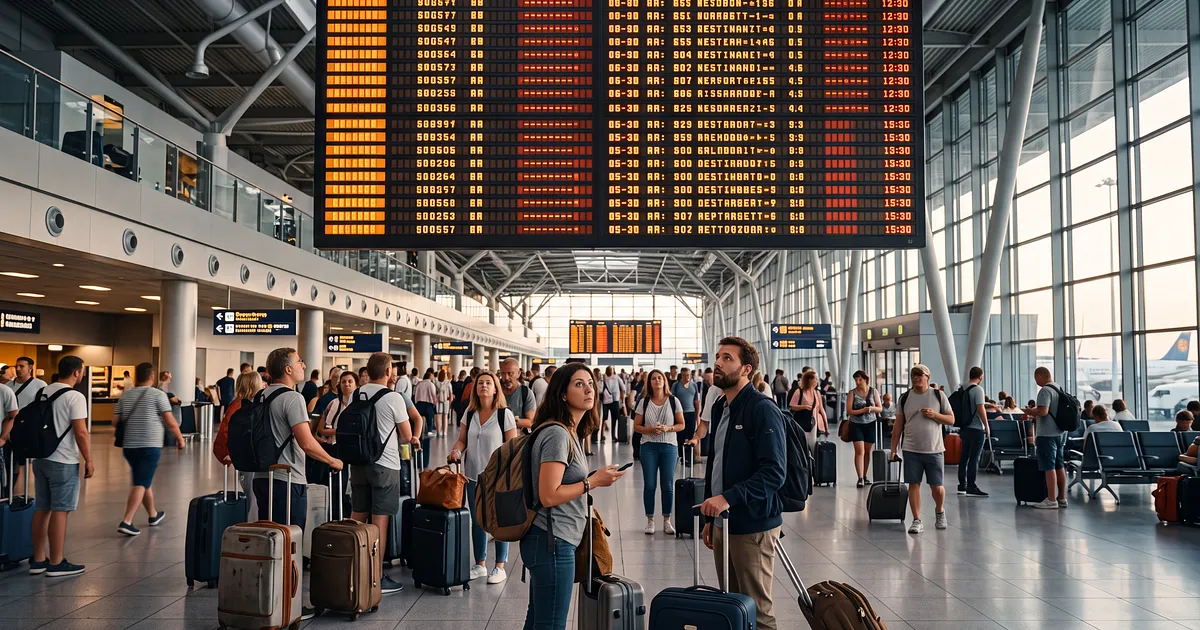
Your flight is heading to Crete, not Paris. And yet the board says "cancelled." Sounds illogical? It isn't. A French air traffic control strike in 2026 doesn't just hit France, it hits half of Europe. And there's been plenty of it this year already: strike days in April (the 18th, 19th, and 25th), across the Ascension weekend in May (14th to 16th), and again in early July. The big one is still ahead, though. A four-day national walkout is planned for October 7 to 10.
Quick answer: A French air traffic control strike in 2026 hits flights that never touch France, since most of the cancelled routes are pure overflights. Compensation under EU 261 usually doesn't apply here, because a third-party strike counts as an extraordinary circumstance. You're still entitled to care, meals, a hotel, and rebooking, though. The single biggest thing you can do: rebook yourself in the app the moment a strike is announced, rather than waiting in line.
Here's what that means for your summer trip, and what you can actually do about it.
Why the French air traffic control strike grounds all of Europe
France sits smack in the middle of Europe's airspace. Fly from Germany to Spain, Portugal, Italy, or the Greek islands, and you almost always cross French territory. That's the catch.
According to Ryanair, most disrupted passengers during a French ATC strike aren't even flying to or from France, they're just passing through French airspace on the way somewhere else. Industry estimates put pure overflights at roughly 70 percent of cancelled connections. Your Frankfurt to Heraklion flight? Counts as one.
Just how bad it can get shows in the strike of July 3 and 4, 2025, probably the best-documented reference case out there. According to an official Eurocontrol report, an average of 1,422 flights were cancelled per day across those two days, that's 4.7 percent of all European flights. Punctuality dropped from 75 percent to 64 percent on those days. Another 3,713 flights ran late daily. More than a million passengers were affected, and around 200,000 couldn't fly at all. That's not a rounding error, that's a continent-wide pile-up. Ryanair alone scrapped 170 flights carrying over 30,000 people.
And no, this isn't a one-off headache. A report based on the French Senate's findings puts the cost of French ATC delays to airlines at 800 million euros in 2025. By 2030, that's forecast to climb to 1.3 billion. Staff shortages, ageing tech, a wave of retirements, honestly, none of this looks like it gets fixed fast.
Your EU 261 rights for flight delay compensation, and the big misunderstanding
This is where most travelers make an expensive mistake. "Flight cancelled, so I automatically get 400 or 600 euros." Sounds fair. Usually wrong, though, and most people only find that out the hard way.
An ATC strike is industrial action by a third party, not by the airline itself. Under EU Regulation 261/2004 that counts as an extraordinary circumstance, meaning something the airline genuinely couldn't control. In practice, that means the flat-rate cash compensation almost always drops away.
But, and this matters, your other rights stay fully intact. Germany's Federal Aviation Office is clear on this: the airline still has to cover care such as meals, communication, and a hotel if you're stranded overnight, no matter what caused the disruption. On top of that comes your choice: a full refund of the ticket price, or a free rebooking. If the chaos of rebooking means your checked bag goes missing too, our guide to lost luggage rights and compensation covers deadlines and up to 1,900 euros in compensation.
Put simply: care? Yes. Cash on top? Usually no.
What to do when a flight is cancelled by a strike: quick checklist
ATC strikes aren't the only cancellation risk this season, either. The Lufthansa strike in March 2026 followed a similar pattern, but with one key difference worth knowing: when the airline's own staff walk out, compensation can actually apply, since that's not a third-party circumstance. Worth knowing before you write off a claim.
If your flight is affected, or might be, here's roughly how I'd work through it.
- Check the app before the queue. Most rebookings go through faster there than on the hotline or at the desk, and push alerts help you catch changes early.
- When a strike is announced, rebooking yourself before you even call usually beats waiting. Airlines tend to open a free rebooking window right in the app, and it doesn't stay open long.
- Document everything. Screenshots of the cancellation, boarding passes, receipts for food and hotel, useful later for refunds or a delay claim too. Even with no compensation coming, you can reclaim those care costs.
- Ask for meals and a hotel if you're stranded for hours or overnight. You're entitled to it, full stop.
- Check the strike calendar. The ADAC advises checking your flight status early and contacting the airline directly. A quick look at known strike dates before you book tends to pay off.
- Build in a real buffer for connections, three hours instead of one, and fly early in the day where you can, since delayed aircraft tend to pile up as the day goes on.
Do that, and the next French air traffic control strike in 2026 should feel a lot less chaotic.
Why your hand luggage suddenly matters
Sounds trivial. It isn't. When your flight gets cancelled and your checked bag is already deep in the system, you can be stuck for hours or overnight. Without your stuff.
So every carry-on deserves a small emergency kit: charging cable and a power bank (a dead phone is your worst enemy during rebookings), medication, travel documents within reach, a change of clothes, and an empty water bottle to refill. Pack smart and the chaos gets a lot easier to ride out, our airport packing tips that save you from costly mistakes walk through the rest. And if you're still after a case that fits any cabin, check our carry-on luggage test 2026.
French strikes are now about as predictable as peak season itself. You can't stop them. But you can be ready, instead of improvising at the gate.
Frequently Asked Questions
Do I get compensation for a French air traffic control strike?
Usually not. An ATC strike counts as an extraordinary circumstance under EU 261/2004, so the flat-rate compensation of 250 to 600 euros almost never applies. Your rights to care, a refund, or free rebooking do stay in place, though, and that part gets missed a lot.
Why is my flight affected when I'm not flying to France?
Because most cancelled flights are pure overflights, an estimated 70 percent according to Ryanair. France sits in the middle of Europe's airspace, and routes to Spain, Italy, or Greece almost always cross it. When French air traffic control walks out, traffic backs up across the continent.
Does the airline have to pay for my hotel during a strike?
Yes, generally. If the cancellation forces you to stay overnight, the airline must cover accommodation, meals, and communication. These care obligations apply regardless of whether any cash compensation is due.
When are strikes announced in France for 2026?
2026 has already seen strikes in April, in May over the Ascension weekend, and in early July. The biggest announced walkout is a four-day national strike from October 7 to 10, 2026. More short-notice dates are entirely possible across the season.
What to do when a flight is cancelled by a strike?
Rebook yourself in the airline app as fast as you can, before you get stuck in a queue or on the hotline, since the best alternative flights tend to vanish within minutes. Document everything for later refunds, and actively ask for care during long waits.
*Last updated: July 2026*