I Watched My Friend Go Through the EU's New EES Border System at Frankfurt Airport
 8 min read
My buddy Dave from Austin texted me three days before his flight. "Dude, should I book a hotel near the airport? Reddit says people waited 7 hours in Lisbon."
I told him to relax. Frankfurt is not Lisbon. Probably.
On April 12th, 2026, two days after the EU's EES system went into full operation, I picked Dave up at Frankfurt Airport. It was his first EES airport experience, and honestly, I was curious too. Here is what happened.
The EES System in 30 Seconds
The EES (Entry/Exit System) is the EU's new biometric border control. Since April 10th, 2026, every non-EU citizen entering the Schengen area has to provide fingerprints and a facial photo. No more passport stamps. Everything is digital.
According to the European Commission, over 45 million border crossings have been registered since the phased rollout began in October 2025. The EU says the system works. Airport operators? They have a different opinion.
Getting Off the Plane
Dave landed at 2:20 PM. Direct flight from Austin, Terminal 1. I was waiting in the arrivals hall, stopwatch running on my phone.
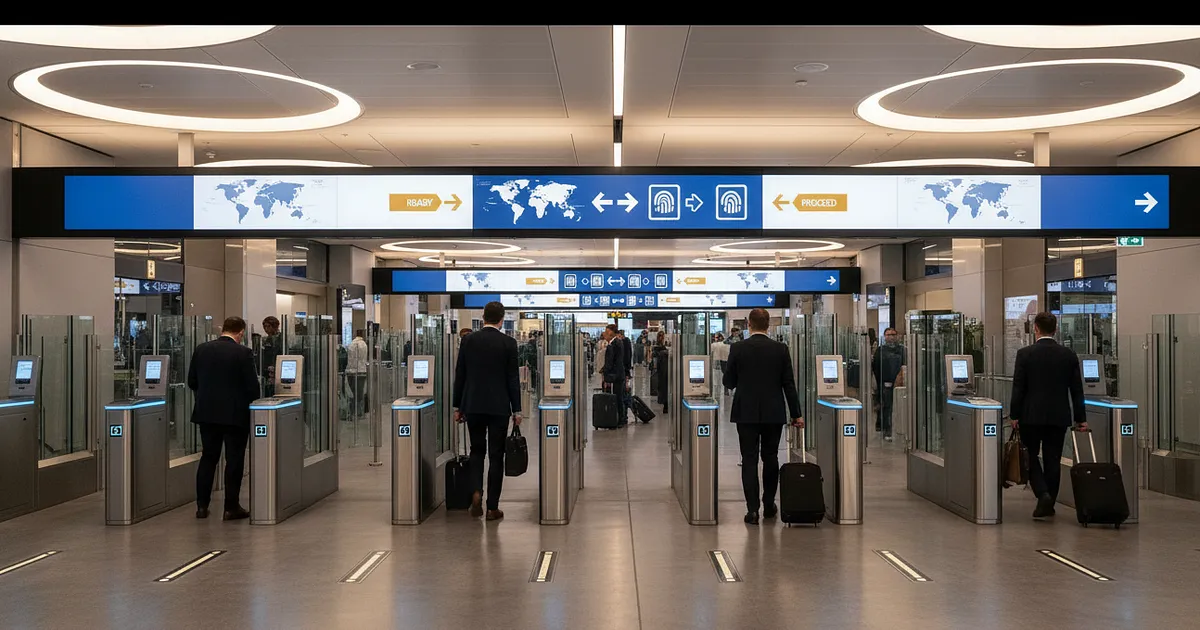
From what he told me afterwards: the signage was decent but not perfect. He followed the "Non-EU/EEA" signs toward the kiosks. Some signs were only in German. For an American who spent his high school German years forgetting everything? Not ideal.
The queue at the self-service kiosks was about 15 people deep. Nothing like the chaos in Lisbon where travelers waited up to 7 hours before the system was temporarily suspended. But it was not an empty hall either.
Step by Step Through the EES
Dave walked me through the whole thing over a beer later. I'll give you his version.
The kiosk. He placed his passport (no cover, he had read that somewhere) on the left side of the machine. The chip got scanned automatically. Then he looked into a small camera for the facial photo. Glasses off. One picture. Done.
Fingerprints. Four fingers of his right hand on the scanner, no thumb. He needed two attempts because he placed his fingers too wide the first time. The screen showed instructions, but he still felt unsure about it.
The officer. After the kiosk, he walked to the border desk. The officer scanned his passport again, did a second fingerprint verification. Quick chat. "Purpose of visit?" "Visiting a friend." Stamp? None. All digital now.
Frankfurt Airport has 218 self-service kiosks installed, according to the Federal Police. That day, maybe 12 of them looked actively staffed. I don't know if that is normal or a Saturday afternoon thing.
How Long Does EES Take? Honest Numbers
I timed it. From Dave's "I'm in line now" text to his "I'm through."
23 minutes.
About 8 minutes of queuing, 4 minutes at the kiosk (including the fingerprint do-over), and the rest at the officer's desk plus walking. Industry data from ACI Europe suggests wait times increased by up to 70% since the EES launch. For Dave, it felt more like 40 to 50% compared to his last Frankfurt trip in September 2025.
Honestly? Not dramatic. But he was traveling alone on a quiet Saturday. A family of four, all registering for the first time? I would expect 40 minutes and up. The initial registration takes 2 to 5 minutes per person. That adds up fast.
What Worked Well
The kiosks ran smoothly. No crashes, no freezing (unlike Frankfurt in early winter 2025, when fingerprint scanners reportedly froze in cold temperatures). The border officers were patient and friendly. An older British gentleman ahead of Dave needed several attempts at the kiosk, and the officer calmly helped him through.
The technology works. That is the good news.
What Did Not Work So Well
The signage. A major international hub, and some of the EES directions were German-only. Fraport's own board member, Dr. Prumm, called Frankfurt "Germany's gateway to the world". If that is the claim, the wayfinding needs to match it.
And the wait time exists. 23 minutes is manageable, sure. But if you have a tight connection or you don't know what to expect, it becomes stressful.
ACI Europe director Olivier Jankovec put it plainly: there is a complete disconnect between the EU's perception that EES works well and the reality travelers face. I think he has a point. The system works technically. "Works" and "works well for travelers" are two different things.
Tips for Your First EES Border Crossing
A few things that helped Dave, and a few I would do differently next time.
Keep your passport accessible. You need it immediately at the kiosk, without a cover. If you travel with a backpack, keep your documents in an easy-to-reach front pocket or organizer. This is something I cover in our hand luggage packing tips too: documents you need at the airport go in the one pocket you can reach without putting everything down.
Take your glasses off before the kiosk. Saves 30 seconds. Sounds trivial, but when 15 people are waiting behind you, you don't want to fumble.
Plan extra time. I would say 30 minutes extra for first-time registration, 15 minutes for return visits. Maybe I am being overcautious. But I would rather wait at the gate than sweat in a queue.
Download the Travel to Europe app. Dave did not have it. You can pre-register passport data and your facial image. Fingerprints still have to be done at the border, but pre-registration is supposed to speed things up.
Bring a power bank. If the wait gets longer, a dead phone is the last thing you need.
Next Time Will Be Faster
This is the part that reassured Dave the most. The initial registration is a one-time thing. On his next entry, biometric data only gets verified, not captured from scratch. That should be significantly quicker.
The data is stored for three years under EU Regulation 2017/2226, then automatically deleted. If you overstay the 90-day rule, the data stays for five years.
Does the data storage bother me? As an EU citizen, nothing changes for me personally. For Dave, it is a trade-off. He said, "It feels weird, but TSA PreCheck back home is honestly worse." He might be right.
Is the EES as Bad as Everyone Feared?
No. At least not on the day I was there.
The Reddit panic was overblown, at least for Frankfurt on a normal Saturday. Based on Dave's EES airport experience, the system works. It is just slower than the old stamp-and-wave process, and "slower" feels a lot worse when you're tired from a transatlantic flight.
Will it look different during peak holiday season when thousands of families are trying to get through at once? Probably. Airports and airlines have already warned about longer wait times over Easter.
But as a solo traveler who is prepared and knows what to expect? 23 minutes. Manageable.
Dave was sitting in my car half an hour after landing, complaining about the weather. Not about the EES.
Frequently Asked Questions
How long does the EES check take at the airport?
The EES airport experience at Frankfurt took 23 minutes total for Dave's first-time registration, including queue time. The actual processing at the kiosk and the officer's desk was about 12 minutes. Return visits should be noticeably faster since biometric data only needs verification.
Are EU citizens affected by the EES?
No. The EES applies only to third-country nationals, meaning travelers without an EU passport. Germans, French, Italians and all other EU citizens continue using the regular EU lane or EasyPass. As an EU citizen, you only notice the EES through busier terminals.
What data does the EES store?
Four fingerprints from the right hand (no thumb), one facial photo, passport data, plus the date, time, and location of the border crossing. The data is automatically deleted after three years.
Can I pre-register for the EES?
Partially. The official Travel to Europe app by Frontex lets you upload passport data and a facial image in advance. Fingerprints still have to be taken in person at the border. The app speeds up the process but does not replace it.
What happens if the kiosk malfunctions?
You get redirected to manual processing by a border officer. It takes a bit longer but works reliably. Frankfurt has 218 kiosks available, so a complete outage is unlikely.
*Last updated: April 2026*
Sources
- European Commission home-affairs.ec.europa.eu
- chaos in Lisbon where travelers waited up to 7 hours traveltourister.com
- 218 self-service kiosks presseportal.de
- ACI Europe suggests wait times increased by up to 70% airliners.de
- initial registration takes 2 to 5 minutes per person etias.com
- fingerprint scanners reportedly froze in cold temperatures ukblogspot.co.uk
- complete disconnect between the EU's perception that EES works well and the reality travelers face iata.org
- Travel to Europe app frontex.europa.eu
- EU Regulation 2017/2226 eur-lex.europa.eu
- Airports and airlines have already warned about longer wait times over Easter airliners.de