
A Week Off-Grid: A Digital Detox Vacation With Just Carry-On Luggage
 8 min read
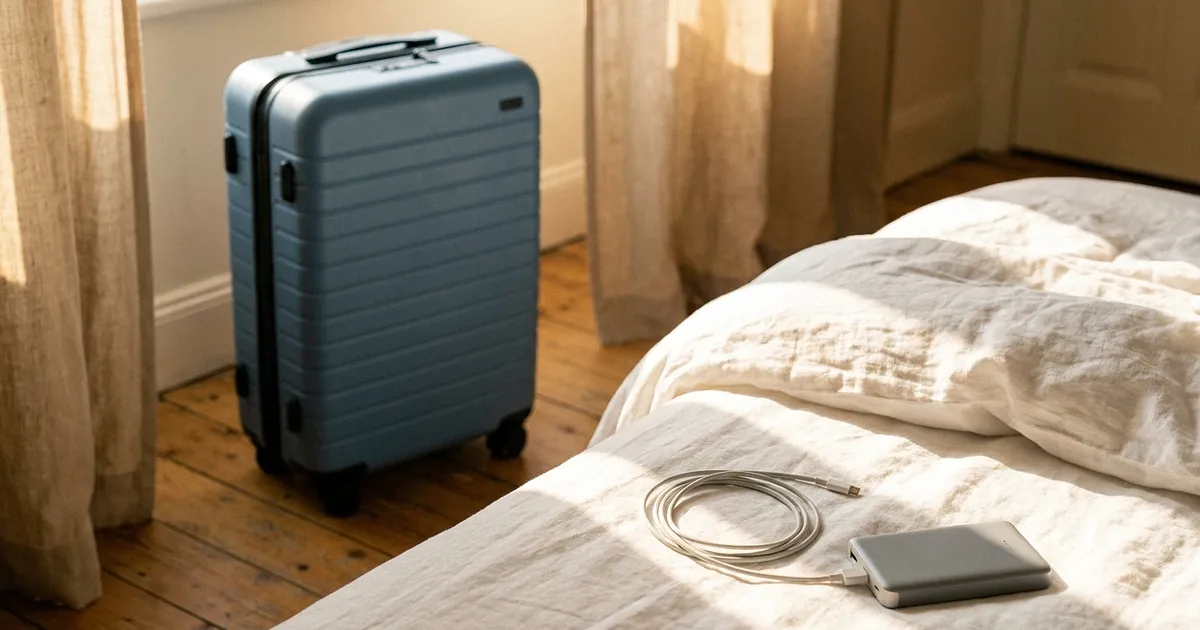
The charging cable was still lying on the bed when the case was already shut. That's the moment it clicked. On a digital detox vacation you don't just leave the phone behind. You leave behind everything that hangs off the phone. No wall plug, no second cable, no power bank, no adapter for the power bank, no spare cable for when the first one dies.
Sounds like small stuff.
But it's the point where a week without a phone and a single carry-on turn out to be the same decision: subtract once, gain twice.
Almost nobody sees it through. According to Bitkom, more than a third of Germans plan some kind of digital break, but only 3% commit to a full week on their summer vacation (Bitkom Research, 2024/2025 survey wave, n=1,004). Three percent. I found that depressing at first and then, honestly, kind of reassuring. If that few manage it, a clumsy first attempt is fine.
What doesn't go in the bag on departure morning
Every normal carry-on packing list has a little electronics corner. Charger, cable, power bank, usually a multi-plug for the hotel room, plus headphones that also want charging. That whole corner disappears. That's when a digital detox vacation actually shows up in the carry-on, before screen time ever enters the picture.
Which is the part no digital detox article I read beforehand ever mentions. Everyone talks about screen time and mindfulness. Nobody talks about cable spaghetti.
What's left fits comfortably into an ordinary hard-shell case, 55x40x23, the standard cabin-baggage size at most European airlines. No special measurements, no trick to it.
Hauptstadtkoffer Mitte Handgepäck-Hartschalenkoffer 55x40x23 TSA
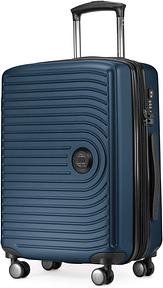
Hauptstadtkoffer Mitte Handgepäck-Hartschalenkoffer 55x40x23 TSA
View at AmazonAffiliate link. Buying through it earns us a commission; the price stays the same for you.
The space that suddenly opens up
And it's more than you'd guess. Into that freed-up corner went a paperback, a folded paper map from a tourist office, and a second pair of shoes that normally never makes the cut.
It only stays tidy if you actually sort it, though. Packing cubes are unglamorous and they just work.
McNory Packwürfel-Set 8-teilig, wasserdichte Reise-Organizer
I'm not going to claim the bag got measurably lighter, because I never weighed it. It felt lighter. Mostly it stopped feeling like a tech backpack and started feeling like luggage for a holiday.

McNory Packwürfel-Set 8-teilig, wasserdichte Reise-Organizer
View at AmazonAffiliate link. Buying through it earns us a commission; the price stays the same for you.
Day one of the digital detox vacation: the phantom buzz
The first day was ridiculous. Roughly every twenty minutes my hand went into an empty pocket. Classic phantom vibration, and it's annoying precisely because you can watch yourself doing it and still can't stop.
It helps to know this isn't a character flaw. Prof. Christian Montag of Ulm University puts it flatly: our brain has no choice but to react to new stimuli. The reach into the pocket is reflex, not weak willpower.
Montag is also skeptical that a week of cold turkey does much. He thinks sustained lower usage beats a short exit followed by a full relapse. Fair enough, probably true. I'm not selling you a life transformation here.
Something does happen, though. A randomised trial published in PNAS Nexus (Castelo et al., February 2025) blocked mobile internet for two weeks and measured gains in attention, mood and wellbeing that came out larger than the average effect of pharmaceutical antidepressants. On sustained attention the improvement worked out to roughly ten years of age-related decline erased.
By day three the hand stops going into the pocket. More or less.
Getting lost is part of it
The fear beforehand wasn't boredom. It was Google Maps. Or rather, no Google Maps.
I missed the bus stop, walked a couple of kilometres the wrong way, and had to ask an older woman who spoke none of my language. We sorted it out by pointing. Best part of the day.
A German family describes five days completely off-grid in a cave dwelling in Andalusia, and their conclusion is as unremarkable as it is calming: surprisingly little changed. The journalist who spent a phone-free week in a monastery got lost in fresh snow, and tells that as the best story of the trip.
Travel writer Lisa Abend makes a point at Adventure.com I haven't been able to shake since: research everything in advance and you keep ending up in the same cafés, surrounded by the same people. The phone plans the travel out of travelling.
Photos, notes, and what that does to the packing
The most common objection to phone-free travel is the camera. I get it. Seven days without a single picture would have been too much for me too.
An offline vacation doesn't have to mean a picture-less one, though. An instant camera solves it in a way that matches the rest of the week. You take one shot instead of forty, and you see it immediately, without a screen. It goes in the cabin bag normally, and the film is happier in the cabin than in the hold.

FUJIFILM instax mini 12 Sofortbildkamera
View at AmazonAffiliate link. Buying through it earns us a commission; the price stays the same for you.
Paper instead of the notes app
For everything else, paper. Restaurant names, bus departures, the sentence you want to keep. A travel journal weighs almost nothing and costs less than dinner.
Reisetagebuch (Landkarte) zum Ausfüllen
It's also the only trip record you'll genuinely look at again afterwards. Phone photos never get looked at again. Okay, that's not true, they do. But you scroll them, you don't read them.

Reisetagebuch (Landkarte) zum Ausfüllen
View at AmazonAffiliate link. Buying through it earns us a commission; the price stays the same for you.
What was left after the digital detox vacation
I didn't come back a better person. The phone was on again eleven minutes after landing, and I scrolled the whole escalator down like always.
Still. Psychologist Seth Gillihan writes at Psychology Today about his own phone-free vacation that he did not miss the device once, not even in genuinely inconvenient moments. That matched my week exactly, and it surprised me more than anything else did.
Not a niche habit either, from what I can tell. Nearly half of Europeans deliberately use travel for an offline vacation and more distance from social media, according to the Dertour Travel Trend Report 2026 (48.9%, around 8,000 respondents across 13 European markets).
If you want to try your own digital detox vacation, I wouldn't start with screen time. Start with the charging cable. Put it next to the case and leave it there. At Kofferly we usually obsess over what fits into one cabin bag. This time the better question was what gets to fall out.
All products from this post
The ones we named above are marked; the rest are alternatives in the same category.
Affiliate notice: As an Amazon Associate, we earn from qualifying purchases. Product prices and availability are subject to change.
Frequently Asked Questions
What counts as a digital detox vacation?
It's a trip where you deliberately drop the smartphone and mobile internet for a set stretch of time, usually a few days up to a week. Some people only kill notifications, others leave the device switched off for days. Vacation is the easiest window, because work and daily routine are already paused.
Does the phone have to stay at home?
No, and the version that actually works is the one where it doesn't. The phone travels switched off in the carry-on as emergency insurance. What matters is that you stop using it as camera, map, calendar and time-filler. Powered off in a bag counts. A quick check every two hours doesn't.
How do you navigate without Google Maps?
Paper maps from tourist offices, the big map at the station, and asking people. If that feels risky, load offline maps onto an old device before you leave. You'll still get lost occasionally, it usually costs twenty minutes, and it tends to become the story you tell afterwards.
What do you save in the carry-on by leaving the phone behind?
The wall plug, the charging cable, the spare cable, the power bank plus its own cable, and often a travel adapter too. That's the whole tech corner of the packing list. In exchange a paperback, a paper map and a small camera fit into the same case without needing a second bag.
How long should a phone-free trip be?
A week is a good target, because the reflex fades after roughly two or three days. First-timers are better off starting with a weekend. And an attempt you abandon halfway isn't a failure, it's just a shorter attempt.
Sources
- Bitkom bitkom.org
- Prof. Christian Montag utopia.de
- randomised trial published in PNAS Nexus academic.oup.com
- five days completely off-grid family4travel.de
- a phone-free week in a monastery wirsindanderswo.de
- makes a point at Adventure.com adventure.com
- Seth Gillihan writes at Psychology Today psychologytoday.com
- Dertour Travel Trend Report 2026 ad-hoc-news.de