Germany's Airport Fees Hit Record Highs in 2026: Now the EU's Second Most Expensive
 6 min read
The short version: From 2026, air navigation charges at German airports rise to 401 EUR per service unit. That's nearly 50% more than 2024 and 5% more than 2025. Germany is now the second most expensive place to fly from in the EU. Passengers pay an average of 52 EUR in government charges per flight from German airports. Flying has gotten more expensive in 2026, and you'll feel it.
401 EUR per flight movement. Paris charges 207 EUR. Rome? Just 184 EUR.
I looked at the numbers twice because they seemed absurd. Germany airport fees in 2026 make it the second most expensive place to fly from in the entire EU. And you'll feel it the next time you book a ticket.
What the Germany Airport Fees in 2026 Actually Mean
The so-called terminal navigation charge is what every airline pays to German air traffic control. Per flight. According to the BDF (Federation of German Airlines), this rate climbs to 401 EUR per service unit in 2026. That's 5% more than the already record-high 381 EUR from 2025.
For context, the rate was 271 EUR in 2024. So nearly a 50% increase in two years. That's not inflation. That's a pricing explosion.
This airport fees increase has pushed Germany to record territory in 2026. On a typical European flight with an Airbus A320, government-imposed costs add up to roughly 4,500 to 5,000 EUR per flight. Not per passenger. But airlines pass that on to you, obviously.
Germany Airport Fees 2026: The EU Comparison
Three numbers that explain why EasyJet and Ryanair increasingly route through Milan instead of Frankfurt:
| Airport | Fee per SU (2026) | Compared to Germany |
|---|---|---|
| Frankfurt/Munich | 401 EUR | Reference |
| Paris CDG | 207 EUR | 48% cheaper |
| Rome/Milan | 184 EUR | 54% cheaper |
An ADAC analysis of around 120 routes puts it more concretely: passengers flying from Frankfurt pay an average of 74 EUR in government charges per domestic flight. Flight prices are rising in Germany structurally faster than in neighboring countries. The national average sits at 52 EUR.
If you live near the borders with France, the Netherlands, or Austria, it's honestly worth checking alternative airports. Amsterdam Schiphol and Basel-Mulhouse are particularly popular — both easily reachable by train. The price difference can be significant.
Airlines Are Pulling Planes Out of Germany
The high fees have real consequences. Not hypothetical ones.
The BDL (German Aviation Association) reports that airlines have already relocated 60 aircraft from Germany to cheaper countries. Point-to-point carriers had 190 planes in Germany in 2019. Now it's 130.
What that means for you: fewer direct connections, less competition, higher prices on the remaining routes.
Ryanair made the sharpest move. In an official statement, the budget carrier announced 1.8 million seats cut for Germany, bases closed in Dortmund, Dresden, and Leipzig.
Hamburg reduced by 60%. If you've been flying Hamburg to Mallorca regularly — yeah, that's probably why the route disappeared.
If you want to know which 24 routes Ryanair specifically cut and whether your departure airport is affected, we've broken it all down in detail.
But the Air Travel Tax Is Going Down?
True — from July 2026, Germany's air travel tax drops. Short-haul flights go from 15.53 EUR to 13.03 EUR per ticket. Sounds promising.
It's barely noticeable, though. As ZDFheute reports, there's no guarantee airlines will actually pass those savings on to passengers. Consumer advocates estimate a maximum of 7.73 EUR savings per European ticket. If anything at all.
Meanwhile, security fees at nine German airports are hitting new records in 2026, according to Airliners.de. Dusseldorf, Hamburg, Stuttgart, Bremen, Leipzig/Halle.
The net math? Tax down: minus 2.50 EUR. Fees up: considerably more. Bottom line, you'll probably pay more in 2026 than in 2025.
Your Options — Despite Everything
Flying has gotten more expensive in 2026. That's just the reality. You can't change the fees. But you can adapt your own strategy.
The simplest lever: travel carry-on only. Budget airlines now price checked baggage as an add-on by design — that's not an accident. If you want to understand what checked baggage costs across different airlines and what gate fees look like, our airline comparison is worth a read.
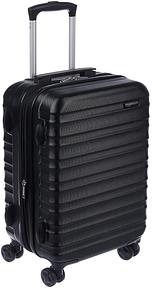
Someone who uses a compact cabin trolley, tested and ranked (like the Travelite 4-Rad Koffer Handgepäck Größe S, Trolley mit Dehnfalte, 55 cm, 37-41 Liter or the Amazon Basics Hartschalen-Kabinen-Koffer - ABS-Handgepäck Zugelassen für Ryanair - 55 x 40 x 20cm) often pays significantly less regardless of which airport they depart from.
If you also want to dodge pricey excess-baggage fees, pack more efficiently with a Große Koffer Organizer Set 12-teilig, Wasserdichte Packwürfel, Travel Organizer zum Gepäckpacken and weigh your bag beforehand with a Freetoo Digitale Gepäckwaage, Tragbare Hängewaage bis 50 kg — no expensive surprise at check-in.
One practical tip: book flights for after July 2026 when the tax cut kicks in. Whether it'll actually make tickets cheaper is genuinely unclear. No magic solution — but every euro saved matters.
Not available in your region — closest match
Amazon Basics Hard Shell Suitcase, black
View at Amazon (as of Aug 14)Affiliate link. Buying through it earns us a commission; the price stays the same for you.
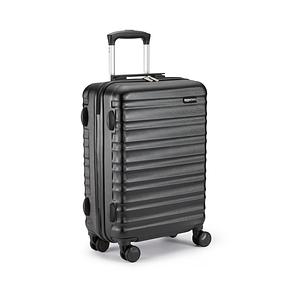
Amazon Basics Hartschalen-Kabinen-Koffer - ABS-Handgepäck Zugelassen für Ryanair - 55 x 40 x 20cm
View at Amazon (as of Aug 10)Affiliate link. Buying through it earns us a commission; the price stays the same for you.
Not available in your region — closest match
Amazon Basics Hard Shell Suitcase, black
View at Amazon (as of Aug 14)Affiliate link. Buying through it earns us a commission; the price stays the same for you.

Freetoo Digitale Gepäckwaage, Tragbare Hängewaage bis 50 kg
View at Amazon (as of Aug 11)Affiliate link. Buying through it earns us a commission; the price stays the same for you.
All products from this post
The ones we named above are marked; the rest are alternatives in the same category.
Not available in your region — closest match
Amazon Basics Hard Shell Suitcase, black
View at Amazon (as of Aug 14)
Not available in your region — closest match
Amazon Basics Hard Shell Suitcase, black
View at Amazon (as of Aug 14)
Affiliate notice: As an Amazon Associate, we earn from qualifying purchases. Product prices and availability are subject to change.
Frequently Asked Questions
Why are airport fees so high in Germany in 2026?
Short answer: a stack of separate charges that add up. The air navigation fee alone sits at 401 EUR per flight movement in 2026 — the second highest in the EU. Add security fees (rising at nine airports right now) and air travel tax, and you're looking at an average of 52 EUR in pure government charges per ticket from a German airport.
Will flying from Germany get cheaper in 2026?
Probably not — at least not in any meaningful way. The air travel tax drops in July, but only by around 2.50 EUR on short-haul routes. Meanwhile, air navigation and security fees are climbing higher. What you'll see in your wallet: best case, no change; more realistically, a small increase in overall costs.
Which German airports are most expensive in 2026?
Frankfurt leads with an average of 74 EUR in government charges per domestic flight. Nine additional airports (Dusseldorf, Hamburg, Stuttgart, Bremen, Leipzig/Halle, Hanover, Dresden, Saarbrucken, Erfurt) face rising security fees in 2026.
What's the difference between air travel tax and airport fees?
The air travel tax is a government levy on tickets paid directly by passengers. Airport fees (air navigation, security) are charged to airlines and passed on through ticket prices. Both together make up the total government-imposed cost burden per flight.
Is it worth flying from airports in neighboring countries?
It can be, honestly. Paris CDG charges 48% less in navigation fees than Frankfurt. If you live near the border (western Germany, southern Germany, near Austria), an alternative airport could save you more than any tax cut would. Amsterdam Schiphol and Basel-Mulhouse are both worth checking — and both are easily reachable by train.
*Last updated: March 2026*