Lithium Battery on a Plane 2026: E-Bike and Power-Tool Batteries Explained
 6 min read
Flying with your e-bike this summer? Or packing the cordless drill for a job abroad? Sooner or later you hit the same question: what can a lithium battery on a plane actually do these days? The honest answer is a bit annoying, because it depends entirely on which battery you mean. An e-bike pack and a power-tool pack play in completely different leagues.
Don't confuse either one with a power bank. Power banks have their own, much simpler rules, and you probably know them already. We're talking about the big batteries here.
E-Bike Battery on a Plane: Almost Always a No
Let's start with the clear case. According to Germany's Luftfahrt-Bundesamt, e-bikes with lithium batteries may not be carried as sports or special baggage, because the batteries count as Class 9 dangerous goods. Not in your carry-on, not in your checked bag. Full stop.
And the watt-hour rating? Doesn't help you here. A typical e-bike pack sits well above the allowed maximum anyway, but even if it didn't, the ban would still apply. The dangerous-goods portal gefahrgut.de backs this up: under ICAO-TI and IATA-DGR, e-bikes are explicitly not treated as mobility aids.
So what are your options? Ship the battery as air freight, rent one at your destination, or check the bike without its battery. None of them is fun, I know.
And in 2026 the shipping side got stricter. Since 1 January 2026, the IATA Dangerous Goods Regulations (67th edition) require certain lithium batteries to be charged to no more than 30% when shipped as air freight. That covers an e-bike battery you send as cargo. It does not touch the battery in your carry-on, so ignore anyone who tells you to discharge your bag.
Lithium Battery on a Plane: The Wh Ladder for Every Other Battery
For nearly everything except e-bike packs, the rated energy in watt-hours decides. Per the Luftfahrt-Bundesamt's rules, it breaks down like this:
Up to 100 Wh: allowed with no approval, but carry-on only.
100 to 160 Wh: only with airline approval, and a maximum of two spare batteries per person.
Above 160 Wh: banned outright, anywhere on the aircraft.
One thing people miss: a battery in checked luggage isn't an option for spares, they always belong in the cabin. IATA is clear that loose spare batteries must never travel in checked baggage, which catches more people out than you'd expect. Tape over the terminals, or pack each one in its own pouch.
Power-Tool Battery on a Plane: Usually Relaxed
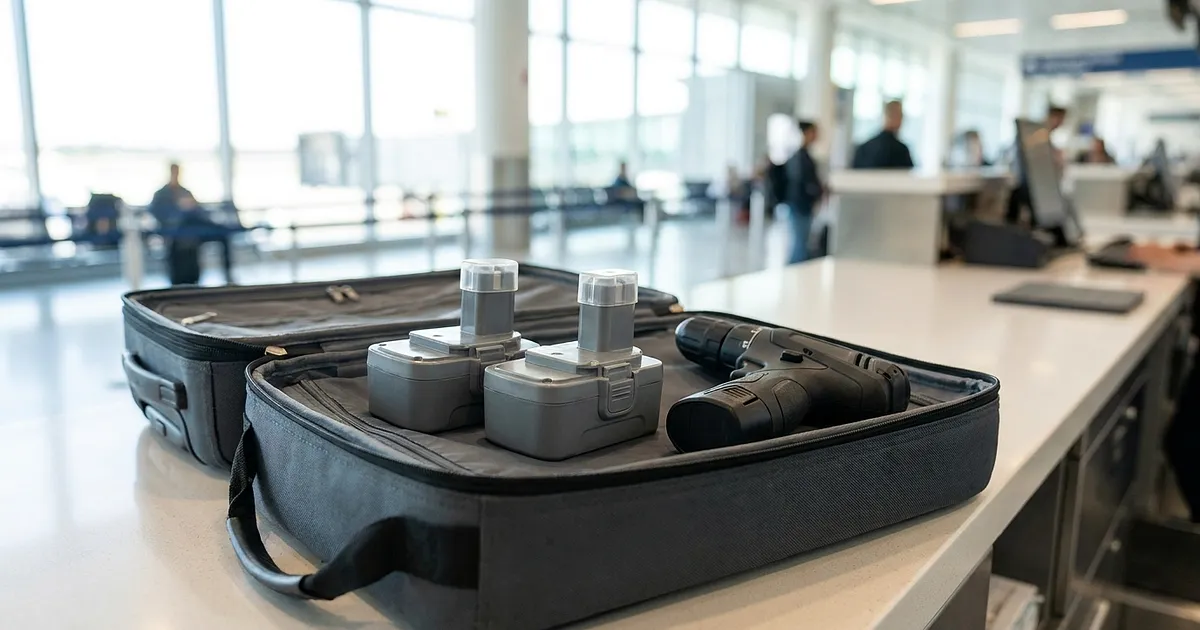
Now the good news for anyone traveling with a toolkit. A lithium battery on a plane is usually no problem when it's a tool pack. The common 18-volt packs from Bosch, Makita, DeWalt, Milwaukee and Einhell almost all land comfortably under the 100 Wh line. You work out the watt-hours yourself: voltage times capacity, so volts times amp-hours.
| Brand / Model | Voltage | Capacity | Wh (calculated) | Under 100 Wh? |
|---|---|---|---|---|
| Bosch ProCORE18V 4.0 Ah | 18 V | 4.0 Ah | 72 Wh | Yes |
| Einhell Power X-Change 18V 4.0 Ah | 18 V | 4.0 Ah | 72 Wh | Yes |
| Makita LXT BL1850B 18V 5.0 Ah | 18 V | 5.0 Ah | 90 Wh | Yes |
| DeWalt XR DCB184 18V 5.0 Ah | 18 V | 5.0 Ah | 90 Wh | Yes |
| Milwaukee M18 XC5.0 18V 5.0 Ah | 18 V | 5.0 Ah | 90 Wh | Yes |
| Milwaukee M18 FORGE HD12.0 18V 12.0 Ah | 18 V | 12.0 Ah | approx. 216 Wh | No, above 160 Wh |
Take a look at that last row. The big Milwaukee 12 Ah pack works out to roughly 216 Wh, which puts it above even the 160 Wh ceiling. Honestly, you might not expect a tool battery to clear 160 Wh either, until you do the math on this one. So don't just assume every tool battery is small. Do the math on your actual pack before you zip the bag.
And here's a practical trick people forget: the battery goes in your carry-on, but the tool itself, with its pointed drill or driver bit, often has to go in checked baggage. That's probably not a fire rule, it's airport security not wanting sharp tools in the cabin.
In the end it's less of a headache than it sounds: whether a lithium battery on a plane is fine mostly comes down to which kind you're carrying. E-bike battery? Stays home or travels as freight. For a tool battery, a quick check on the watt-hours usually settles it. When you're not sure, a quick call to your airline before the flight sorts it out, they probably check this more strictly than you'd guess anyway. And have a browse through our other baggage guides before you close the case.
Frequently Asked Questions
Can I bring an e-bike battery in my carry-on or checked bag?
No. E-bike batteries count as Class 9 dangerous goods and are not allowed as passenger baggage, in the cabin or the hold, regardless of watt-hours. They may only travel as declared air freight, separate from the bike itself.
How many watt-hours can a lithium battery have on a plane?
Up to 100 Wh, a battery is fine in your carry-on with no approval. Between 100 and 160 Wh you need airline approval and can bring at most two spare batteries. Above 160 Wh, it's not allowed at all.
Can I take my cordless drill on a plane?
Usually yes. Most 18-volt tool batteries land between 36 and 90 Wh, under the 100 Wh line. The battery has to go in your carry-on, while the tool itself often goes in checked baggage because of its sharp bit.
Does the 100 Wh limit apply to tool batteries too?
Yes. Tool batteries follow the same watt-hour rules as any other loose lithium battery. Multiply volts by amp-hours for your exact figure. Large professional 12 Ah packs can push past the limit.
Does the new 2026 30% rule affect my carry-on?
No. The 30% charge limit that took effect on 1 January 2026 applies only to certain lithium batteries shipped as air freight. Nothing changes for the batteries in your carry-on or checked bag.